
An Analysis of Factors Affecting Student Satisfaction in Online Liberal Arts Software Courses
 ; Hyodong Ha††
; 하효동††
; Hyodong Ha††
; 하효동††
Abstract
As digital transformation continues to expand across industries, the importance of software education has become increasingly prominent. Accordingly, many universities offer software-related general education courses for non-CS major students in online formats. However, non-CS major students often fail to clearly recognize the relevance of software learning to their majors or career paths, which can lead to resistance to learning engagement and lower student satisfaction. This study examined 111 non-CS major university students enrolled in a general education software course to analyze the effects of attitudes toward software and perceptions of online teaching and learning approaches on student satisfaction. The results showed that both factors had statistically significant effects on student satisfaction. These findings highlight the importance of clearly communicating the necessity of software learning, providing major-related examples and assignments, and strengthening LMS-based learner analytics and instructor–learner interactions. The results may serve as foundational evidence for instructional design and educational policy development aimed at improving satisfaction in online software courses for non-CS major students.
초록
산업 전반에서 디지털 전환이 확산됨에 따라 소프트웨어 교육의 중요성은 더욱 커짐에 따라 많은 대학에서 비전공자를 대상으로 한 소프트웨어 관련 교과목을 온라인 형태로 제공하고 있다. 그러나 비전공자들은 소프트웨어 학습이 자신의 전공이나 진로와의 관련성을 충분히 인식하지 못하는 경우가 많아 학습 참여에 저항을 보이기도 하며, 이는 강의만족도의 저하로 이어질 수 있다.
본 연구에서는 교양 소프트웨어 교과를 수강한 비전공자 대학생 111명을 대상으로, 소프트웨어에 대한 태도와 온라인 교수·학습 방식에 대한 인식이 강의만족도에 미치는 영향을 분석하였다. 연구 결과, 두 요인 모두 강의만족도에 통계적으로 유의한 영향을 미치는 것으로 나타났다. 이는 교양 소프트웨어 강좌에서 소프트웨어 학습 필요성을 명확히 안내하고 전공 연계 사례 및 과제를 제공하는 한편, LMS 기반 학습자 분석과 교수자–학습자 상호작용 강화의 필요성을 시사한다. 본 연구는 비전공자 대상 온라인 소프트웨어 교과의 만족도 제고를 위한 수업 설계 및 교육 정책 수립에 기초자료로 활용될 수 있을 것으로 기대된다.
Keywords:
Computer Education, Software Education, Student Satisfaction, Software Attitude, Perception of Online Course Delivery Method키워드:
컴퓨터교육, 소프트웨어교육, 강의만족도, 소프트웨어 태도, 온라인 강의 방식 인식1. Introduction
Driven by the impact of the Fourth Industrial Revolution, software competency has become an essential skill in contemporary society. In Korea, various national-level policies—such as the Software-Centered University Initiative [1], the DS Plus Convergence Talent Development Program [2], and the revised information education curriculum for primary and secondary schools [3]—have been actively promoting the cultivation of software talent. Along with these societal demands, the spread of COVID-19 prompted many universities to provide general education software courses for all incoming students in an online format [4]. These transitions occurred naturally due to practical constraints, including classroom shortages and difficulties in securing qualified instructors. Consequently, even after social distancing measures were lifted, online software courses in general education have continued to prevail [5].
However, online software education is implemented differently depending on institutional policies, and in many cases, students’ preferences or perceptions of teaching and learning methods are insufficiently considered [6]. Moreover, many Korean universities require students to take software-related courses regardless of their major. Students in non-STEM fields—particularly those majoring in the humanities, social sciences, and arts—often experience resistance or hold negative perceptions toward software courses [7].
Nevertheless, software education is essential for nurturing future-ready talent in the era of the Fourth Industrial Revolution, and it plays a crucial role in enhancing national competitiveness. Uniform online instructional formats that do not sufficiently reflect students’ perceptions of online learning or attitudes toward software education may fail to motivate learners. Such a lack of motivation can negatively affect student satisfaction, which in turn influences students’ intention to persist in learning [8] and the amount of time they invest in their studies [9]. Furthermore, student satisfaction is closely associated with learning motivation [10], making it a critical factor to examine in the context of online software education.
2. Literature Review
2.1 A Comparative Study of Synchronous and Asynchronous Online Lectures
The abrupt transition to online learning due to COVID-19 was inevitable as a result of quarantine measures [11, 12]. Depending on institutional policies, courses were conducted either through pre-recorded lectures or in real-time, despite being online. As of 2019, the proportion of online courses in South Korean universities was only 1%[13]. In response to this shift, Ha & Yoo (2024) conducted a study comparing synchronous and asynchronous online courses with identical content to examine their differences[6].
Online course formats can be broadly categorized into synchronous and asynchronous modes. Synchronous online lectures allow students to attend classes from a location of their choice, but all students must participate at the same scheduled time[14]. In contrast, asynchronous online lectures enable students to determine not only their learning environment but also the time at which they engage with the course content[15].
One key feature of synchronous online lectures is that students can ask questions in real time, similar to traditional offline classes[16]. However, research indicates that students tend to be highly reluctant to participate in discussions or ask questions during these sessions[17]. On the other hand, asynchronous online lectures, while offering students the flexibility to review the material repeatedly at their own pace, present limitations in terms of peer interaction, as students engage with the content at different times[16].
The findings of the study revealed notable differences in students' perceptions of online computer programming course delivery methods among non-CS (Computer Science) major students. While the pre-survey indicated a preference for asynchronous online lectures over synchronous ones, the actual satisfaction levels were found to be higher for synchronous online lectures.
Additionally, students who participated in synchronous online lectures showed a statistically significant improvement in computational thinking and STEAM literacy. Although not statistically significant, software comprehension also demonstrated greater improvement in the synchronous format compared to the asynchronous format. These results suggest that synchronous online lectures have a substantial impact on students' development of computational thinking, software comprehension, and STEAM literacy.
Moreover, students expressed a preference for a hybrid lecture format that incorporates both synchronous and asynchronous elements.
However, although this previous research identified the impact of online lecture formats on learning outcomes, it did not explain why students prefer certain instructional approaches or what mechanisms determine their level of satisfaction. To address this gap, the present study empirically examines how internal factors—specifically, students’ attitudes toward software and their perceptions of online instruction—affect their satisfaction in online software education.
2.2 Factors Influencing Student Satisfaction
In studies related to learning, extensive research has been conducted on the relationship between learning (or instructional) attitudes and student satisfaction [18-21].
Attitude refers to an individual's evaluation of a particular object or behavior within a given environment. It is a disposition acquired after learning and represents a consistent behavioral pattern influenced by one’s perception and evaluation of events or objects[22].
Shao (2019) analyzed the factors influencing online learning satisfaction using the Technology Acceptance Model (TAM). The study found that attitude toward online learning had a significant impact on online course satisfaction [23].
Yalç ı nkaya (2024) identified a significant positive relationship between attitudes toward remote education and remote education satisfaction. The study further revealed that attitude directly affects satisfaction, with online learning motivation acting as a mediating factor in this relationship[20]
Similarly, Çobanoğlu, Aktan, and Öztemür (2022) reported that a positive attitude toward online education can enhance satisfaction levels. They argued that learners with positive attitudes are more likely to perceive challenges in the learning process as opportunities for growth, demonstrating greater resilience and active participation, which ultimately contributes to higher satisfaction[21].
Conversely, Yekefallah, Namdar, Panahi, and Dehghankar (2021) suggested that higher satisfaction with online courses increases the likelihood of developing a positive attitude toward online learning[24]. Most prior studies, however, have focused on learners’ general attitudes toward online learning (e.g., learning attitude, e-learning attitude), and thus have not sufficiently captured the unique characteristics of specific courses or learning contexts. In the case of general education software courses, various psychological and cognitive factors—such as students’ level of prior knowledge, resistance to software-related content, perceived relevance to their major, and learning motivation—may significantly influence their student satisfaction.
Nevertheless, existing research often applies general learning attitude constructs without considering these contextual characteristics, which limits the explanatory power of such studies in the specific setting of software education for non-CS majors. Although prior findings indicate that learners’ interest in the course content and their perceived need for the subject strongly affect student satisfaction [25, 26], many studies treat the distinctive features of software courses and students’ attitudes as separate issues.
Therefore, in educational environments where the learning characteristics of non-CS majors are particularly salient—such as general education software courses—there is a clear need to examine not learners’ general attitudes toward learning but rather their attitudes toward software itself (Software attitude) as an independent determinant of satisfaction.
Software attitude (ATT) refers to learners’ perceptions of the everyday and societal value of software, as well as their beliefs about the importance of learning software and its potential for future application. It is a multidimensional construct comprising cognitive evaluations of the necessity, significance, and career relevance of software.
In this study, we analyze how the software attitude (SW attitude) proposed by Ha & Yoo (2024) influences student satisfaction. Considering that software education is provided as a required general education course for non-CS majors, students’ perceptions and attitudes toward software can be regarded as an important factor shaping their satisfaction with the course. Based on this rationale, the following hypothesis was established.
- H1 : Students' SW attitude influences their student satisfaction.
As noted earlier, online courses can be categorized into synchronous formats (e.g., Zoom, Webex, Google Meet) and asynchronous formats in which learners access pre-recorded materials at their preferred time and location. Prior research has shown that although students initially preferred pre-recorded lectures before taking the course, their satisfaction with synchronous lectures increased by the end of the semester (Ha & Yoo, 2024). This suggests that the format of online instruction may influence learners’ experiences and satisfaction; however, that study remained largely descriptive in comparing delivery modes and did not sufficiently analyze the underlying mechanisms explaining why students exhibit such shifts in preference.
Research on distance education has been active even before COVID-19, yet much of it has focused on the general characteristics of online learning environments. Arbaugh (2000) analyzed the effectiveness of Internet-based learning through factors such as perceived usefulness, ease of use, and instructional flexibility [27], while Wilson (1996) and Piccoli et al. (2001) emphasized learning community formation, technology use, and interaction and control within virtual learning environments (VLEs) [28, 29]. Although these studies made important contributions by explaining structural and technological dimensions of online learning environments, subjective factors—particularly learners’ perceptions and experiences of online instructional formats—have been relatively underexamined. In particular, previous research distinguished human factors (e.g., learners, instructors) from design factors (e.g., learning models, technology, interaction), yet offered limited direct analysis of how learners’ perception of online delivery formats contributes to their satisfaction. As online instruction continues to maintain a significant role in higher education even after the official end of COVID-19 [5], understanding learners’ perceptions becomes essential for improving the quality of future online education.
The construct of “perception of online lecture delivery formats” (PER) refers to how learners evaluate and interpret the manner in which online instruction is provided (Ha & Yoo). This may involve aspects such as the quality of content delivery, perceived interaction with the instructor, and the degree of learner control. However, existing studies have not sufficiently explained the specific processes or mechanisms through which such perceptions translate into student satisfaction.
To address this conceptual gap, the present study employed a set of self-report items designed to capture the extent to which learners perceive various online instructional formats as appropriate for software theory learning, programming practice, comprehension of course content, maintenance of code-reading and writing skills, and the enhancement of digital literacy. These measures enable a multidimensional assessment of how learners perceive the educational effectiveness of online delivery formats in supporting the learning objectives of software courses.
Furthermore, following prior research by Santos and Stuart (2003), which suggested that individuals’ perceptions and expectations of online learning may indirectly influence educational outcomes through their learning responses [30], this study formulated the following hypothesis.
- H2 : Students' perceptions of online classes affect their satisfaction.
Student satisfaction refers to the degree to which learners experience enjoyment or a sense of accomplishment within a learning environment [31], and it is widely used as a key indicator for evaluating educational quality [32, 33]. Cohen and Baruth (2017) reported strong associations between satisfaction and learning motivation, self-regulated learning, and self-efficacy, emphasizing that satisfaction is not merely an “emotional reaction” but a major variable that explains the overall learning process [34]. In online learning contexts, satisfaction is directly related to course completion [35], and low satisfaction has repeatedly been cited as a factor contributing to high dropout rates.
Although the COVID-19 pandemic has officially ended, online learning continues to play a significant role in higher education, and research efforts have increasingly sought to identify factors that undermine its sustainability. Previous studies have pointed to several challenges in online learning, including insufficient instructor–student interaction compared to face-to-face instruction, weakened peer support due to physical distance, and limited access to learning infrastructure such as libraries and laboratories [36, 37]. However, these structural explanations primarily focus on the “environmental factors” of online learning and fall short of adequately addressing the psychological and subjective aspects of how learners perceive and interpret their online learning experiences.
Furthermore, as AI technologies become deeply embedded in everyday life, the ability to critically interpret digital information and to develop basic code literacy has emerged as an essential competency [38]. Despite the increasing importance of computer programming and software education, empirical analyses examining the determinants of satisfaction within the specific context of online general education software courses remain limited. Although factors such as learners’ major, prior experience with online environments, and psychological attitudes toward software may interact in complex ways, many studies conceptualize satisfaction in broad and generalized terms, making it difficult to capture the unique demands and learner characteristics associated with software education for non-CS majors.
Student satisfaction (SAT) refers to the extent to which learners perceive that the course has enhanced key competencies such as computational thinking, software understanding, and STEAM literacy. In other words, it represents perceived learning effectiveness rather than simple evaluative or affective responses.
To address this gap, the present study adapted items from the Satisfaction with Academic Training (SAT) scale proposed by Ha and Yoo (2022) to construct a self-report questionnaire. Using this framework, the study empirically examines how student satisfaction is formed within the context of online general education software instruction.
Before establishing the research model, it is important to clarify that the measurement items for ATT (SW attitude), PER (perception of online delivery), and SAT (student satisfaction) used in this study were not directly taken from Ha and Yoo (2024) or any single existing scale. Although the conceptual definitions were informed by prior studies, the actual items were adapted and reconstructed by synthesizing multiple sources to suit the instructional context of online general education software courses. Because of this modification, the original factor structures cannot be assumed, making a confirmatory factor analysis (CFA) inappropriate at this stage. Therefore, an exploratory factor analysis (EFA) was conducted to empirically identify the latent factors emerging from the data.
3. Research Model
Based on the literature reviewed in Section 2, we established the research model shown in Figure 1 to test the proposed hypotheses. The analysis was conducted under the assumption that learners’ perceptions of online lecture delivery formats and their software (SW) attitudes influence their student satisfaction.
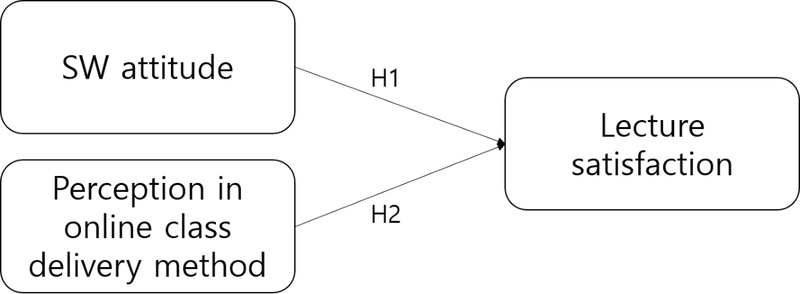
Research model
3.1 Measurement Variables and Rationale for Applying EFA
The items measuring ATT (attitude toward software), PER (perception of online lectures), and SAT (student satisfaction) were not adopted verbatim from previous studies. Instead, they were adapted and reconstructed based on multiple related works to align with the specific context of an online general education software course.
Because the items were modified and integrated in this manner, it is difficult to assume that the factor structure established in the original scales remains valid. This violates a key prerequisite for conducting CFA, which requires a theoretically established measurement model.
Therefore, an Exploratory Factor Analysis (EFA) was first conducted to identify the latent factor structure that emerges from the adjusted items in the actual data. The validity of the items and the underlying factor structure were examined through EFA, and the resulting factors were subsequently used to validate the proposed research model.
3.2 Controlling for Instructor Effect
To control for instructor-related effects that could influence student satisfaction, all classes in this study were taught by the same instructor using an identical curriculum, instructional materials, and assessment criteria. Accordingly, the instructor’s teaching style, feedback practices, and instructional competence were held constant across all students, and the only experimental condition that differed was the mode of instruction (synchronous vs. asynchronous).
In particular, to minimize potential variation in learning experiences attributable to instructor communication in the online learning environment, instructor–learner interactions were deliberately designed to be provided at a sufficient and consistent level across all instructional conditions. Specifically, regular office hours were offered to allow students to visit the instructor’s office for face-to-face consultation, and a real-time KakaoTalk-based chat channel was established to facilitate ongoing question-and-answer exchanges among the instructor, teaching assistants, and students. In addition, prompt feedback was provided for questions submitted via the LMS discussion board and email. Through these multiple communication channels, instructor presence and accessibility were ensured in the online course environment. This instructional design was intended to control for variability related to instructor communication and instructor-specific characteristics.
3.3 Participants
The survey data used in this study were drawn from a previous study [6], and the questionnaire was administered at the end of the semester (Week 15). Prior to participation, all students were informed of the research purpose and data privacy procedures, and a total of 111 students voluntarily participated in the study.
Among the participants, 59 were male and 52 were female. The distribution of academic years was as follows: 38 first-year students, 37 second-year students, 21 third-year students, and 15 fourth-year students. All respondents were non-IT majors from diverse academic backgrounds, including business, economics, and education.
3.4 Research Procedure
This study conducted a survey of non-CS major students enrolled in an online general education software course to empirically identify the factors affecting their satisfaction. The analysis aimed to provide evidence regarding how non-CS major students perceive online software education and which factors determine their level of satisfaction. To ensure the validity of the study, the analysis was conducted on courses taught by the same instructor and using identical instructional content.
3.5 Measures and Statistical Analysis
SPSS v.27 and G*Power v.3.1.9.6 were used for the analysis. To validate the research model, an exploratory factor analysis was first conducted. The Maximum Likelihood method was employed as the extraction technique, and Direct Oblimin was applied as the oblique rotation method. Communalities and factor loadings in the pattern matrix were evaluated using a threshold of 0.50. As a result, three items (ATT1, ATT2, and ATT3) associated with the SW attitude construct were removed due to failing to meet the cutoff criterion.
4. Experiment and Result
The results of the factor analysis are presented in Table 1. The Kaiser–Meyer–Olkin (KMO) value was 0.810, and Bartlett’s test of sphericity yielded a statistically significant result (p < 0.05), confirming the suitability of the data for factor analysis. As shown in Table 1, three factors with eigenvalues greater than 1 were extracted. The initial explained variance was 73.978%, and the final cumulative variance explained by the extracted factors was 64.68%, which exceeds the commonly accepted threshold of 60%, indicating that the factors possess adequate explanatory power. The chi-square statistic was 56.038, and the model fit test also produced a significant result (p < 0.05).

The result of factor and reliability analysis
Second, the reliability of the input variables was examined. As shown in Table 1, all variables demonstrated Cronbach’s α values above 0.6, indicating that each factor consisted of items with acceptable internal consistency.
Before conducting the multiple regression analysis, the minimum required sample size was calculated using the GPower program. GPower is a tool designed to determine the minimum sample size necessary to achieve adequate statistical power [39]. With the number of predictors set to two, the minimum required sample size was 68. The sample size of this study was 111, which exceeds the required threshold.
In addition, methodological guidelines for multiple regression with two independent variables recommend a minimum of 100 participants to ensure stable estimates [40]. As this condition was satisfied, the analysis proceeded, and the results of the multiple regression are provided in the Appendix.
The correlation analysis showed that all independent variables were significantly correlated with the dependent variable at the 0.05 significance level. Perception of Online Class Delivery Method showed a low correlation coefficient of 0.302, whereas SW Attitude exhibited a higher correlation of 0.623.
The R² value, representing the model fit, was 0.495, indicating that the regression model explained 49.5% of the variance in student satisfaction. The ANOVA results yielded an F-value of 53.026, and the model was statistically significant (p < 0.05). The Durbin–Watson statistic was 1.944, which is close to 2, indicating no autocorrelation. All VIF values were below 10, confirming the absence of multicollinearity. The collinearity diagnostics further supported this conclusion, with condition index values of 1.000, 1.021, and 1.043—all below the threshold of 15.
All factors had statistically significant effects at the 0.05 level and positively influenced student satisfaction. Therefore, both research hypotheses, H1 and H2, were supported. Among the predictors, SW Attitude had the strongest effect, with a standardized regression coefficient of 0.637, followed by Perception in Online Class Delivery Method at 0.328.
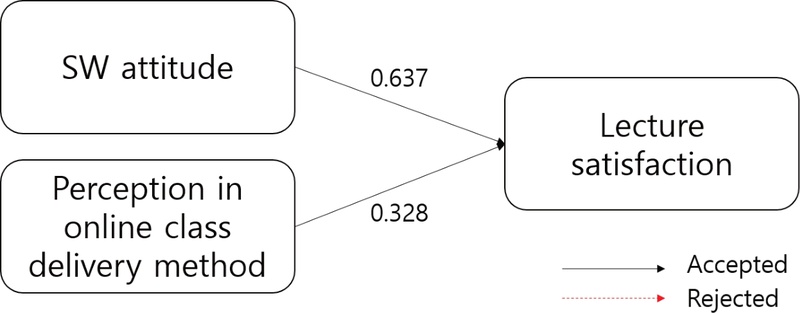
The result of research model verification
This study, conducted as a follow-up to Ha and Yoo [6], empirically examined the factors that influence student satisfaction in order to develop effective software (SW) education strategies in online learning environments. An educational environment consists of instructors, learners, and learning spaces, and the effective coordination of these three elements can enhance student satisfaction. To ensure consistency in the experiment, all classes were taught by the same instructor using identical instructional content. As the learning environment transitioned from offline to online, learners’ perceptions of online lecture delivery formats were included as an independent variable. Moreover, because SW education is offered as a required general education course for all non-CS major students, it was deemed necessary to examine their attitudes toward software.
The factor analysis classified the measurement items into three factors: perception of online lecture delivery formats, SW attitude, and student satisfaction. During this process, three items related to SW attitude—convenience in daily life (ATT1), SW-related occupations (ATT2), and societal development (ATT3)—were removed. Kim (2018) explains that students learn programming not to become professional developers but to enhance understanding within their own fields and to develop competencies required in the era of the Fourth Industrial Revolution [41]. Considering this, non-CS major students may have felt a sense of distance from SW-related occupations, which could explain the removal of ATT2.
The removal of ATT1 and ATT3 may also be understood within a broader social context. Students in the humanities and social sciences, in particular, tend to express concerns about issues such as job displacement resulting from the Fourth Industrial Revolution [42, 43], which contrasts with the more positive views of technological advancement commonly observed among engineering students. These differences in perception may have been reflected in the factor structure.
The results of the multiple regression analysis indicated that both independent variables—perception of online lecture delivery formats and SW attitude—positively influenced student satisfaction, supporting both hypotheses. Among the predictors, SW attitude exhibited nearly twice the standardized coefficient of the perception variable, making it the strongest predictor of satisfaction. This finding is related to the process of human maturity, in which individuals adapt to environmental changes and integrate new technologies into their identities [44]. In a societal context where the importance of software continues to grow, students’ positive attitudes appear to play a decisive role in enhancing student satisfaction.
Based on these findings, several implications can be drawn for improving the effectiveness of general education software courses.
First, it is necessary to continuously emphasize the importance of software education and to enhance students’ interest and perceived relevance by providing practical examples linked to their respective academic disciplines. To this end, the necessity of software learning and the learning trajectory of the course can be clearly communicated through an orientation session at the beginning of the semester. In addition, presenting concrete examples connected to students’ majors and career paths and extending these examples into major-related assignments can help learners perceive the practical usefulness of general education software courses. These approaches may help foster more positive attitudes toward software learning among non-major students.
Second, the findings suggest that utilizing learning management system (LMS)–based learner analytics and strengthening instructor–learner interactions can be effective strategies for improving students’ perceptions of online lecture formats. In this study, the instructor identified students who required additional support at an early stage and provided targeted guidance through structured interaction channels, such as regular Q&A sessions and office hours. In addition, future implementations may consider providing pre-disclosed, level-based rubrics for assignments to further support learners in monitoring their learning progress. These approaches may be applied to other general education software courses to enhance students’ perceptions of online teaching and learning.
Overall, these implications are meaningful in that they propose concrete instructional design and operational strategies for enhancing learners’ attitudes and engagement in general education software courses, and they may serve as a practical foundation for the more effective design and improvement of software education at the general education level.
5. Conclusion
This study empirically identified the factors influencing student satisfaction in an online general education software (SW) course for non-CS major students. The exploratory factor analysis (EFA) and regression results revealed that both learners’ perceptions of online lecture delivery formats and their SW attitude had significant effects on student satisfaction, with SW attitude emerging as the strongest predictor. These findings suggest that in an era where the importance of SW education is rapidly increasing, the formation of learners’ attitudes plays a decisive role in shaping the quality of their learning experience.
Furthermore, the study rigorously controlled for instructor effects by ensuring that all classes were taught by the same instructor and that identical communication channels (KakaoTalk, LMS, individual consultations, email, etc.) were provided to all students. As a result, instructor–student interaction did not vary across learners, meaning that the statistical and structural conditions necessary to analyze instructor interaction as a mediating or moderating variable were not met. For these reasons, the exclusion of instructor interaction as an analytical variable is theoretically and methodologically justified. Nevertheless, future research should consider separately measuring the quality of perceived instructor interaction or students’ sense of social presence to explore whether these factors function as mediators or moderators in online SW education contexts.
This study also has limitations in that it utilized data from a single institution within a single country, which may restrict the generalizability of the findings. In addition, the measurement items were adapted from existing instruments rather than based on an established factor structure, necessitating the use of exploratory factor analysis (EFA). Future studies should conduct confirmatory factor analysis (CFA) to validate the factor structure identified in this study and expand the sample to include multiple institutions and countries to strengthen external validity.
Lastly, longitudinal research is needed to elucidate how changes in learners’ attitudes and perceptions in online SW education environments relate to long-term learning outcomes. Such follow-up studies are expected to provide meaningful policy and educational implications for improving the quality of online general education software courses.
Acknowledgments
본 연구는 2026년 한성대학교 학술연구비 지원과제임
References
- Software-Centered University Council. (n.d.). Software-Centered University Council. Software-Centered University Council. https://www.swuniv.kr
- Gil, M. (2022, May 17). Data science convergence talent development project selected: 465 billion KRW funding over 7 years. Dailysecu. https://www.dailysecu.com/news/articleView.html?idxno=136834
- Ministry of Education (2023, January 02). 2022 Revised National Curriculum for primary, secondary and special schools announced. Ministry of Education. https://english.moe.go.kr/boardCnts/viewRenewal.do?boardID=265&boardSeq=93810&lev=0&statusYN=W&s=english&m=0201&opType=N
-
Choi, J., & Shim, J. (2022). Satisfaction and effectiveness of online software liberal arts education. Journal of the Korea Institute of Information and Communication Engineering, 26(6), 930–935.
[https://doi.org/10.6109/jkiice.2022.26.6.930]

-
You, J. (2023). The structural relationship between task value for SW education, self-regulated learning, social presence, and computational thinking-oriented problem-solving skills in online SW project education at universities. The Journal of Korean Association of Computer Education, 26(4), 11–20.
[https://doi.org/10.32431/kace.2023.26.4.002]
- Ha, H., & Yoo, S. (2024). Comparing synchronous and asynchronous online programming classes: Similarities and differences. International Journal of Information and Education Technology, 14(2), 293–301. https://www.ijiet.org/vol14/IJIET-V14N2-2051.pdf
-
Kim, W. (2017). A study on the recognition of freshmen on computational thinking as an essential course. Culture and Convergence, 39(6), 141–170.
[https://doi.org/10.33645/cnc.2017.12.39.6.141]
-
Wu, Y., Hsieh, L., & Lu, J. (2015). What's the relationship between learning satisfaction and continuing learning intention? Procedia-Social and Behavioral Sciences, 191, 2849–2854.
[https://doi.org/10.1016/j.sbspro.2015.04.148]
-
Sun, P., Tsai, J., Finger, G., Chen, Y., & Yeh, D. (2008). What drives a successful e-learning? An empirical investigation of the critical factors influencing learner satisfaction. Computers & Education, 50(4), 1183–1202.
[https://doi.org/10.1016/j.compedu.2006.11.007]
- Martin, L. (1988). Enhancing children’s satisfaction and participation using a predictive regression model of bowling performance norms. Physical Educator, 45(4), 196–209.
-
Birmingham, W., Wadsworth, L., Lassetter, J., Graff, T., Lauren, E., & Hung, M. (2021). COVID-19 lockdown: Impact on college students’ lives. Journal of American College Health, 71(3), 879–893.
[https://doi.org/10.1080/07448481.2021.1909041]
-
Yoo, S., Mun, C., Cheon, M., Lee, O., Rhee, Y., & Ha, H. (2022). A study on the factors affecting academic achievement in the non-face-to-face class environment due to COVID-19: Focusing on computer liberal arts education class. Sustainability, 14(11), 6547.
[https://doi.org/10.3390/su14116547]
-
Do, J. (2020). An investigation of design constraints in the process of converting face-to-face course into online course. Journal of Education & Culture, 26(2), 153–173.
[https://doi.org/10.24159/joec.2020.26.2.153]
- Pappas, C. (2015, October 9). Synchronous vs asynchronous learning: Can you tell the difference? E-learning Industry. https://elearningindustry.com/synchronous-vs-asynchronous-learning-can-you-tell-the-difference
- Lawless, C. (2020, April 23). Synchronous vs. asynchronous learning: Which is right for your learners? LearnUpon. https://www.learnupon.com/blog/synchronous-learning-asynchronous-learning/
- Gazan, M. (2020). Synchronous and asynchronous learning: Perceptions of students at a state university in Turkey. Futuristic Implementations of Research in Education, 1(2), 96–107. http://firejournal.org/index.php/fire/article/view/11/
-
Barr, M., Nabir, S., & Somerville, D. (2020). Online delivery of intensive software engineering education during the COVID-19 pandemic. Proceedings of the IEEE 32nd Conference on Software Engineering Education and Training (CSEE&T), Virtual Conference, USA, 1–6.
[https://doi.org/10.1109/CSEET49119.2020.9206196]
- Hablo, D., & Gorospe, J. (2022). Attitude Toward Online English Learning, Satisfaction On The Use Of Virtual English Learning Environment, And English Performance Of Junior High School students Of Pedro T. Mendiola Sr. Memorial National High School. International Journal of Education Research & Social Sciences, 3(2), 919–944. https://ijersc.org/index.php/go/article/view/352
-
Yoo, J. (2022). Attitude toward leisure, satisfaction with leisure policy, and happiness are mediated by satisfaction with leisure activities. Scientific Reports, 12(1), 11723.
[https://doi.org/10.1038/s41598-022-16012-w]
- Yalçınkaya, D. (2024). The mediating role of satisfaction in distance education in the relationship between attitude towards distance education and online motivation. Pegem Journal of Education and Instruction, 14(3), 126–133. https://www.pegegog.net/index.php/pegegog/article/view/3223
-
Aktan, D., & Öztemür, B. (2022). Teachers’ perceived skills, challenges and attitudes towards distance education: A validity and reliability study. International Journal of Assessment Tools in Education, 9(2), 451–469.
[https://doi.org/10.21449/ijate.959440]
-
Pruet, P., Ang, C., & Farzin, D. (2016). Understanding tablet computer usage among primary school students in underdeveloped areas: Students’ technology experience, learning styles and attitudes. Computers in Human Behavior, 55(B), 1131–1144.
[https://doi.org/10.1016/j.chb.2014.09.063]
-
Shao, C. (2020). An empirical study on the identification of driving factors of satisfaction with online learning based on TAM. Proceedings of the 5th International Conference on Economics, Management, Law and Education (EMLE 2019), Bangkok, Thailand, 1067–1073.
[https://doi.org/10.2991/aebmr.k.191225.205]
-
Yekefallah, L., Namdar, P., Panahi, R., & Dehghankar, L. (2021). Factors related to students’ satisfaction with holding e-learning during the COVID-19 pandemic based on the dimensions of e-learning. Heliyon, 7(7), e07628.
[https://doi.org/10.1016/j.heliyon.2021.e07628]
- Baek, H., Han, S., Choi, E., & Kim, S. (2008). A study on the influence of the digital textbook attribute factors on learning interest and learning satisfaction. Journal of Digital Contents Society, 9(4), 735–749.
-
Messerer, L, Merkle, B., Karst, K., & Janke, S. (2024). Interest–major fit predicts study satisfaction and/or achievement? Comparing different ways of assessment. Studies in Higher Education, 1–13.
[https://doi.org/10.1080/03075079.2024.2413867]
-
Arbaugh, J. (2000). Virtual classroom characteristics and student satisfaction with internet-based MBA courses. Journal of Management Education, 24(1), 32–54.
[https://doi.org/10.1177/105256290002400104]
- Wilson, B. (1996). Constructivist learning environments: Case studies in instructional design. Educational Technology Publications.
-
Piccoli, G., Ahmad, R., & Ives, B. (2001). Web-based virtual learning environments: A research framework and a preliminary assessment of effectiveness in basic IT skills training. MIS Quarterly, 25(4), 401–426.
[https://doi.org/10.2307/3250989]
-
Santos, A., & Stuart, M. (2003). Employee perceptions and their influence on training effectiveness. Human Resource Management Journal, 13(1), 27–45.
[https://doi.org/10.1111/j.1748-8583.2003.tb00082.x]
-
Sweeney, J., & Ingram, D. (2001). A comparison of traditional and web-based tutorials in marketing education: An exploratory study. Journal of Marketing Education, 23(1), 55–62.
[https://doi.org/10.1177/0273475301231007]
-
Kurucay, M., & Inan, F. (2017). Examining the effects of learner-learner interactions on satisfaction and learning in an online undergraduate course. Computers & Education, 115, 20–37.
[https://doi.org/10.1016/j.compedu.2017.06.010]
-
Bayrak, F., Tıbı, M., & Altun, A. (2020). Development of online course satisfaction scale. Turkish Online Journal of Distance Education, 21(4), 110–123.
[https://doi.org/10.17718/tojde.803378]
-
Cohen, A., & Baruth, O. (2017). Personality, learning, and satisfaction in fully online academic courses. Computers in Human Behavior, 72, 1–12.
[https://doi.org/10.1016/j.chb.2017.02.030]
-
Ho, I., Cheong, K., & Weldon, A. (2021). Predicting student satisfaction of emergency remote learning in higher education during COVID-19 using machine learning techniques. PLoS One, 16(4), e0249423.
[https://doi.org/10.1371/journal.pone.0249423]
-
Peechapol, C., Na-Songkhla, J., Sujiva, S., & Luangsodsai, A. (2018). An exploration of factors influencing self-efficacy in online learning: A systematic review. International Journal of Emerging Technologies in Learning, 13(9), 64–79.
[https://doi.org/10.3991/ijet.v13i09.8351]
-
Aguilera-Hermida, A. (2020). College students’ use and acceptance of emergency online learning due to COVID-19. International Journal of Educational Research Open, 1, 100011.
[https://doi.org/10.1016/j.ijedro.2020.100011]
-
Denny, P., Prather, J., Becker, B., Finnie-Ansley, J., Hellas, A., Leinonen, J., Luxton-Reilly, A., Reeves, B. N., & Santos, E. (2024). Computing education in the era of generative AI. Communications of the ACM, 67(2), 56–67.
[https://doi.org/10.1145/3624720]
-
Kang, H. (2021). Sample size determination and power analysis using the G*Power software. Journal of Educational Evaluation for Health Professions, 18, 1–13.
[https://doi.org/10.3352/jeehp.2021.18.17]
- Park, W., Son, S., Park, H., & Park, H. (2010). A proposal on determining appropriate sample size considering statistical conclusion validity. Seoul Journal of Industrial Relations, 21, 51–85. https://hdl.handle.net/10371/144993
- Kim, J. (2018). Computational thinking and programming as a college liberal arts education. Korea Multimedia Society, 22(1), 20–25. https://www.dbpia.co.kr/journal/articleDetail?nodeId=NODE07420253
-
Yoo, Y. (2019). University students’ awareness and preparedness for social problems of the fourth industrial revolution. Journal of Korea Contents Association, 19, 566–575.
[https://doi.org/10.5392/JKCA.2019.19.03.566]
-
Chang, M., & Jung, M. (2019). The study of awareness and preparation of college students for the era of 4th industrial revolution. Journal of Korea Contents Association, 19, 47–57.
[https://doi.org/10.5392/JKCA.2019.19.06.047]
- Duckworth, A. (2016). Grit: The power of passion and perseverance. Scribner.
Appendix
부 록
The result of factor and Reliability analysis

· 2010년 고려대학교 컴퓨터교육과(이학사)
· 2012년 고려대학교 일반대학원 컴퓨터교육학과(이학석사)
· 2020년 고려대학교 일반대학원 컴퓨터학과(공학박사)
· 2015년 2월~2017년 5월 롯데카드 IT기획팀, IT비즈팀
2017년 10월~2018년 12월 Stipop 풀스택 개발자, CTO
2023년 1월~2024년 8월 고려대학교 데이터과학원 연구교수
2024년 9월~현재 한성대학교 컴퓨터공학부 웹공학트랙 조교수
관심분야 : 지식그래프, 링크드데이터, 컴퓨터교육, 인공지능 윤리, 디지털격차
sujin.yoo@hansung.kr

· 2013년 숭실대학교 경영학부(경영학사)
· 2016년 숭실대학교 소프트웨어특성화대학원(공학석사)
· 2020년 한양대학교 일반대학원 정보시스템학과(공학박사)
· 2023년 3월~현재 한양여자대학교 빅데이터과 조교수
관심분야 : 빅데이터, 정보시스템, 소프트웨어 교육
special007@hywoman.ac.kr