An Analysis of Factors Influencing SW·AI Career Goals of Students Participating in the Youth SW Companion Project

Abstract
This study analyzed survey data from 1,090 students and 163 teachers who participated in the 2024 Youth SW Companion Project to identify factors influencing students' SW·AI career goals. Using multiple regression analysis and SHAP analysis, Model 1 (student variables only) revealed that digital problem-solving competency self-efficacy, SDGs awareness, perceived program quality, and program satisfaction had significant positive effects on SW·AI career goals, in that order. In Model 2, which additionally incorporated teacher variables, teachers' instructional methods showed a negative effect, while overall program evaluation showed a positive effect. The findings indicate that the most critical factor in fostering students' SW·AI career aspirations is their confidence in being able to solve digital problems, and that teachers' instructional approaches must be aligned with students' learning levels.
초록
본 연구는 2024년 청소년 SW 동행 프로젝트에 참여한 학생 1,090명과 교사 163명의 설문 자료를 분석하여, 학생의 SW·AI 진로목표에 영향을 미치는 요인을 규명하였다. 다중회귀분석과 SHAP 분석을 병행한 결과, 학생 변수만 투입한 모형1에서 디지털 문제해결 역량 자기효능감, SDGs 인식, 프로그램 품질 인식, 프로그램 만족도 순으로 SW·AI 진로목표에 유의한 정적 영향을 미쳤다. 교사 변수를 추가 투입한 모형2에서는 교사의 수업 운영방법이 부적 영향을, 전반적 평가가 정적 영향을 보였다. 본 연구는 SW·AI 분야 진로를 높이는 데 학생이 디지털 문제를 해결할 수 있다는 자신감을 갖는 것이 가장 중요하며, 교사의 수업 방식이 학생의 수준과 맞아야 한다는 점을 보여준다.
Keywords:
SW·AI Career Goals, Digital Problem-Solving Competency, Self-Efficacy, Multiple Regression Analysis, SHAP Analysis키워드:
SW·AI 진로목표, 디지털 문제해결 역량, 자기효능감, 다중회귀분석, SHAP 분석1. Introduction
As digital transformation (DX) driven by artificial intelligence (AI) and software (SW) technologies reshapes industries and society at large, cultivating talent equipped with SW and AI competencies has emerged as a core national priority. The World Economic Forum's Future of Jobs Report projects that by 2027, 23% of all job roles will be transformed or newly created in technology sectors including AI, big data, and cybersecurity, and reports that strengthening SW and AI education at the primary and secondary levels is spreading worldwide in response [1]. In Korea, the 2022 Revised National Curriculum has made informatics a required subject and reinforced AI literacy education, underscoring that the rise of AI technology is exerting wide-ranging influence across society and that nations are treating AI talent development as a core educational policy [2, 3].
Against this backdrop, the Korea Foundation for Science and Creativity (KOSAC) operates the "Youth SW Companion Project”which provides middle and high school students with project-based learning experiences in which they use digital technologies to address real-world social problems linked to the Sustainable Development Goals (SDGs). Noh J. & Park K. (2023) [4] reported that a robot-based SW·AI convergence education program effectively improved elementary students' computational thinking, motivation, and attitudes, while Lee, S. & Kim, J. (2023) [5] confirmed that a SW·AI convergence digital citizenship program contributed to improvements in computational thinking and digital citizenship. These studies suggest that SW·AI education can exert positive effects not only on cognitive competencies but also on affective competencies and awareness of social values.
In particular, career aspirations in the SW·AI field extend beyond mere academic outcomes and directly influence occupational choices and career planning in a digital society. According to the Ministry of Education's (2023) Survey on Career Education in Elementary and Secondary Schools, the proportion of high school students aspiring to become computer engineers or software developers ranked 4th overall at 3.6%, while middle school students ranked 5th at 2.6% [6]. Nevertheless, Lee, J. & Lee, S. (2021) [7], in analyzing how the timing of SW education experiences affects SW-related career orientation among high school students, noted that while SW education has a significant effect on career orientation, the underlying mechanisms remain insufficiently understood.
According to Bandura's (1997) theory of self-efficacy, an individual's belief in their ability to successfully perform a given task serves as a core motivational mechanism in setting career goals and engaging in career exploration behaviors. Oh, G., & Jang, E. (2021) [8] empirically demonstrated that SW education experience significantly affects AI confidence and computational thinking self-directedness among incoming university students in science and engineering fields, while Hong, S., & Im, H. (2024) [9] confirmed, through analysis of the Korean Children and Youth Panel Survey data, that career education experience has a significant effect on adolescents' perceptions of occupational values. These studies suggest that exploring how the development of competency self-efficacy in SW·AI education affects career goals is critically important.
Meanwhile, when discussing the effects of SW·AI education, the role of teacher-related factors must be addressed alongside student-related factors. Hong, S., & Han, H. (2023) [10], in analyzing teacher perceptions of the educational use of AI tools such as ChatGPT, reported that teachers' AI competencies and instructional approaches directly influence students' learning experiences. Kim, S., Do, J., & Lee, J. (2024) [11], in exploring middle school students' patterns of online content use in a digital transformation environment, emphasized the influence of the quality of the teaching-learning environment on learners' self-directed learning behaviors. However, empirical studies that specifically analyze how teachers' program delivery approaches, competencies, and overall evaluations affect students' SW·AI career goals remain rare [12, 13].
Accordingly, this study draws on survey data from 1,090 students and 163 teachers who participated in the 2024 Youth SW Companion Project to empirically identify the factors that influence students' career goals in the SW·AI and computer fields, and to determine the direction and magnitude of each factor's effect on those goals.
2. Related Work
2.1 Characteristics and Significance of the Youth SW Companion Project
The Youth SW Companion Project is an initiative launched in 2024 by the Ministry of Science and ICT and KOSAC, aimed at strengthening middle and high school students' digital-based self-directed problem-solving competencies and enhancing their career adaptability in the SW·AI field [14]. The initiative was designed to complement school-based informatics education in line with the expanded informatics instruction hours under the 2022 Revised National Curriculum, and to connect school-based learning with external digital education resources. Jeon, S. et al. (2023) [2] analyzed how the AI education content framework in the 2022 Revised Curriculum was structured to systematically link instruction across all grade levels from elementary through high school, and recommended an approach that combines AI education opportunities both inside and outside of school.
The program's operational structure is characterized by an ecosystem-based model in which four stakeholders collaborate: student-led clubs, supporting teachers, university student mentors providing tutoring and career counseling, and professional instructors from digital innovation companies offering career exploration opportunities. Educational content is organized around digital problem-solving programs linked to ten topics selected from the UN SDGs' 17 goals based on youth interests including marine and terrestrial ecosystem conservation, climate change response, and reduction of inequalities and is delivered in a blended online-offline format totaling 15 hours. In 2024, 4,360 students nationwide and 1,241 university student mentors participated [14].
Instruction was delivered through Project-Based Learning (PBL). Rather than passively receiving knowledge, students were guided to internalize competencies through the process of independently planning, implementing, and presenting digital projects connected to real-world social problems. The program was conducted in a blended (online and offline) format over 15 sessions, following a sequence of: exploration of social problems and selection of an SDGs topic, data collection and exploration of digital tools, prototype design and implementation using coding or data analysis tools, and public presentation of outcomes.
In this way, the Youth SW Companion Project is distinguished from conventional SW education programs in that it provides experiences in which students implement tangible outcomes using digital technologies within the context of SDGs-linked real-world social problems, and incorporates informal career modeling through university student mentors. This is consistent with research findings emphasizing that experiences in which students proactively identify and solve problems are more effective than knowledge-transmission approaches in fostering digital competencies and career motivation [3].
2.2 Career Goals in SW·AI and Self-Efficacy
Career aspirations in the SW·AI field are growing rapidly among Korean youth. According to the Ministry of Education's (2023) Survey on Career Education in Elementary and Secondary Schools, the proportion of high school students aspiring to careers in emerging technology sectors such as software development, IT engineering, and robotics engineering increased approximately threefold from 3.6% in 2013 to 11.6% in 2023, while the proportion among middle school students rose from 3.5% to 5.3% over the same period [15]. This can be understood as a reflection of adolescents' keen sensitivity to the societal changes brought about by accelerating digital transformation. However, a survey of AI perceptions conducted by Kwon, D., Heo, N., & Kang, J. (2023) [16] among 272 high school students found that while students scored high on perceiving AI as necessary in their lives, their interest in learning it was comparatively low. This suggests a gap between awareness of AI's necessity and motivation for AI-related career orientation, and indicates the need for educational approaches that go beyond simply raising AI awareness to internalize career motivation.
Self-efficacy is attracting attention as a key mechanism for bridging this gap. Self-efficacy refers to an individual's belief in their ability to successfully perform a specific task; according to social cognitive career theory, it directly influences the formation of career interests and the setting of career goals [17, 18]. In the context of SW·AI education, Oh, G., & Jang, E.(2021) [8] empirically demonstrated that university students' SW education experience significantly affects AI confidence and computational thinking self-directedness, while Park, C., & Kang, G. (2022) [19] confirmed that self-efficacy serves as a core antecedent variable of AI service acceptance attitudes, exerting a positive influence through the mediation of innovativeness. Park, S. (2024) [20] also reported that participation in extracurricular programs has the potential to enhance self-efficacy among late adolescents, suggesting that program experiences conducted outside of school such as the SW Companion Project can contribute to self-efficacy development. These studies consistently support the view that competency self-efficacy in the SW·AI domain is a core factor promoting technology adoption and career-oriented behavior.
Nevertheless, studies directly examining the effect of SW·AI education on students' career goals remain scarce. Lee, Y. (2024) [13], in a meta-analysis of 191 papers on informatics education, noted that studies pertaining to career attitudes and motivation account for only a small fraction of the total, with the majority focused on improvements in cognitive competencies. Sim, T., & Ye, C. (2023) [12], in their analysis of domestic SW·AI education research trends, similarly highlighted the pronounced shortage of research on career motivation and self-efficacy among affective competencies relative to cognitive competency research. Furthermore, studies that simultaneously examine teacher-related and student-related factors in an integrated manner to assess their influence on SW·AI career goals are virtually nonexistent.
This study therefore seeks to fill this gap by integrating analysis of students' competency self-efficacy, SDGs awareness, program satisfaction and quality perceptions, and teachers' program delivery perceptions to empirically identify the factors that influence SW·AI career goals.
3. Methods
3.1 Participants and Data Collection
To analyze the factors influencing career aspirations in SW·AI, this study utilized survey data collected through the "2024 Youth SW Companion Project” conducted by KOSAC. The survey was administered between July and November 2024 to 163 teachers (36 middle school, 127 high school) and 1,090 students (282 middle school, 808 high school) who participated in the project across all 17 metropolitan cities and provinces nationwide. Prior to data collection, participants were informed that the collected data may be used for research purposes in accordance with confidentiality protections under Article 33 of the Statistics Act. Prior to analysis, cases with missing values on key variables were excluded, and only complete-response data were used in the final analysis. Table 1 presents the number of participating teachers and students across all 17 metropolitan cities and provinces.

Number of Participating Teachers and Students by Region
3.2 Measurement Instruments
The survey instruments were divided into a student version and a teacher version. The student survey comprised four constructs SDGs Awareness (SA1), Digital Problem-Solving Competency Self-Efficacy (SA2), Program Satisfaction (SB1), and Perceived Program Quality (SB3) along with the dependent variable, Career Goals in the Digital (SW·AI) and Computer Fields (SB2). The teacher survey consisted of four constructs: Program Design (T1), Instructional Content (T2), Instructional Methods (T3), and Overall Evaluation (T4). All items were measured on a five-point Likert scale (1 = Strongly Disagree to 5 = Strongly Agree). Table 2 presents the composition of the measurement instruments. The survey was based on the "2024 Youth SW Companion Project Effectiveness Survey" conducted by KOSAC through Gachi Solutions in December 2024, and the detailed survey items are provided in the Appendix.
Measurement Scales and Constructs
3.3 Research Model
The theoretical foundation of this study is Bandura's (1997) [17] theory of self-efficacy and Lent, Brown, & Hackett's (1994) [18] Social Cognitive Career Theory (SCCT). According to SCCT, an individual's career goals are shaped by self-efficacy and outcome expectations, which develop through the mediation of learning experiences. This study applies this theoretical framework to the context of informal SW·AI learning among adolescents and posits three pathways as follows.
The first pathway is competency self-efficacy. Digital problem-solving competency self-efficacy (SA2) serves as a core antecedent variable in SCCT; it is hypothesized that students' belief in their ability to solve problems using digital technologies exerts a direct influence on the formation of SW·AI career goals.
The second pathway is outcome expectations and social value awareness. SDGs awareness (SA1) corresponds to the outcome expectations mechanism in SCCT; it is hypothesized that students' perception that digital technology can contribute to solving social problems exerts a positive influence on the formation of career consciousness.
The third pathway is the quality of the learning environment. Program satisfaction (SB1), perceived program quality (SB3), and teacher-related variables (T1–T4) are hypothesized to function as learning environment conditions within which self-efficacy and outcome expectations are formed, thereby exerting an indirect influence on career goals.
3.4 Analytical Methods
The dependent variable was students' "Career Goals in the Digital (SW·AI) and Computer Fields" (SB2), computed as the mean of the five items comprising that construct. Independent variables were computed as mean factor scores for the items within each construct, consisting of four student variables (SA1, SA2, SB1, SB3) and four teacher variables (T1, T2, T3, T4).
To achieve the research objectives, Multiple Regression Analysis was conducted using SPSS 26.0. Model 1 included student variables only, and Model 2 additionally incorporated teacher variables. VIF values were computed for all predictors to assess multicollinearity, and standardized residuals were examined to confirm the absence of influential outliers.
However, multiple regression analysis assumes linearity and independence among variables and does not directly decompose the contribution of each predictor to individual predicted values. To address these limitations, SHAP (SHapley Additive exPlanations) analysis was additionally performed using Python 3.12. SHAP rigorously decomposes each independent variable's contribution to individual predicted values based on Shapley values from cooperative game theory [21], enabling visual exploration of nonlinear effects and interaction patterns among variables. Its model-agnostic property further allows cross-validation of the convergence between regression and machine learning model results. SHAP analysis was conducted using the SHAP library in Python; a LinearRegression model (scikit-learn) was fitted on the same predictor set as the multiple regression models, and LinearExplainer was applied to compute individual feature contribution values for each observation. The LinearRegression model was applied using scikit-learn's default settings (fit_intercept=True) without additional hyperparameter tuning. This enabled intuitive visualization and complementary interpretation of the rankings and directions of variable influence identified through regression analysis.
4. Results
4.1 Reliability and Descriptive Statistics of Measurement Instruments
To verify the internal consistency of the measurement instruments, Cronbach's α coefficients were computed for each construct, and descriptive statistics were calculated to characterize the distribution of key variables. Reliability and descriptive statistics are presented in Table 3.
Reliability and Descriptive Statistics of the Measures
The results showed that the dependent variable, SW·AI Career Goals (SB2), had a reliability of α = .871. Among the student independent variables, all demonstrated satisfactory reliability: SA1 SDGs Awareness (α = .854), SA2 Digital Problem-Solving Competency (α = .916), SB1 Program Satisfaction (α = .903), and SB3 Perceived Program Quality (α = .921). The teacher variables likewise demonstrated high reliability across all constructs, with T1 Program Design (α = .871), T2 Instructional Content (α = .929), T3 Instructional Methods (α = .931), and T4 Overall Evaluation (α = .931), all reaching α ≥ .87.
4.2 Multiple Regression Analysis Results for SW·AI Career Goals
To identify the factors influencing SW·AI Career Goals (SB2), a two-step multiple regression analysis was conducted: Model 1 (n = 1,090), which included only student variables, and Model 2 (n = 974), which additionally incorporated teacher variables. Model 2 was restricted to students attending the 107 schools from which teacher survey data were collected, reducing the sample to n = 974.
Table 4 presents the multiple regression results for student variables predicting SW·AI Career Goals. Model 1, which included four student independent variables, was statistically significant (F = 369.35, p < .001) and accounted for 57.7% of the variance in the dependent variable. All four variables exerted significant positive effects on SW·AI Career Goals. (SA2) Digital Problem-Solving Competency (β = .368, t = 11.534) showed the strongest positive effect, indicating that higher student self-efficacy in solving problems using digital technologies is associated with stronger career aspirations in the SW·AI field. (SA1) SDGs Awareness (β = .187, t = 6.074) showed the second strongest significant positive effect, confirming that students with a stronger sense of commitment to addressing sustainable development issues through digital technology report higher career goals. (SB3) Perceived Program Quality (β = .149, t = 3.817) and (SB1) Program Satisfaction (β = .147, t = 3.789) also each exerted significant positive effects.
Results of Multiple Regression Analysis on SW·AI Career Goals (Model 1: Student Variables)
Model 2, which additionally incorporated teacher variables, was statistically significant (F = 170.70, p < .001) and explained 58.6% of the variance in the dependent variable (R2adj = .583). The incremental variance explained by the addition of teacher variables over Model 1 (ΔR2= .009) was statistically significant but modest in magnitude, indicating that teacher variables as a set contribute only marginally beyond student variables in explaining SW·AI career goals.
The influence of student variables remained largely consistent with Model 1. Among the teacher variables, T3 Instructional Methods (β = −.170, t = −3.592) showed a statistically significant negative coefficient, and T4 Overall Evaluation (β = .087, t = 2.003) showed a positive coefficient, while T1 Program Design (β = .058, t = 1.741) and T2 Operational Content (β = .019, t = 0.492) were not statistically significant.
The negative coefficient of T3 warrants cautious interpretation. Prior to interpreting the direction of this effect, it should be noted that the four teacher variables showed moderate intercorrelations; however, VIF values for all teacher predictors were below 3.0 (T1 = 2.31, T2 = 2.78, T3 = 2.64, T4 = 2.19), indicating that multicollinearity does not substantially distort the estimates. Nevertheless, given that students are nested within classrooms and schools, a multilevel modeling approach would be more appropriate for isolating the teacher-level effects from within-classroom variance. The present analysis should therefore be understood as an exploratory finding, and the negative association between T3 and student career goals — while statistically significant — should not be interpreted causally without further investigation. One plausible interpretation is that instructional approaches rated highly by teachers may have been perceived by students as overly demanding or misaligned with their current proficiency levels, potentially suppressing career motivation; however, this remains speculative given the cross-sectional design and the absence of student-perceived difficulty measures. Table 5 presents the multiple regression results for student and teacher variables predicting SW·AI Career Goals.
Results of Multiple Regression Analysis on SW·AI Career Goals (Model 2: Student+Teacher Variables)
4.3 SHAP Analysis Results for Variable Contribution
SHAP analysis was conducted to complement the multiple regression findings by visually confirming the distribution of individual variable contributions and providing a more nuanced comparison of relative contribution magnitudes that regression coefficients alone cannot fully capture. The analysis was performed primarily based on Model 1 with student variables, and was additionally conducted for Model 2 including both student and teacher variables.
The SHAP analysis results showed that the variable importance rankings were fully consistent with the regression coefficient (β) rankings. The SHAP Feature Importance plot in Figure 1 represents the mean |SHAP value| of each variable as bar length, with (SA2) Digital Problem-Solving Competency (SHAP = .2955) showing the highest contribution, followed by (SA1) SDGs Awareness (.1508), (SB3) Perceived Program Quality (.1219), and (SB1) Program Satisfaction (.1179), in that order. Notably, (SA2) Digital Problem-Solving Competency d e m o n s t ra t e d a n o ve r wh el m i n gly h i gh e r contribution magnitude compared to the other three variables, visually confirming that digital problem-solving competency self-efficacy plays a decisive role in predicting SW·AI career goals.
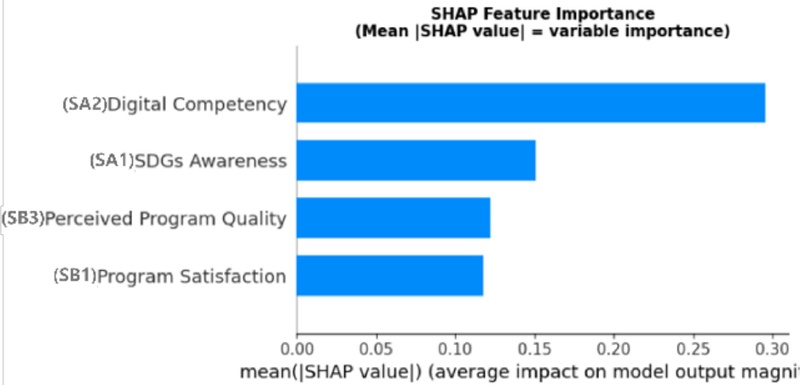
SHAP Feature Importance for Student Variables (Model 1)
In the SHAP analysis for Model 2 incorporating both student and teacher variables, (SA2) Digital Problem-Solving Competency (SHAP ≈ .30) exhibited overwhelmingly high importance. Among the teacher variables, (T3) Instructional Methods recorded the second highest SHAP importance. This is consistent with the regression finding that T3 exerted a significant negative effect (β = −.170), and the SHAP analysis similarly showed that T3's contribution was relatively larger than that of other teacher variables, confirming that the two analytical approaches converge in a mutually complementary manner.
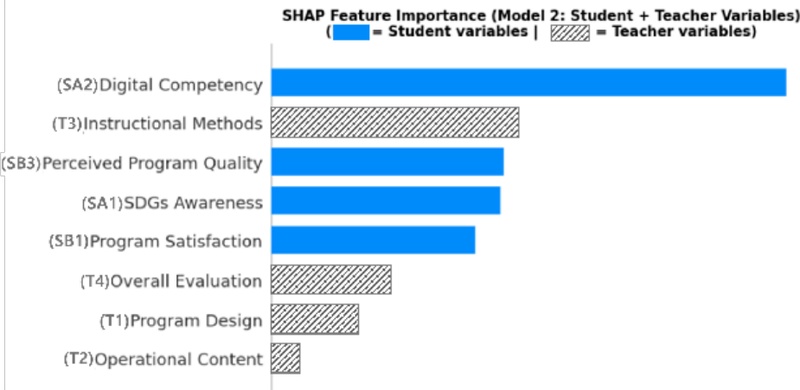
SHAP Feature Importance for Student and Teacher Variables (Model 2)
5. Conclusion
This study analyzed the factors influencing adolescents' SW·AI career goals using survey data from students and teachers who participated in the “2024 Youth SW Companion Project”, guided by Bandura's (1997) [17] theory of self-efficacy and Lent, Brown, & Hackett's (1994) [18] Social Cognitive Career Theory (SCCT) as the theoretical framework. The results confirmed that students' digital problem-solving competency self-efficacy is the most critical factor in career goal formation, suggesting that competency awareness developed through hands-on problem-solving experiences rather than simple knowledge acquisition exerts a decisive influence on career motivation. SDGs-linked social value awareness also emerged as a significant factor, confirming that educational approaches connecting digital technologies to real-world social problem-solving are effective in shaping career consciousness.
Program satisfaction and perceived program quality positively influenced career goals, though their effects were comparatively limited. This indicates that individual competency awareness developed through the learning process has a more direct impact than satisfaction with the program itself. Particularly noteworthy is the finding that teacher evaluations of instructional methods negatively affected students' career goals, suggesting that systematic or advanced instructional approaches highly rated by teachers may have been perceived by students as too difficult or burdensome, potentially undermining their interest in and motivation toward SW·AI careers. In other words, a mismatch between instructional approach and learner level may have functioned as a barrier to career interest formation. By contrast, more positive overall program evaluations by teachers tended to be associated with higher student career goals.
In summary, the f indings of this study suggest three design principles for SW·AI career education. First, it is essential to strengthen mastery experience-centered practical education to build competency self-efficacy. Second, outcome expectations should be enhanced through SDGs-linked social problem-solving contexts. Third, teacher training and feedback systems should be established to ensure that instructional approaches are appropriately aligned with learners' proficiency levels. These findings provide important implications for the design of future SW·AI education programs and the formulation of related policies.
Although this study measured students' SW·AI career goals through self-report survey items, it was not possible to verify whether these goals translated into actual career-choice behaviors, such as selecting a related major, participating in relevant clubs or competitions, or making decisions to pursue SW·AI fields in higher education. The gap between expressed career goals and actual behavioral outcomes is a recurring concern in career development research [22], and future studies employing longitudinal designs that track specific behavioral indicators following career goal formation are therefore warranted.
Acknowledgments
이 논문은 2025년도 한국방송통신대학교 학술연구비 지원을 받아 작성된 것임
참고문헌
- WEF. (2023). The Future of Jobs Report 2023. World Economic Forum. https://www3.weforum.org/docs/WEF_Future_of_Jobs_2023.pdf
-
Jeon, S., Lee, J., Choi, H., Lee, S., & Kim, M. (2023). Development of Artificial Intelligence education content system of K-12 for Artificial Intelligence convergence education. The Korean Association of Computer Education, 26(2), 71-88.
[https://doi.org/10.32431/kace.2023.26.2.007]

-
Sung, E., Kim, D., Shin, S., & Lee, Y. (2023). The Possibilities and Promises for Educational Practice of Artificial Intelligence. The Korean Society for Educational Technology, 39(4), 1479-1508.
[https://doi.org/10.17232/KSET.39.4.1479]
-
Noh, J. & Park, K. (2023). The Effects of SW‧AI Convergence Educational Program on Computational Thinking, Motivation and Attitude. Journal of The Korean Association of Information Education, 27(6), 775-789.
[https://doi.org/10.14352/jkaie.2023.27.6.775]
-
Lee, S. & Kim, J. (2023). Development and Application of SW·AI Convergence Digital Citizenship Education Program for Elementary School Students. Journal of The Korean Association of Information Education, 27(6), 801-810.
[https://doi.org/10.14352/jkaie.2023.27.6.801]
- The Korea Research Institute for Vocational Education and Training. (2023). 2023 Survey on career education status in elementary and secondary schools. Ministry of Education. https://www.krivet.re.kr/kor/sub.do?menuSn=12&pstNo=E120240067
-
Lee, J. & Lee, S. (2021). The Effect of High School Students' First SW Education Experience on SW-related Career Orientation. The Korean Society for Creative Information Culture, 7(4), 225-234.
[https://doi.org/10.32823/jcic.7.4.202111.225]
-
Oh, G. & Jang, E. (2021). An analysis of SW Experience in AI Basic Liberal Arts Education. Journal of The Korean Association of Information Education, 25(5), 769-778.
[https://doi.org/10.14352/jkaie.2021.25.5.769]
-
Hong, S. & Im, H. (2024). A Study on the Types of Career Values and Influencing Factors among Middle and High School Students through Latent Profile Analysis. The Journal of Vocational Education Research, 43(1), 73-103.
[https://doi.org/10.37210/JVER.2024.43.1.73]
-
Hong, S. & Han, H. (2023). Analyzing Perceptions and Educational Needs of Elementary School Teachers for Using ChatGPT in Education. The Korean Association of Computer Education, 26(4), 51-63.
[https://doi.org/10.32431/kace.2023.26.4.006]
-
Kim, S., Do, J., & Lee, J. (2024). Exploring learners' online content utilization patterns in preparation for digital transformation. CNU Research Institute of Education, 45(4), 87-112.
[https://doi.org/10.18612/cnujes.2024.45.4.87]
-
Sim, T. & Ye, C. (2023). Analysis of SW and AI Education research Trends for Digital Talent Development: Using the Subject Scope Literature Review Methodology. Korean Association For Learner-Centered Curriculum And Instruction, 23(16), 193-209.
[https://doi.org/10.22251/jlcci.2023.23.16.193]
-
Lee, Y. (2024). Analysis of research trends related to information education according to the 2015 and the 2022 revised curriculum. Journal of The Korean Association of Information Education, 28(3), 267-274.
[https://doi.org/10.14352/jkaie.2024.28.3.267]
- Korea Foundation for Science and Creativity. (2024). 2024 Youth SW Companion Project operation results. Korea Foundation for Science and Creativity. https://sw.kosac.re.kr/brd/board/784/L/menu/785?brdType=R&thisPage=2&bbsSn=113&brdCodeValue=&searchField=titlecontent
- Ministry of Education. (2023). 2023 Survey on career education status in elementary and secondary schools. Ministry of Education.https://www.korea.kr/news/policyNewsView.do?newsId=148923410
-
Kwon, D., Heo, N., & Kang, J. (2023). Survey of High School Students’ Perception of Artificial Intelligence. The Korean Data Analysis Society, 25(6), 2473-2488.
[https://doi.org/10.37727/jkdas.2023.25.6.2473]
- Bandura, A. (1997). Self-efficacy: The exercise of control. W.H. Freeman.
-
Lent, R., Brown, S., & Hackett, G. (1994). Toward a Unifying Social Cognitive Theory of Career and Academic Interest, Choice, and Performance. Journal of Vocational Behavior, 45(1), 79-122.
[https://doi.org/10.1006/jvbe.1994.1027]
-
Park, C., & Kang, G. (2022). A study on the effects of self-efficacy, usage experience and perceived usefulness on AI Service acceptance attitude. The Korean Entrepreneurship Society, 17(4), 177-197.
[https://doi.org/10.24878/tkes.2022.17.4.177]
-
Park, S. (2024). Analysis of self-efficacy status of young people. Korea Youth Activity Research Association, 10(4), 79-94.
[https://doi.org/10.36697/skya.2024.10.4.79]
- Lundberg, S. & Lee, S. (2017). A Unified Approach to Interpreting Model Predictions. Advances in Neural Information Processing Systems, 30. https://proceedings.neurips.cc/paper/2017/hash/8a20a8621978632d76c43dfd28b67767-Abstract.html
-
Widyowati, A., Hood, M., Duffy, A., & Creed, P. (2024). Negative career goal discrepancy and goal adjustment in young adults: The underlying mechanism of negative emotions. Journal of Career Development, 51(2).
[https://doi.org/10.1177/08948453241235406]
Appendix
김용천

· 2004년 고려대학교 컴퓨터교육과(이학사)
· 2004년 고려대학교 컴퓨터교육학과(이학석사)
· 2024년 고려대학교 컴퓨터교육학과(이학박사)
· 2025년~현재 고려대학교 의료빅데이터연구소 연구교수
관심분야 : 정보교육, SW/AI 교육, 웹 프로그래밍, 의료빅데이터
kimyc3766@gmail.com
윤일규
· 2008년 공주대학교 컴퓨터교육과(이학사)
· 2010년 고려대학교 컴퓨터교육학과(이학석사)
· 2016년 고려대학교 컴퓨터교육학과(이학박사)
· 2018년~현재 한국과학창의재단 AI역량개발실 실장
관심분야 : 정보교육, AI교육, 정보교육평가
yoonilkyu@kosac.re.kr
우호성
· 2012년 가천대학교 컴퓨터미디어학과(공학사)
· 2014년 아주대학교 지식정보공학과 모바일보안 (공학석사)
· 2020년 고려대학교 컴퓨터학과 컴퓨터교육(공학박사)
· 2021년~현재 한국방송통신대학교 대학원 에듀테크학과 부교수
관심분야 : 에듀테크, 정보교육, 빅데이터, 영상처리
hughwoo@knou.ac.kr