PMI 기법을 활용한 중학교 정보교과 ‘추상화와 알고리즘’ 교수·학습 자료 설계 기준 개발 및 적용
 ; 김귀훈††
; Kwihoon Kim††
; 김귀훈††
; Kwihoon Kim††
초록
본 연구는 중학교 정보 교육에서 학생들이 느끼는 알고리즘 학습의 높은 장벽을 해소하고 컴퓨팅 사고력을 증진하기 위해, 수렴적 사고 기법인 PMI(Plus-Minus-Interesting)를 활용한 ‘추상화와 알고리즘’ 단원의 교수·학습 자료 설계 기준을 개발하는 데 목적이 있다. 본 연구는 2015 개정 중학교 정보 교과 ‘추상화와 알고리즘’ 중단원의 성취기준을 분석하였고, PDI 모형에 따라 총 5차시 분량의 교수·학습 자료를 개발하였다. PMI 토론을 위한 교수·학습 자료를 설계하기 위한 설계 기준과, 개발된 차시별 PMI 토론 주제 및 지도안은 2회의 전문가 검토를 통해 타당성이 확인되었다. 본 연구는 PMI 기법의 적절한 활용이 학습 흥미 유발과 성취기준 달성에 효과적이라는 가설을 바탕으로 개발되었으며, 향후 컴퓨팅 사고력을 함양한 창의·융합형 인재를 양성하는 데 기여할 것으로 기대된다.
Abstract
The purpose of this study is to develop design criteria for teaching and learning materials in the “Abstraction and Algorithms” unit of middle school informatics education by utilizing the PMI (Plus-Minus-Interesting) convergent thinking technique. This study aims to lower the high learning barriers students experience in algorithm learning and to enhance their computational thinking (CT) skills. To this end, the achievement standards of the “Abstraction and Algorithms” sub-unit in the 2015 Revised Middle School Informatics Curriculum were analyzed, and instructional materials for a total of five class sessions were developed according to the PDI (Prepare-Develop-Improve) model. The design criteria for PMI-based discussion materials, as well as the discussion topics and lesson plans for each session, were validated through two rounds of expert review. This study was grounded in the hypothesis that the appropriate use of the PMI technique is effective in increasing students’ learning motivation and achieving the achievement standards, and it is expected to contribute to fostering creative and convergent talents equipped with computational thinking skills.
Keywords:
Software Education, Abstraction, Algorithm, PMI Technique, Instructional Design, Development of Teaching and Learning Materials키워드:
소프트웨어 교육, 추상화, 알고리즘, PMI 기법, 교수설계, 교육자료개발1. 서론
현대 사회는 소프트웨어(SW) 기반 기술의 가치 증대와 미래 인재양성을 위한 SW 교육의 강화는 필수적이다[1, 2]. 하지만 비전공 학생들에게 프로그래밍 학습은 높은 학습 장벽으로 작용하며, 기존의 알고리즘 교육 방식은 오히려 문제 해결 의욕을 저해한다는 비판이 제기되고 있다[3]. 또한, 컴퓨팅 사고력(Computational Thinking, CT)의 핵심인 추상화와 알고리즘 기반의 문제 해결력에 대한 효과적인 교수·학습 방안 연구가 미흡한 실정이다[4]. 이에 본 연구는 SW 교육의 본래 목적인 알고리즘적 사고 증진과 흥미 유발을 위해 추상화 과정의 수렴적 사고를 돕는 PMI(Plus-Minus- Interesting) 기법의 교육적 활용 가능성에 주목하였다[5]. 추상화와 알고리즘은 복잡한 문제 상황에서 핵심 요소와 절차를 선별하여 하나의 해결안으로 수렴시키는 사고 과정을 필요로 하므로, 아이디어의 장점, 단점, 흥미 요소를 구조화하는 PMI 기법을 통해 추상화와 알고리즘의 수렴적 사고를 촉진할 수 있을 것이다[6-9].
본 연구는 2015 개정 중학교 정보과 ‘추상화와 알고리즘’ 중단원을 대상으로, 학습자의 흥미와 성취기준 달성을 위해 PMI 기법을 기반으로 한 교수·학습 자료의 설계 기준을 개발하고, 이를 적용한 자료를 개발하는 것을 목적으로 한다. 또한 2015 개정 교육과정이 여전히 적용되고 있는 현 시점에서, 본 연구는 2015 개정 교육과정의 성취기준을 충실히 반영한 기초 연구로서 향후 2022 개정 교육과정으로의 확장을 모색하여 컴퓨팅 사고력을 바탕으로 한 창의적이고 융합적인 인재를 양성하는 데 기여하고자 한다.
본 연구는 Kwon과 Kim(2020)이 중학교 정보과 ‘추상화와 알고리즘’ 영역에 PMI 기법을 적용하기 위한 교수·학습 전략을 제안한 선행 연구를 토대로 한다[10]. 선행 연구에서는 PMI 기법을 활용한 교수·학습 전략과 차시별 토론 주제를 중심으로 교수·학습 프로그램을 제안하여 해당 영역에서 PMI 활동의 교육적 가능성을 탐색하였다. 그러나 교과서 분석을 기반으로 한 교수·학습 자료 설계 기준의 도출이나 전문가 검토를 통한 타당성 검증, 실제 수업 적용을 위한 자료 개발은 제한적으로 다루어졌다. 이에 본 연구는 선행 연구를 확장하여 2015 개정 정보과 교육과정 기반 중학교 정보 교과서 8종을 분석하고, PDI 모형에 따라 교수·학습 자료 설계를 위한 구체적인 설계 기준을 도출하였다. 또한 전문가 검토를 통해 해당 설계 기준의 타당성을 검증하고, 실제 수업 적용을 고려한 PMI 토의 주제 구체화하여 5차시 분량의 교수·학습 자료를 개발하는 데 목적이 있다.
2. 이론적 배경
2.1 PMI 기법
PMI 기법은 아이디어를 다각적으로 처리하는 수렴적 사고 기법으로, 특정 대상이나 제안의 장점(plus), 단점(minus), 흥미로운 점(interesting)을 따져 중립적이고 합리적인 의사결정을 돕는다[6, 11, 12]. PMI 기법의 수업 전개는 Table 1과 같이 3단계로 진행되며, 각 단계는 사고의 섞임을 방지하기 위해 분리하여 진행된다[13, 14]. 본 연구에서의 PMI 기법은 복잡한 문제 상황을 장점을 찾는 P, 단점을 찾는 M, 흥미로운 점을 찾는 I 범주로 구조화하여 핵심 요소를 추출하고, 알고리즘적 대안을 비교·평가하는 방식으로 적용된다.

Lesson Procedure Based on the PMI Technique
최근 정보교육 분야에서는 생성형 인공지능의 확산과 함께 인공지능 융합교육에 대한 연구가 활발히 이루어지고 있으며, 이러한 교육은 학생들이 다양한 지식을 융합적으로 활용하고 창의적으로 문제를 해결하는 역량을 기르는 것을 중요한 목표로 제시하고 있다[15, 16]. 이러한 흐름은 단순한 지식 전달 중심의 학습에서 벗어나 학습자의 창의적·비판적 사고를 바탕으로 다양한 문제를 탐색하고 해결하는 역량을 기르는 방향을 강조한 2022 개정 교육과정의 방향과도 맥을 같이 한다[17-19]. 이러한 관점에서 학습자가 문제를 분석하고 해결 방안을 탐색하도록 하는 PMI 기법은 학습자의 사고 확장을 지원하는 교수·학습 전략으로 활용될 수 있다.
2.2 추상화와 알고리즘
정보 교과에서의 추상화는 문제를 이해하고 분석하여 불필요한 요소를 제거하거나 작은 문제로 나누는 과정이며, 문제의 현재 상태와 목표 상태를 구분하여 목표 달성을 위한 작업을 분석하는 절차를 포함한다[20, 21]. 추상화와 알고리즘이 요구하는 수렴적 사고는 복잡한 문제 상황 중 핵심만을 추출하고, 특정 모델을 형성하는 사고 과정을 말한다[2, 7].
본 연구에서 핵심적으로 활용하는 PMI 기법은 학습자에게 장점, 단점, 흥미로운 점이라는 명확히 분리된 관점으로 개념이나 사물을 분석하도록 함으로써 필요한 요소를 추출하는 연습을 제공한다. 따라서 PMI 기법은 추상화 과정에서 요구되는 수렴적 사고 능력과 핵심 요소 추출 능력을 효과적으로 지도하는 데 있어 높은 연관성과 유용성을 가진다[5].
알고리즘은 문제 해결을 위한 효율적인 방법과 절차로, 2015 개정 정보과 교육과정에서는 알고리즘의 이해와 알고리즘 표현을 내용 요소로 설정하였으며, 추상화와 알고리즘의 성취기준은 실생활의 문제를 추상화하여 해결하기 쉬운 형태로 만들고 문제 해결을 위한 알고리즘을 설계하는 능력과 태도를 함양하는 데 중점을 두어 성취기준을 Table 2와 같이 설정하였다[20].
Achievement Standards in the Unit of Abstraction & Algorithms
중학교 정보과 ‘추상화와 알고리즘’ 성취기준은 2022 개정 교육과정에서도 동일한 기준 코드와 유사한 서술을 유지하고 있으며, 문제의 추상화-알고리즘 설계-표현이라는 기본 학습 흐름 측면에서 연속성을 가진다[22]. PMI 기법은 중학교 정보 교과 ‘추상화와 알고리즘’ 단원에서 학습자가 성취기준을 효과적으로 달성하도록 돕는 핵심적인 역할을 수행할 수 있을 것이다. 첫째, [9정03-02]의 목표에 맞춰, 학습자가 문제 상황의 다양한 요소를 PMI 관점으로 분석하게 하여 목표 상태 도달에 필수적인 요소를 추출한다. 둘째, [9정03-03]과 관련하여, 장점과 단점을 체계적으로 분석하는 과정을 통해 논리적인 문제 해결 방법을 탐색하는 기반을 마련한다. 셋째, [9정03-04]와 관련하여, 문제 해결을 위한 다양한 방법과 절차를 평가할 때 중립적인 시각으로 여러 대안을 다각적으로 비교하고 분석할 수 있도록 돕는다. 넷째, 학습자의 흥미와 동기를 고려하여 알고리즘과 관련된 놀이 활동의 하나로 PMI 기법을 활용한다. 다섯째, 토론 기법으로서의 PMI를 활용하여 모둠별 활동 및 토론을 촉진한다.
3. PMI 교수·학습 자료 설계 기준 개발
본 연구는 PMI 기법을 적용하여 중학교 정보 교과 중 단원 ‘추상화와 알고리즘’을 교수·학습하기 위한 자료 개발을 목적으로, 현실적인 개발이 가능한 PDI 모형에 따라 교수·학습 프로그램과 자료를 개발하는 것을 목표로 한다. PDI 모형은 준비(Preparation)-개발(Development)-개선(Improvement) 단계를 거친다[23].
3.1 준비(Preparation) 단계
본 연구는 2015 개정 교육과정의 ‘추상화와 알고리즘’ 성취 기준에 위배되지 않는 PMI 토론 주제를 설정하기 위해 성취기준을 분석하였다. 또한, 2015 개정 정보과 교육과정 교과서 8권을 분석하여 ‘추상화와 알고리즘’ 단원의 평균 차시 배정과 PMI 토론에 적절한 주제가 있는지 분석하였다[24-31]. 해당 단원의 평균 차시와 토론 가능 주제는 Table 3와 같다.
List of Analyzed Textbooks for the Unit ‘Abstraction and Algorithms’
3.2 1차 개발(Development) 단계
본 연구의 개발 단계는 총 2차례로 나뉜다. 먼저, 전문가 집단의 이해를 돕고 PMI 기법을 활용한 자료 개발에 영향을 미칠 수 있는 주요 요소에 관한 의견을 수렴하기 위한 1차 자료를 개발하였다. 교과서 분석 결과 A출판사의 중학교 정보 교과서가 PMI 토론을 위한 콘텐츠를 가장 많이 가지고 있었기 때문에 PMI 토론에 가장 적합하다고 판단하였고, 이와 관련된 차시별 PMI 토론 주제를 선정하였다. 그 내용은 Table 4와 같다.
PMI Thinking Topics for Each Class Session(1)
3.3 1차 개선(Improvement) 단계
개발한 내용과 더불어 해당 단원에 PMI 기법 도입 시 고려해야 할 요소, 즉 설계 기준이 무엇인지 도출하기 위해 전문가 집단을 대상으로 설문조사를 실시하였다. 전문가 집단 대상자는 Table 5와 같으며, 현직 정보교사 8명의 교육현장 전문가와 정보 교육 관련 석사 학위 이상을 소지한 교사 5인을 교육내용전문가로 구성하였다. 1라운드 설문 문항은 추상화와 알고리즘 단원에 PMI 기법을 적용한 교수·학습 자료의 흥미도·적절성·효과성 5문항과 수업자료 개발에 대한 제언 1문항으로 구성하였고, 모두 개방형 질문으로 이루어졌다. 선행 연구와 델파이 연구 분석 자료를 토대로 연구자가 예비 문항을 작성한 후, 전문가 자문회의 결과를 반영하여 수정·보완하였으며 이후 문항에 대한 타당성 검토를 받았다.
Needs Analysis Participants
3.4 2차 개발(Development) 단계
전문가 집단의 설계 기준에 관한 의견을 토대로 1차 개발한 교수·학습 자료를 보완하였다. 분량 조정, 용어 수정, 흥미 유발 요소 재검토, PMI 토론 주제 수정 등을 거쳐 수정·보완한 자료를 다시 전문가 집단에게 제공하여 전문가 검토를 받았다. 2차 자료는 총 5차시로 구성된다. 이는 1차 개발 자료의 7차시 구성과 차이가 있는데, 1라운드 설문 결과 교육현장전문가 8인 중 4인이 “현실적으로 7차시는 과도하다”고 응답하였고, 실제 수업에서 주로 3~5차시를 진행한다는 점을 고려하여 5차시로 조정하였다. 정규 수업 시간 내 소화하기 위해 거꾸로 수업 등 사전 학습 전략을 병행하여 본 수업에서 PMI 활동과 토론에 집중할 수 있도록 구성하였다. 또한 1라운드 설문 중 “수업자료 개발에 대한 제언”을 반영하여 PMI 토론 주제 일부를 수정하였다. 2차 개발 자료는 Table 6와 같다.
PMI Thinking Topics for Each Class Session(2)
3.5 2차 개선(Improvement) 단계
수정·보완된 자료를 바탕으로, 해당 자료의 흥미도, 적절성, 효과성 영역의 총 5문항을 Likert 5점 척도의 폐쇄형 질문으로 전문가 집단에게 제공하였다. 질문 문항에 대해서는 앞선 1라운드와 동일하게 연구자가 사전에 예비 문항을 작성하였으며, 총 3회의 전문가 자문회의를 통해 검토를 거쳐 최종 설문지를 완성하고 배포하였다. 2라운드 설문지와 더불어 1라운드 설문의 “수업자료 개발에 대한 제언” 문항 응답을 반영하여 수정·보완한 학습지도안을 제공하였다. 2라운드 설문 결과는 2라운드 설문 결과를 토대로 내용타당도비율(CVR)과 변동 계수(CV)를 산출하였으며 그 결과는 Table 7~Table 11과 같다.
Table 7은 전문가를 대상으로 한 설문을 통해 PMI 기반 교수·학습 자료의 수업 적용 가능성과 실행 조건의 적절성을 검증한 결과이다. 대부분 문항에서 평균 4.0 이상, CVR .69 이상을 보여, 제시된 설계 기준이 실제 수업 맥락에서 현실적으로 적용 가능하다는 타당성을 확보하였다[32].
Review Result – Appropriateness of Teaching Materials: Implementation of Materials
Table 8의 결과는 ‘추상화와 알고리즘’ 단원을 5차시 구조로 재구성한 것이 내용량과 흐름 측면에서 적절한지를 평가한 것으로, 전문가들은 전반적으로 긍정적인 응답을 보였다.
Review Result – Appropriateness of Teaching Materials: Quantity (Amount of Content)
Table 9~11은 개발된 자료가 학생 흥미 유발, 문제 해결력·컴퓨팅 사고력 향상, 태도·정의적 측면에 미치는 잠재적 효과에 대한 전문가 판단을 나타낸다. 대부분 항목이 평균 4.23 이상, CVR .69 이상으로 나타나, 앞서 도출한 교수·학습 자료 설계 기준이 SW 교육의 목표와 부합함을 시사한다[32].
Review Result – Appropriateness of Teaching Materials: Implementation of the PMI Technique
Review Result – Interest of Teaching Materials
Review Result – Effectiveness of Teaching Materials
다만 Table 7의 ‘객관적 평가 지표’, Table 9의 ‘PMI 토론 결과 등이 포함되어 있는 학생용 교재’ 항목의 CVR 값이 상대적으로 낮게 나타나, 추후 교수·학습 자료 개정 시, 루브릭 등 평가 도구의 상세화와 PMI 토론 결과를 누적·활용할 수 있는 학생용 자료 설계가 보완될 필요가 있다고 보았다.
4. PMI 교수·학습 자료 개발
4.1 PMI 1차시 수업 설계 및 자료
차시 수업은 학습자들이 PMI(Plus-Minus-Interesting) 기법에 익숙해지도록 설계되었으며, 교과서 86쪽의 ‘놀이공원에서의 문제 발생’과 ‘문제 해결 과정’ 콘텐츠를 활용하여 “놀이공원에서 지도를 살펴보며 다닐 때의 PMI 토론”을 주제로 진행되었다. 수업 도입부에서는 학습자와 직접 관계있는 문제를 선정하여 동기를 유발하고 이를 토론 주제와 연결하였으며, 전개 단계는 ‘생각하기’, ‘개념 알기’, ‘적용하기’의 세부 단계로 구성되었다. 이 중 ‘생각하기’ 단계에서 PMI 토론 기법 설명 및 예제 문제를 제공한 후, PMI 토론을 단순한 브레인스토밍이 아닌 ‘개념 알기’ 단계에 적극 활용하여 학습 목표인 목표 상태에 보다 신속하게 도달할 수 있는 방법을 모색하는 데 중점을 두었다. 또한, 학습 활동지의 ‘PMI 토론 해보기’ 활동에서는 학습자가 문제를 충분히 이해하도록 문제 상황 제공과 발문을 추가함으로써, 학습 목표 도달을 위한 구체적인 적용을 유도하였다.
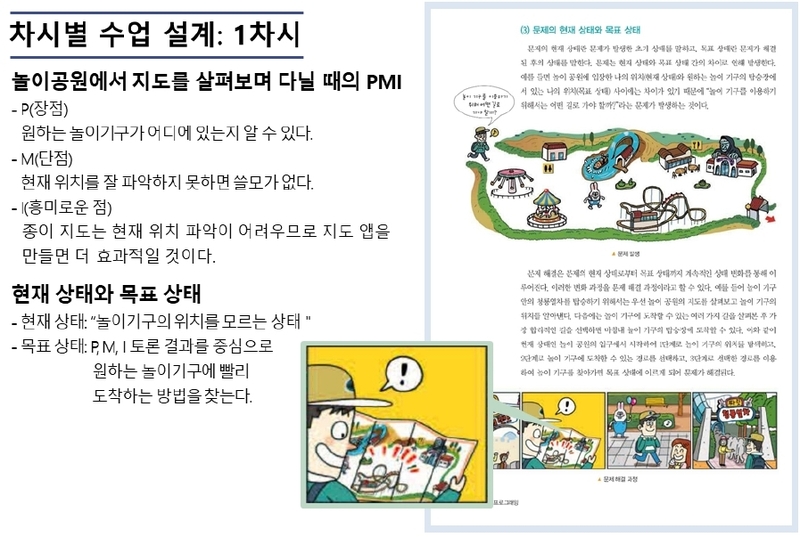
Textbook Excerpts, PMI Discussion, and Content Elements of Lesson 1
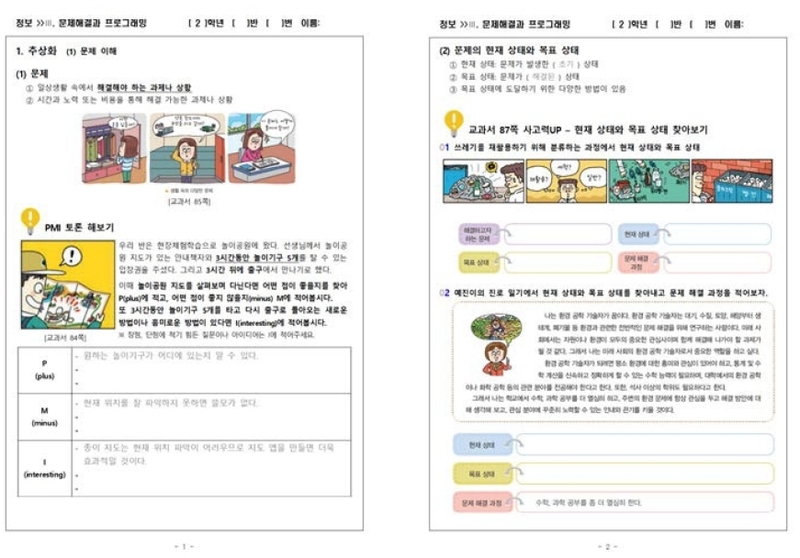
Lesson 1 Worksheet
4.2 PMI 2차시 수업 설계 및 자료
2차시 수업은 학습자들이 교사의 개입 없이 학생들 스스로 PMI 토론을 진행하며 기법에 익숙해지도록 하는 데 초점을 맞추었다. 당초 픽토그램을 주제로 하려 했으나, ‘추상화와 알고리즘’ 단원의 학습 목표 달성에 효과적인 네트워크 모델, 그래프, 노드와 엣지 개념을 포함하는 “지하철 노선도 만들기 PMI”로 주제를 변경하였다. 수업 도입부에서는 학습자의 흥미 유발을 위해 픽토그램 애니메이션이나 복잡한 지도를 노선도로 추상화하는 영상 자료를 활용한다. 전개 단계의 ‘생각하기’에서는 PMI 토론이 두 번 진행되는데, 첫 번째 토론에서는 복잡한 지도와 지하철 노선도를 비교하며 지하철 노선도의 P, M, I를 찾아 추상화의 개념을 간접적으로 경험하게 한다. 이어지는 두 번째 토론에서는 학습자들이 직접 지하철 노선도를 만들 때 필요한 요소를 P, 불필요한 요소를 M, 기타 요소를 I에 기록하는 활동을 통해, 추상화의 핵심인 요소 추출 및 생략 과정을 직접 체험하도록 구성하였다.
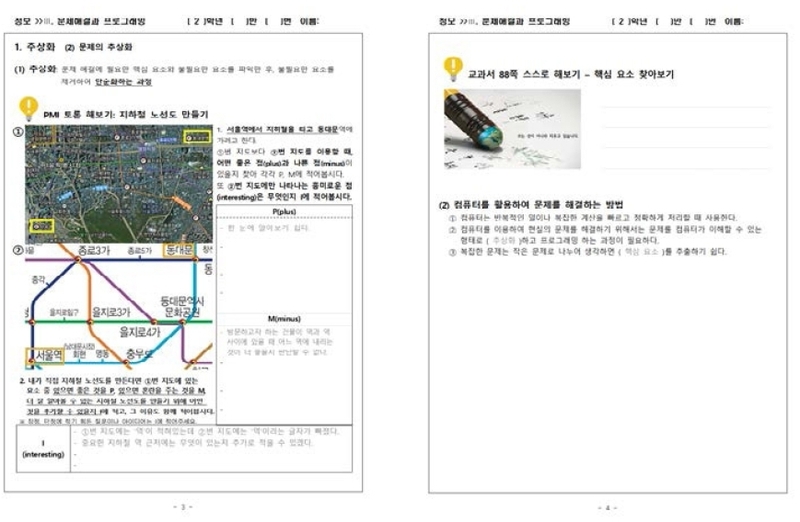
Lesson 2 Worksheet
4.3 PMI 3차시 수업 설계 및 자료
3차시 수업은 학습자들이 PMI 토론에 완전히 익숙해지며 더 많은 아이디어를 창출하는 단계로 기획되었다. 학습 활동지에 제시된 것과 같이 PMI 토론 주제는 “김치볶음밥 레시피의 PMI”이다. 이 일상적인 레시피를 알고리즘의 조건(명확성 등)에 맞추어 분석하는 과정으로 수업이 진행되며, 학생들이 찾은 P, M, I 요소를 알고리즘의 조건과 직접 연결하여 이해를 돕는다. 예를 들어, 레시피의 ‘적당량’과 같은 모호한 표현이 알고리즘의 조건 중 명확성에 어떻게 위배되는지를 설명함으로써, 실생활 예시를 컴퓨팅 알고리즘의 예시로 자연스럽게 확장하도록 지도한다. ‘적용하기’ 단계에서는 학습자들이 PMI 활동을 통해 도출한 P, M, I 요소와 알고리즘의 조건을 고려하여 김치볶음밥 레시피를 자율적으로 수정·보완하는 활동을 수행하며, 알고리즘적 사고를 실제 문제 해결에 적용하는 경험을 제공한다.
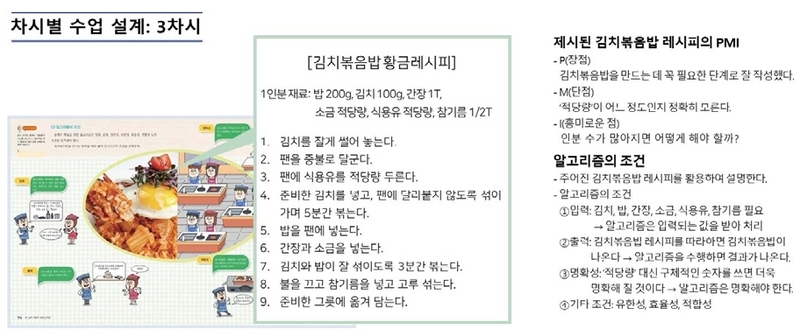
Textbook Excerpts, PMI Discussion, and Content Elements of Lesson 3
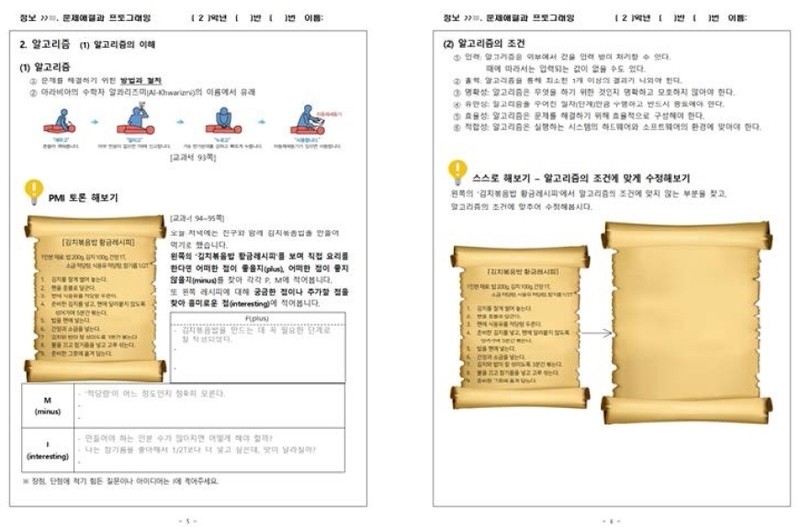
Lesson 3 Worksheet
4.4 PMI 4차시 수업 설계 및 자료
4차시 수업은 PMI 토론을 통해 도출된 다수의 아이디어 중 문제 해결에 가장 적합한 최선의 대안을 선택하는 단계이다. 주제는 교과서 96쪽의 ‘놀이기구 순회 방법’ 알고리즘 중 첫 번째인 “현재 위치에서 가장 가까운 놀이기구를 먼저 이용할 때의 PMI”로 설정하였다. 이 차시의 핵심은 동일한 목표 상태에 도달하는 여러 알고리즘 중에서 최선의 대안을 분별하도록 하는 것이다. 학습 활동을 통해 PMI 요소 중 M(Minus)이 가장 많은 알고리즘은 최선이 될 수 없음을 설명하고, I(Interesting) 요소를 반영하여 기존 알고리즘을 개선하거나 새로운 알고리즘을 창출할 수 있음을 제시함으로써, 학습자들이 다양한 알고리즘을 비판적으로 평가하고 개선하는 능력을 함양하도록 유도하였다.
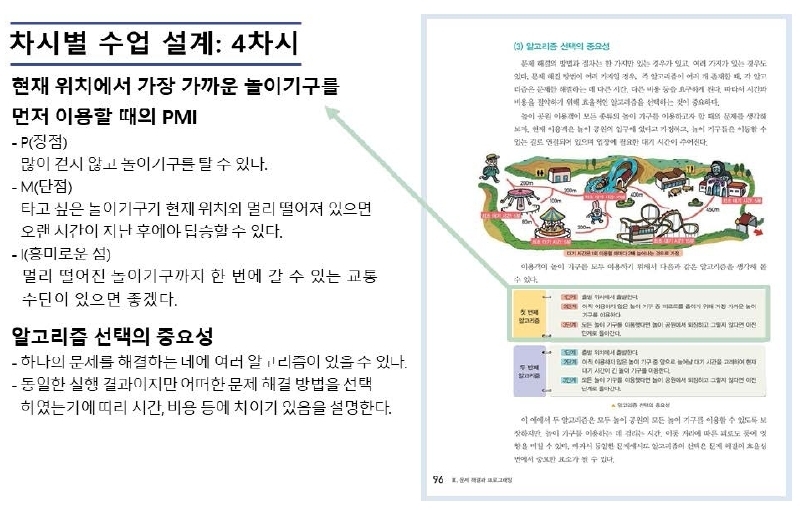
Textbook Excerpts, PMI Discussion, and Content Elements of Lesson 4
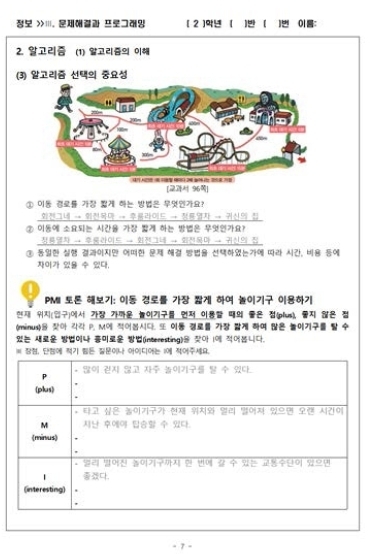
Lesson 4 Worksheet
4.5 PMI 5차시 수업 설계 및 자료
5차시 수업은 학습자들이 PMI 토론을 통해 도출된 아이디어 중에서 문제 해결에 가장 적합한 대안을 선택하는 데 다시 한번 초점을 맞춘다. 5차시 PMI 토론 주제는 교과서 99쪽 ‘스스로 해보기’ 활동인 ‘김치볶음밥 만들기’를 활용하며, 이 알고리즘을 자연어 표현이 아닌 그림 형태로 제시하고 이에 대해 PMI 토론을 진행한다. 이 활동을 통해 학습자들은 알고리즘을 표현하는 방법이 다양하며, 알고리즘의 특성과 목적에 따라 가장 적합한 표현 방식을 선택하여 사용할 수 있다는 중요한 개념을 이해하도록 지도한다. 이는 추상화된 문제 해결 과정을 최종적으로 구현하는 데 필요한 모델링 및 표현 능력을 함양하는 데 기여한다.
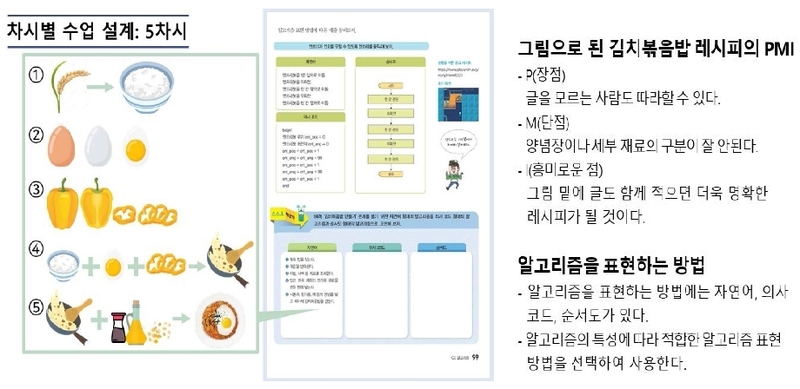
Textbook Excerpts, PMI Discussion, and Content Elements of Lesson 5
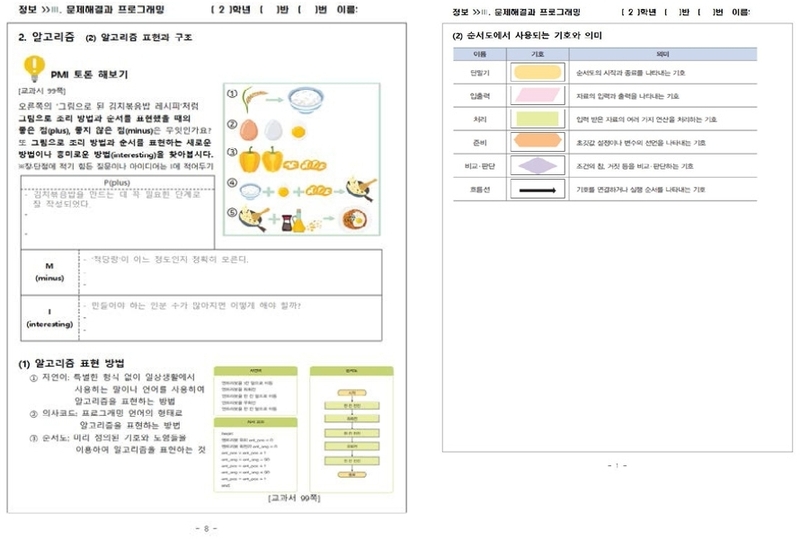
Lesson 5 Worksheet
5. 결론 및 제언
본 연구는 중학교 정보 교과 중단원 ‘추상화와 알고리즘’에서 PMI 기법을 활용한 교수·학습 자료의 설계 기준을 개발하고 이를 적용한 수업 자료를 제안하는 것을 목적으로 수행되었다. 이를 위해 PDI(prepare-development-improvement) 개발 절차에 따라 교수·학습 자료를 개발하였다. 개발된 기준을 적용하여 두 차례에 걸쳐 해당 단원의 차시별 PMI 토론 주제와 교수·학습 지도안, 학습 활동지를 개발하였다. 이 과정에서 차시별 PMI 토론 주제는 전문가 검토를 통해 그 타당성이 확인되었다. 이러한 결과는 PMI 기법을 중학교 정보과 ‘추상화와 알고리즘’ 단원에 적용하기 위해 각 차시별 PMI 토론 주제를 제안한 Kwon과 Kim(2020)의 선행 연구를 확장하여 구체적인 교과서 분석과 차시별 수업 구조 설계, 전문가 타당도 검증을 통해 수업자료 설계 기준을 체계화하였다는 점에서 학술적 의의를 지닌다. 또한 본 연구에서 제시한 설계 기준과 예시는 향후 2022 개정 교육과정에 기반한 정보과 수업에서 PMI 기법을 활용한 수업자료 개발의 준거로 활용될 수 있다는 점에서 실천적 시사점을 제공한다. 나아가 본 연구에서 제시한 중학교 정보과 적용 가능 PMI 주제 아이디어는 해당 교과에 적합한 질 높은 창의적 PMI 주제 개발의 기초 자료로 활용되어 효과적인 교수·학습에 기여할 것으로 기대한다.
또한 PMI 기법은 학습자가 주어진 문제 상황에 대해 장점(Plus), 단점(Minus), 흥미로운 점(Interesting)을 탐색하고 이를 바탕으로 토론을 통해 다양한 관점을 분석하는 활동 중심 전략이라는 점에서 문제 상황을 다각적으로 분석하고 해결 방안을 탐색하는 사고 과정을 강조하는 교수·학습 접근과 관련이 있다. 특히 단순한 지식 전달 중심의 학습에서 벗어나 학습자의 창의적·비판적 사고를 바탕으로 다양한 문제를 탐색하고 해결하는 역량을 강조하는 2022 개정 교육과정의 방향을 고려할 때, 본 연구에서 제안한 PMI 기법 기반 교수·학습 자료는 2022 개정 교육과정이 지향하는 문제 해결 중심 교수·학습의 방향과도 부합하는 교수 전략으로 활용될 수 있을 것이다.
다만 2022 개정 교육과정과 2015 개정 교육과정이 동시에 유지되고 있는 현 시점에서 본 연구는 2015 개정 교육과정을 기반으로 교수·학습 자료를 설계하였으며, 개발된 자료의 실제 수업 적용을 통한 효과성 검증이 이루어지지 않았다는 한계를 가진다. 2022 개정 교육과정의 ‘추상화와 알고리즘’ 역시 2015 개정 교육과정과 비슷한 맥락을 유지하고는 있으나, 2022 개정 교육과정의 내용 체계를 반영하여 교수·학습 자료를 수정·보완하고 실제 수업 적용을 통한 효과성 검증 연구를 수행할 후속 연구의 필요성이 제기된다.
Acknowledgments
본 논문은 1저자의 석사 논문을 수정 및 보완하였음
References
- Ministry of Education. (2018). The National Framework for the Elementary and Secondary Curriculum, Proclamation of the Ministry of Education #2018-162 [Annex 1].
- Park, H., & Kim, J. (2019). Educational Strategies for Cultivating Software-Convergence Talent in the Era of the Fourth Industrial Revolution. Korea Information Processing Society Review, 26(1), 64-75.
- Myung, H. (2014). Effects of Software Special Class on Programming and Creative Problem Solving Capability[Master's thesis]. The Graduate School of Education, Hanyang University.
-
Sung, Y., Jeong, Y., & Park, N. (2017). Development of Algorithm and Programming Framework for Information Education Curriculum Standard Model. Journal of The Korean Association of Information Education, 21(1), 77-87.
[https://doi.org/10.14352/jkaie.21.1.77]

- Lee, S. (2015). Life & Communication - A Cognitive Traning Method for Broadening Perspective. TTS Journal/ Telecommunications Technology Association, 162, 114-115.
-
Choi, H., & Jang, Y. (2022). The Effect of Traditional Play Using the PMI Technique on Young Children’s Peer Competence and Creative Personality. The Journal of Education, 42(2), 181-199.
[https://doi.org/10.25020/je.2022.42.2.181]
- Kim, D., & Lee, T. (2019). Review of Concept of Abstraction in Computational Thinking. Conference of Korea Society of Computer and Information, Gumi, Korea, 27(1), 309-312.
- Jang, S., Park, I., Jeong, H., & Lim, H. (2008). Creative invention problem solving based on STEM. Seoul National University of Education. https://clik.nanet.go.kr/clikr-collection/policyinfo/prism/2008/12566666952347437.pdf
-
Im, S., & Jeong, Y. (2017). Development of Teaching and Learning Methods Based on Algorithms for Improving Computational Thinking. Journal of The Korean Association of Information Education, 21(6), 629-638.
[https://doi.org/10.14352/jkaie.2017.21.6.629]
- Kwon, H., & Kim, Y. (2020). Development of Teaching and Learning Strategies for ‘Abstraction and Algorithm’ in Middle School Using PMI Techniques. Proceeding of the Korean Association of Computer Education 2020 Summer Conference, 24(2), 133-136.
- Edward, B. (2010). Edward de Bono’s Thinking Course. Thenanbooks.
- Kim, G. (2018). A Study on the Middle School Music Lesson through Creative Thinking Techniques [Master's thesis]. Master of Education in Music Education, Chungnam National University.
- Lim, M. (2019). High school music teaching instruction plan Based on ‘PMI’ discussion learning[Master's thesis]. Graduate School of Korea National University of Education.
- Jang, J. (2003). Effect of instruction using creativity program on creativity and attitude toward science of middle school students[Master's thesis]. The Graduate School of Education, Ewha Womans University.
-
Lee, D., Lee, Y., & Paik, S. (2024). Development and Effect Analysis of Future Problem Solving Program based Informatics, Mathematics, Science Convergence Education Teachers’ Training Course using AI for Secondary School Teachers. The Journal of Korean Association of Computer Education, 27(5), 1-11.
[https://doi.org/10.32431/kace.2024.27.5.001]
-
Jang, E., & Oh, K. (2025). Analysis of the Impact of Generative AI Utilization on Computational Thinking and Problem-Solving Ability. The Journal of Korean Association of Computer Education, 28(7), 83-98.
[https://doi.org/10.32431/kace.2025.28.7.008]
- Ministry of Education. (2022). The National Framework for the Secondary Curriculum - Informatics, Proclamation of the Ministry of Education #2022-33 [Annex 1].
-
Shin, D., & Jo, J. (2025). Analysis of Learning Objectives in Middle School Information Textbooks. The Journal of Korean Association of Computer Education, 28(6), 41-47.
[https://doi.org/10.32431/kace.2025.28.6.004]
-
Cho, Y., & Cho, K. (2025). Analysis of Achievement Standards in the 2022 Revised AI Education Curriculum Using Text Mining. The Journal of Korean Association of Computer Education, 28(1), 51-59.
[https://doi.org/10.32431/kace.2025.28.1.005]
- Ministry of Education. (2015). The National Framework for the Secondary Curriculum - Informatics, Proclamation of the Ministry of Education #2015-74 [Annex 10].
- Yoo, J., Lim, J., Hong, J., & Jeong, Y. (2019). Software Education Theory (Revised Edition). CMASS.
- Ministry of Education. (2022). The National Framework for the Secondary Curriculum - Informatics, Proclamation of the Ministry of Education #2022-33 [Annex 10].
-
Lee, J. (2022). Case Study on the Development of STEAM Instruction Material for Mathematics Subject-Based Advanced Technology and ICT Teaching Tools. Journal of the Korean School Mathematics, 25(4), 333-352.
[https://doi.org/10.30807/ksms.2022.25.4.002]
- Kim, Y., Kim, S., Kim, Y., Kim, H., Lee, C., Song, Y., Jeon, J., & Jeon, H. (2020). Middle School Informatics. EOBooks.
- Han, S., Ryu, M., Jeon, S., Hwang, M., Kim, H., Hong, S., & Seo, J. (2020). Middle School Informatics. Sungandang.
- Kim, Y., Lim, J., Kim, M., Park, J., Jeong, Y., & Lee, S. (2020). Middle School Informatics. Kumsung.
- Jeong, Y., Kang, S., Kim, M., Yoon, S., Seo, M., Lee, D., Son, Y., Lee, C., Song, S., Lim, S., Song, J., Lim, J., & Shin, I. (2020). Middle School Informatics. CMASS.
- Kim, H., Lee, Y., Kim, S., Lee, H., & Kim, S. (2020). Middle School Informatics. CHUNJAE.
- Lee, W., Kim, J., Yoo, S., Kim, M., Shin, E., & Kim, T. (2020). Middle School Informatics. MiraeN.
- Lee, M., Kwak, H., Lee, J., Jeong, B., & Lee, J. (2020). Middle School Informatics. Gilbut.
- Bae, Y., Kim, J., Shin, S., Oh, D., Choi, K., & Hong, E.(2020). Middle School Informatics. YBM.
-
Ayre, C., & Scally, A. J. (2014). Critical values for Lawshe’s content validity ratio: Revisiting the original methods of calculation. Measurement and Evaluation in Counseling and Development, 47(1), 79-86.
[https://doi.org/10.1177/0748175613513808]

· 2019년 부산대학교 컴퓨터공학부(공학사)
· 2021년 한국교원대학교 컴퓨터교육전공 (교육학석사)
· 2025년~현재 한국교원대학교 컴퓨터교육과 박사과정
관심분야 : 정보·AI교육, 융합교육, 프로그램 개발
hyunahkwon@korea.kr
· 1998년 KAIST 전기및전자공학과(공학사)
· 2000년 KAIST 전기및전자공학과(공학석사)
· 2019년 KAIST 전기및전자공학부(Ph.D).
· 2000년~2005년 LG 데이콤 주임연구원
· 2005년~2020년 ETRI 실장, 책임연구원
· 2020년~현재 한국교원대학교 컴퓨터교육과 교수
· 2006년~현재 ITU-T SG11 Rapporteur, Editor
· 2022년~현재 한국AI융합교육연구소 소장
· 2023년~현재 교육정보원 원장
관심분야 : 인공지능융합교육, AI디지털교과서, 지능형에지컴퓨팅, 강화학습
kimkh@knue.ac.kr