Development and Application of a Generative AI Prompt Engineering Instructional Program Based on Adaptive Help-Seeking
 ; Youngjun Lee††
; 이영준††
; Youngjun Lee††
; 이영준††
Abstract
The proliferation of generative artificial intelligence (GAI) among K-12 learners has highlighted the need for instructional strategies that foster autonomous and critical engagement with AI tools. This study developed and evaluated a six-session GAI prompt engineering instructional program grounded in adaptive help-seeking principles with the aim of enhancing elementary students' GAI literacy. Drawing on self-regulated learning theory and the help-seeking model for interactive learning environments, prompt engineering strategies were structured into three phases: planning, execution, and reflection. The program was designed as a six-session curriculum following the ADDIE model and applied to 39 sixth-grade elementary students in South Korea. A one-group pretest-posttest design was employed to assess the program's effectiveness on GAI literacy complemented by a qualitative thematic analysis of learners’ interaction logs. Results indicated statistically significant improvements across overall GAI literacy and all six subscales, with particularly large effect sizes observed in critical understanding and evaluation, and perception of GAI. Furthermore, the thematic analysis confirmed that the majority of learners actively executed adaptive help-seeking behaviors such as diagnosing cognitive impasses, contextualizing abstract concepts, and critically internalizing acquired information. These findings suggest that integrating adaptive help-seeking principles into GAI prompt engineering instruction is positively associated with promoting learners' capacity to engage with AI tools in a critical, autonomous, and reflective manner.
초록
K-12 학습자의 생성형 인공지능(GAI) 사용 확산은 AI 도구를 자율적이고 비판적으로 활용할 수 있도록 촉진하는 교수 전략의 필요성을 부각시켰다. 본 연구는 초등학생의 GAI 리터러시 향상을 목적으로 적응적 도움 요청 원리에 기반한 6차시 GAI 프롬프트 엔지니어링 교육 프로그램을 개발하고 그 효과를 평가하였다. 자기조절학습 이론과 상호작용적 학습 환경에서의 도움 요청 모델을 바탕으로 프롬프트 엔지니어링 전략을 계획, 수행, 성찰의 세 단계로 구조화하였다. 본 프로그램은 ADDIE 모형에 따라 6차시 교육과정으로 설계되었으며, 한국의 초등학교 6학년 학생 39명에게 적용되었다. 프로그램이 GAI 리터러시에 미치는 효과를 평가하기 위해 단일집단 사전-사후 검사 설계를 적용하였으며, 학습자의 상호작용 로그에 대한 질적 주제 분석을 병행하였다. 연구 결과, 전체 GAI 리터러시 및 6개 하위 요인 모두에서 통계적으로 유의미한 향상이 나타났으며, 특히 GAI 인식과 비판적 이해 및 평가 요인에서 큰 효과 크기가 관찰되었다. 주제 분석 결과, 대다수의 학습자가 인지적 막힘 진단, 추상적 개념의 맥락화, 획득한 정보의 비판적 내면화 등 적응적 도움 요청 행동을 적극적으로 수행하였음이 확인되었다. 이러한 결과는 GAI 프롬프트 엔지니어링 교육에 적응적 도움 요청 원리를 통합하는 것이 학습자가 비판적이고 자율적이며 성찰적인 태도로 AI 도구를 활용하는 역량을 촉진하는 데 긍정적인 관련이 있음을 시사한다.
Keywords:
Generative AI, Adaptive help-seeking, Prompt engineering, Generative AI literacy, Self-regulated learning키워드:
생성형 AI, 적응적 도움 요청, 프롬프트 엔지니어링, 생성형 AI 리터러시, 자기조절학습1. Introduction
The advent of Generative Artificial Intelligence (GAI) has significantly expanded both the user base and the scope of Artificial Intelligence (AI) applications. By supporting interactive communication based on natural language, GAI has profoundly enhanced AI accessibility for the general public, even those without a background in computer science. Furthermore, GAI possesses high versatility, as it can be utilized across a diverse range of devices, including smartphones and tablet PCs. In South Korea, smartphone penetration has reached 99.4% among individuals, and educational institutions have successfully achieved a one-device-per-student ratio through smart educational initiatives designed to facilitate remote learning since the pandemic [1]. This advanced digital infrastructure, combined with the inherent characteristics of GAI, has provided a critical foundation for K-12 students, as digital natives, to actively utilize AI. According to the Korea Press Foundation (2025), the average GAI usage rate among adolescents was recorded at 67.6%. When examined by school level, the usage rate was 51.2% for elementary school students, 69.8% for middle school students, and 82.3% for high school students, demonstrating a proportional increase with grade level [2]. Notably, students reported using GAI primarily for educational purposes [3], suggesting that GAI exerts a substantial influence on their learning experiences.
However, previous research indicates that the utilization of GAI by K-12 students presents a double-edged sword. On the positive side, GAI-assisted learning reduces cognitive load through personalized instruction tailored to individual proficiency levels, thereby offering a customized learning experience. Additionally, the real-time, conversational feedback provided by GAI has been reported to foster sustained learning and engagement [4]. This is primarily because communicating with GAI lowers the socio-emotional barriers—such as feelings of shame, embarrassment, and social stigma—that often accompany public help-seeking from teachers or peers in traditional classroom settings [5]. Conversely, alongside these positive aspects, there are concerning reports of "cognitive offloading," a phenomenon where learning with GAI leads to excessive cognitive dependency. Cognitive offloading occurs when users rely heavily on GAI-generated information, resulting in diminished cognitive task execution during the learning process. Studies have shown that such users exhibit weaker brain engagement and neural connectivity compared to those employing conventional information processing methods [6]. Crucially, this cognitive offloading is strongly correlated with negative educational outcomes, including a decline in critical thinking abilities and the weakening of reasoning and argumentation skills [7, 8].
Given the increasing use of GAI among K-12 students, there is a need for instructional strategies that can address the dual impacts GAI may have on learners. Utilizing GAI in a manner that bypasses or resolves cognitive impasses on behalf of the learner fundamentally impedes the development of their intrinsic competencies. Therefore, it is essential to educate learners to utilize GAI as a cognitive assistant to navigate and resolve these impasses when they are recognized, rather than relying on it as a mere answer generator. Aligning with this necessity, the 2022 Revised National Curriculum of South Korea defines digital literacy as the capacity to self-directedly utilize technology, establishing the cultivation of self-directed talent with this competency as a core educational objective [9].
In particular, elementary school students are at a critical developmental stage where foundational learning habits and attitudes are formed. The indiscriminate introduction of GAI at this juncture carries a significant risk of instilling cognitive dependency and passive learning patterns [10]. Because elementary students generally lack the self-regulatory capacity to identify and navigate cognitive impasses, they are highly susceptible to using GAI merely to avoid challenging problem situations and obtain effortless answers. To address this issue, the present study developed a GAI prompt instructional program based on the principles of adaptive help-seeking aiming to cultivate the learners' competency to critically engage with GAI as an educational assistant. This program is composed of prompt engineering strategies designed to facilitate self-directed GAI use by learners, along with an instructional curriculum that implements these strategies. Developed in accordance with the ADDIE model, the strategies and instructional program were applied to 6th-grade elementary students, and their effectiveness was rigorously verified by analyzing their impact on the enhancement of students' GAI literacy.
2. Theoretical Background
2.1 Self-Regulated Learning (SRL)
Self-Regulated Learning (SRL) refers to an active learning process wherein learners autonomously set goals, select and execute appropriate strategies to achieve those goals, and reflect on the outcomes [11]. Rather than being an innate trait like an intelligence quotient (IQ), SRL is an acquired competency that can be developed and enhanced. It constitutes a complex system in which a learner's cognition, motivation, and behavior are integrally regulated throughout the learning process. Through the experience of optimizing their thoughts and behaviors to achieve specific goals, learners cultivate themselves into self-directed individuals. When encountering errors or difficulties during the learning process, SRL competencies enhance the persistence and efficiency of learning by enabling learners to recognize the problem, modify their strategies, or request necessary assistance [12]. In essence, the core of developing SRL competency lies not merely in achieving learning success, but in the continuous process of the learner monitoring and adjusting their own learning process.
As illustrated in Table 1, SRL is structured around a three-stage cyclical phase model. This model delineates the process of resolving cognitive impasses during learning, exhibiting a cyclical and self-reinforcing nature that is continuously adjusted based on the reflections of previous learning cycles [13]. Learners develop their SRL competencies by iteratively repeating three phases: Forethought, Performance, and Self-Reflection. The Forethought phase occurs prior to learning and involves establishing task execution plans and goals. During this phase, learners analyze the given task to set measurable objectives and select appropriate strategies. The Performance phase is the stage where the strategies planned in the forethought phase are actively executed and monitored; thus, task execution and performance management occur simultaneously during the learning activity. Finally, the Self-Reflection phase takes place after the task is completed, serving as the stage where learners evaluate their performance. Learners reflect on the factors contributing to success or the root causes of failure to derive actionable lessons. These lessons subsequently influence future learning endeavors, acting as a catalyst for continuous, cyclical development.

Cyclical Phases of Self-Regulated Learning
These SRL competencies play a crucial role in achieving learning success and improving academic achievement within Interactive Learning Environments (ILEs), where learners interact with non-human agents such as computers. Mercier and Frederiksen (2007) argued that because teachers cannot directly observe a student's learning process or provide immediate feedback in ILEs, the learner's SRL competency exerts a greater impact on their learning outcomes [14]. Furthermore, given the absence of human facilitators—such as teachers or peer learners—to provide immediate assistance when learning difficulties arise, the strategy of seeking help is fundamentally encompassed within SRL competencies. Consequently, it is imperative for learners to exercise SRL within ILEs, and selecting appropriate help-seeking strategies to resolve problems or cognitive deficits encountered during learning is of paramount importance. This study conceptualizes the learning environment involving interactions with GAI as an ILEs, and explores strategies that enable learners to effectively exercise their SRL competencies when seeking help from GAI.
2.2 Help-Seeking as an Active Learning Strategy
In the perspective of traditional educational psychology, help-seeking was predominantly perceived as an indicator of dependency. However, modern educational psychology has redefined help-seeking as an active learning strategy initiated by the learner [15, 16]. From the perspective of SRL, help-seeking is an active process wherein learners recognize that their prior knowledge is insufficient to solve a given problem and subsequently determine from whom, what specific knowledge, and through which methods they should seek assistance to bridge this cognitive gap. Based on its characteristics, help-seeking behavior is broadly classified into Adaptive Help-Seeking and Executive Help-Seeking, the distinguishing features of which are outlined in Table 2 [17].
The types of Help-Seeking Strategies
Regarding the primary orientation, the purpose of adaptive help-seeking is to understand the concepts and principles presented in a task, ultimately fostering the learner's ability to solve problems independently. Conversely, executive help-seeking aims to evade cognitive effort, focusing almost entirely on rapidly obtaining the correct answer or completing the task. In terms of operational strategy, learners employing adaptive help-seeking exhibit a strategic approach by specifically identifying where they have encountered an impasse and requesting the minimum necessary assistance to overcome it. In contrast, learners relying on executive help-seeking display a dependency-oriented attitude, desiring all the assistance required to reach the final answer or produce the outcome without personal effort. Concerning the impact on learning, learners who engage in adaptive help-seeking enhance their SRL competencies by monitoring and adjusting their learning process through the act of seeking help. Meanwhile, those who utilize executive help-seeking experience increased reliance on external assistance, which fundamentally limits the development of their intrinsic learning capabilities and problem-solving skills.
Aleven et al. (2003) pointed out that traditional research on help-seeking has predominantly been confined to conventional classroom environments. Addressing this gap [18], Mercier and Frederiksen (2008) restructured the help-seeking model within Interactive Learning Environments (ILEs) based on previously established help-seeking procedures [19], as presented in Table 3.
The Structure of Help-Seeking Process
‘Recognize an impasse’ stage is the initial phase that triggers the help-seeking process, where learners realize that their current state of knowledge is insufficient to complete the task. ‘Diagnose the impasse’ stage involves identifying the root causes of this cognitive blockage. Learners explore various potential sources of the impasse, such as knowledge deficits, procedural execution errors, or inadequate planning. In the establish ‘specific need for help’ stage, learners decide to seek external assistance and specify the exact nature of the help required. This involves understanding the task's demands and articulating personal needs. ‘Find appropriate help’ stage is the process of managing how well the acquired assistance aligns with the requested help and applying it to the task. ‘Comprehend help’ stage entails integrating the newly acquired knowledge with prior knowledge; if executed successfully, this results in the updating of the learner's mental model. Finally, ‘Evaluate help’ stage involves assessing the effectiveness of the provided assistance based on criteria such as relevancy, comprehensibility, and helpfulness following the learning activity.
Building upon these foundational studies, Chen et al. (2025) conducted research recognizing GAI as a primary source of help within ILEs and analyzed the resulting interactions [20]. The study acknowledged that while the traditional concept of an ILE was primarily established around formalized, rule-based Intelligent Tutoring Systems (ITS), GAI shares the fundamental attributes of an ILE by forming a real-time feedback loop with learners and facilitating active engagement as a non-human agent. Furthermore, the researcher reported that learners' patterns of seeking help from GAI diverge significantly from how they request assistance from human agents. Procedurally, the group receiving help from GAI exhibited highly non-linear help-seeking patterns. They frequently bypassed the diagnosis of their cognitive impasses, directly requesting the necessary help, or immediately applied the received assistance to the task without undertaking any evaluative reflection. Behaviorally, there was a strong tendency to demand immediate correct answers without providing any feedback regarding the assistance received. Synthesizing these observations, learners demonstrated distinct patterns of executive help-seeking, characterizing a heavy reliance on GAI and an uncritical acceptance of the information it provided.
According to a review analyzing instructional design studies utilizing GAI in South Korea, the majority of applications focused on generating outputs and enhancing learning efficiency [21]. Concerns have been raised that this form of utilization induces cognitive offloading, thereby reducing learners' critical engagement and exacerbating their dependency on AI [5, 22]. In other words, interactions involving help-seeking from GAI reflect executive help-seeking behaviors. If this pattern persists, it could hinder the development of learners' self-regulated learning competencies. Learners are deprived of the opportunity to reflect on their cognitive limitations, experience the planning and regulation necessary for problem-solving, and engage in self-reflection during task execution [23]. Therefore, there is a critical need for instructional designs that empower K-12 learners to interact with GAI based on adaptive help-seeking principles.
2.3 Analysis of Prompt Engineering Strategies by Help-seeking Strategies
Interactions between learners and GAI are conducted through natural language. To effectively facilitate these natural language interactions in educational settings, prompt engineering education has garnered significant attention. The specific commands inputted into GAI by users to achieve desired outcomes are termed "prompts," and prompt engineering refers to the technique of designing these prompts to be optimized for fulfilling the user's objectives [24].
Unlike traditional computer science, which utilizes programming languages to execute commands, prompt engineering is a technique that structures and presents words and sentences through natural language to specify the user's intended purpose. Effective prompts encompass strategies such as goal setting, clear instruction, condition specification, and iterative refinement[25]. These strategies can be differentiated based on the learner's orientation and the degree of cognitive effort exerted. Prompt engineering strategies that specify the necessary assistance and provide feedback on the received help—aimed at cultivating learner autonomy, problem-solving skills, and critical thinking—can be considered to be based on adaptive help-seeking. Conversely, if prompt strategies are employed with the goal of evading the cognitive effort required for production and focusing on the rapid completion of outputs, they are rooted in executive help-seeking.
To derive prompt engineering strategies based on adaptive help-seeking, this study analyzed which types of help-seeking align most closely with effective prompt engineering strategies utilized in existing educational research. Baek (2025) synthesized a total of eight prompt engineering strategies used in research through an analysis of domestic and international literature on prompt education [26]. These eight strategies were analyzed according to the criteria presented in Table 2—primary orientation and goals, operational strategies, and impact on learning—and were classified as shown in Table 4. The classification was divided into three distinct categories: adaptive help-seeking, conditional adaptive help-seeking, and executive help-seeking.
The types of Prompt Engineering strategies by Help-Seeking Strategies
Strategies closely aligned with adaptive help-seeking include ‘Clarification Prompting’, ‘Chain-of-Thought Prompting’, and ‘Iterated and Refined Prompting’. ‘Clarification Prompting’ is a strategy where learners specify ambiguous expressions to enhance the accuracy of GAI's responses. This is classified as adaptive help-seeking because it involves the learner self-diagnosing their cognitive gaps and refining their requests [27]. ‘Chain-of-Thought Prompting’ encourages the step-by-step verbalization of the problem-solving process. It is categorized as adaptive help-seeking because the very process of externalizing the learner's learning process step-by-step can serve as an object of learning itself [11]. ‘Iterated and Refined Prompting’ is an iterative design strategy that continuously modifies prompts by incorporating feedback. This corresponds to the evaluation phase of adaptive help-seeking, as it involves inputting prompts and providing feedback that critically evaluates the GAI's responses [11].
Strategies classified as conditional adaptive help-seeking, which can transition into adaptive help-seeking depending on the context, include ‘Persona Prompting’ and ‘Constraint-based Prompting’. ‘Persona Prompting’ is a strategy that assigns a specific role to the AI to exchange responses within a consistent context. If this strategy imposes limitations on the AI's ability to directly provide the correct answer, it closely resembles adaptive help-seeking. However, absent such limitations, it can easily devolve into a structure that promotes executive help-seeking. ‘Constraint-based Prompting’ is a strategy that specifies concrete conditions—such as the style, format, and length of the output—to improve its quality and consistency. If learners proactively design constraints aligned with their self-established goals, it aligns with adaptive help-seeking. Conversely, if the primary objective is simply to obtain a faster and higher-quality output, it functions as executive help-seeking, as it bypasses the cognitive effort required to elaborately design constraints in advance.
Strategies closely associated with executive help-seeking include ‘Case-based learning Prompting’ such as One, Few, or Zero-shot Prompting, as well as ‘Multimodal Prompting’. ‘Case-based learning Prompting’ fall under executive help-seeking because they delegate the generation of outcomes by providing zero or only a few examples. ‘Multimodal Prompting’ diversifies input modalities by communicating with AI using images, shapes, and symbols in addition to text. This tends to focus on obtaining results by substituting the learner's own cognitive structuring with provided visual materials. Consequently, it has a high likelihood of promoting executive help-seeking.
Based on these analytical findings, this study extracted prompt strategies closely aligned with adaptive help-seeking to construct an adaptive help-seeking prompt strategy.
3. Development of a GAI instructional program Based on Adaptive Help-Seeking Strategies
3.1 Design of Prompt Engineering Strategies Based on Adaptive Help-Seeking
The primary objective of prompt engineering strategies based on adaptive help-seeking is to guide learners to procedurally diagnose their own cognitive impasses and execute help-seeking behaviors to resolve them. To achieve this, the strategies were designed across three phases—Forethought, Performance, and Self-Reflection—grounded in the self-regulated learning model proposed by Nelson-Le Gall (1981) and the adaptive help-seeking model articulated by Mercier and Frederiksen (2008) [17, 19].
The Forethought Phase occurs before the learner constructs a prompt and encompasses the adaptive help-seeking steps of ‘Recognize an impasse’, ‘Diagnose the impasse’, and ‘Establish a specific need for help’. In this phase, the learner acknowledges their state of cognitive blockage, diagnoses its root cause, and concretely determines the specific assistance required. This constitutes the core stage of the adaptive help-seeking strategy; it is a metacognitive activity where learners monitor their current state of comprehension, serving as a prerequisite for self-regulated learning. Before requesting help from the GAI, learners must first answer three guiding questions: (1) To recognize the impasse: "Where exactly am I stuck right now?"; (2) To diagnose the cause of the impasse: "Why am I stuck? What specific concept, information, or procedure do I not know?"; and (3) To delimit the scope of the required help: "What specifically will I ask or request from the AI?"
The Performance Phase involves understanding and appropriately adjusting the received assistance, encompassing the adaptive help-seeking steps of ‘Find appropriate help’ and ‘Comprehend help’. Having concretely prompted their desired assistance during the forethought phase, learners initiate communication with the GAI. However, the process of seeking help from a GAI occurs through continuous interaction between the learner and the AI. Therefore, it is necessary for learners to employ effective prompt strategies to obtain the desired assistance. The researchers analyzed that Clarification Prompting, Chain-of-Thought Prompting, and Iterated and Refined Prompting are useful for inducing adaptive help-seeking, and that Persona Prompting and Constraint-based Prompting can also be used adaptively depending on the context. Learners autonomously utilize appropriate strategies among these while interacting with GAI. For example, if a learner requests a concept necessary for problem-solving but finds the answer from GAI difficult to understand, they can use Clarification Prompting or Constraint-based Prompting to generate a prompt such as, "Explain the concept needed to solve this problem so that a 5th grader can understand it.” For problems requiring procedural thinking, the learner can first clearly explain their problem-solving steps to GAI and request that the AI check the procedure. The educational effectiveness of adaptive help-seeking utilizing such Chain-of-Thought techniques has been previously demonstrated [28].
The Self-Reflection Phase is the stage where the learner evaluates and reflects on the assistance received from GAI, encompassing the ‘Evaluate help’ step of the adaptive help-seeking procedure. This serves as a mechanism to ensure the learner acts as an active agent who evaluates the assistance based on various criteria, rather than a passive recipient. Reflection focuses on the point of impasse during the lesson, the help requested from the GAI, the evaluation of the help (relevancy, comprehensibility, and usefulness), and what the learner accomplished independently using the received help. Evaluating the relevancy, comprehensibility, and usefulness of the provided assistance can foster the learner's self-regulated learning competencies [11]. In particular, reflecting on what was accomplished independently with the help is intended to ensure the learner recognizes their own contribution to generating the learning outcome.
This study envisioned a 6-period instructional program wherein learners practice the three-phase adaptive help-seeking prompt engineering strategies, subsequently applying them to a persuasive essay writing lesson.
3.2 Development of the Instructional Program
This study designed a 6-period instructional program to teach adaptive help-seeking-based prompt engineering strategies following the ADDIE model, as outlined in Table 5.
Process of Program Development by ADDIE model
In the Analysis phase, the developmental stage and characteristics of the learners were analyzed. The participants were 6th-grade elementary school students. Cognitively, they are transitioning from the concrete operational stage to the formal operational stage; thus, it was determined that they would be capable of smoothly utilizing GAI, which involves communicating through written language. Furthermore, the results of a preliminary survey and interviews with their homeroom teacher indicated that all participants had prior experience using GAI for learning. Considering these factors, a writing class utilizing GAI was selected as the theme for this instructional program. To design the lesson, this study drew upon the research of Kwon & Choi (2025), which designed a GAI instructional program based on the achievement standards of the 2015 Revised National Curriculum for Elementary Korean Language [29]. A lesson on writing persuasive essays in collaboration with GAI was selected as the topic. The achievement standards chosen for the task were "Writing an essay by logically organizing one's thoughts based on data [6KOR03-02]" and "Critically accepting information by reading and utilizing media materials [6KOR02-05]."
In the Design phase, task design and lesson sequencing were conducted. Based on the extracted achievement standards, a topic highly relevant to the students' daily lives—potential problems faced by child influencers—was presented in a narrative format, and writing a persuasive essay to resolve these problems was designed as the central task. Prior to executing the main task, brief writing activities were designed to teach and practice prompt engineering strategies based on adaptive help-seeking. ‘Redmenta’ was selected as the GAI tool for this study, as the platform allows the configuration of internal constraints to restrict language use and responses to strictly educational purposes. Based on this, a 6-period instructional program was designed, as shown in Table 6.
Overview of the GAI instructional program (Draft)
Periods 1-2 served as the introduction phase, encompassing an introduction to GAI, ethics education, and instruction on the concept of adaptive help-seeking. Following the introduction and ethics education regarding GAI, an activity was conducted that prompted students to recall their past interactions with GAI to compare adaptive help-seeking with executive help-seeking. Subsequently, students practiced applying the prompt strategies synthesized by Baek (2025), tailored specifically for adaptive help-seeking.
In periods 3-4, students practiced the three-phase prompt engineering strategy based on adaptive help-seeking and applied it through a brief writing assignment. Through example activities, learners acquired methods for communicating with the GAI across the three phases: forethought, performance, and self-reflection. Afterward, they collaborated with the GAI to complete a short piece of writing based on example topics from their textbooks, utilizing prompt engineering rooted in adaptive help-seeking strategies.
Periods 5-6 involved writing a persuasive essay in collaboration with the GAI. Learners drafted a persuasive essay to solve the given problem by employing prompt engineering based on adaptive help-seeking strategies. After writing, they shared their writing and reflections with their group peers, conducting discussions to verify and refine each other's help-seeking purposes and strategies.
During the Development phase, the content validity of the designed instructional program was reviewed by an expert panel, and lesson plans and instructional materials for field application were developed. First, to examine the content validity of the program, responses on a 4-point Likert scale and open-ended feedback regarding the learning themes, objectives, structure, content and methods, coherence, and volume were collected from an expert panel of 10 individuals (8 with master's degrees and 2 with doctoral degrees in computer education). Based on the responses, the Item Content Validity Index (I-CVI) was calculated to indicate content validity, as shown in Fig. 1 [30].

Calculation Formula of I-CVI
For an expert panel consisting of 8 to 12 members, an I-CVI value of 0.78 or higher is considered sufficient to establish validity. The results of the content validity test are presented in Table 7; as all I-CVI values were 0.78 or higher, the program satisfied the criteria for content validity. The experts' open-ended responses are also provided at the bottom of Table 7
Analysis of Content Validity Review
In accordance with the expert feedback that a peer evaluation procedure for the completed essays in the final session is necessary to verify the attainment of the learning achievement standards, this procedure was added. Learners evaluated the essays of other students in their groups using a persuasive essay evaluation rubric provided by the teacher. The final program, finalized after the expert review, is presented in Table 8.
Overview of the GAI instructional program (Final)
4. Application and Effectiveness Analysis
To verify the effectiveness of the prompt engineering based on adaptive help-seeking strategies and the instructional program in improving the Generative AI (GAI) literacy of elementary school students, the application effects were analyzed as follows.
4.1 Participants and Research Design
This study was conducted with 39 sixth-grade students (21 males, 18 females) at 'A' Elementary School. The research employed a one-group pretest-posttest design, as illustrated in Fig. 2.
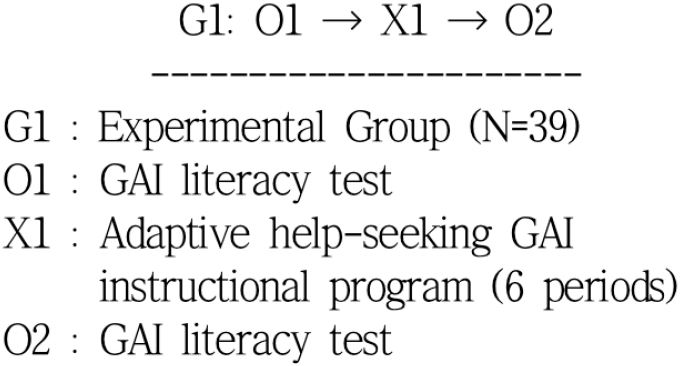
Design of Experiment
4.2 Measurement instrument
To measure the effects of the study, a GAI literacy measurement instrument designed for elementary school students [31] was utilized for both the pretest and posttest. Through two rounds of Delphi surveys, the instrument exceeded the Content Validity Ratio (CVR) threshold and demonstrated an overall reliability (Cronbach's α) of .987, confirming its validity for measuring GAI literacy. Furthermore, this instrument defines GAI literacy as the competency to understand the concepts and technologies of GAI, possess an ethical and critical attitude, and utilize GAI for problem-solving, communication, and collaboration [31]. Based on this definition, it was determined that the instrument perfectly aligns with the educational effects this study aims to measure through its intervention; therefore, it was selected as the measurement tool.
The detailed measurement domains of the instrument are structured as follows: The 'Perception' domain measures the understanding of the characteristics and principles of GAI, while the 'Critical Understanding and Evaluation' domain assesses the methods and attitudes toward utilizing GAI critically. The 'Problem Solving' domain measures the ability to resolve problems utilizing GAI, and the 'Communication' domain evaluates whether effective strategies are employed when communicating with GAI. The 'Collaboration' domain inquires about the methods and attitudes regarding cooperation with GAI during problem-solving, and the 'Ethics' domain asks whether the ethical principles that must be adhered to when using GAI are properly recognized and practiced. The reliability analysis of this study showed that the Cronbach's α values for all sub-factors were .80 or higher, confirming that the measurement instrument secured a high level of internal consistency. The measurement domains, the number of items, and the reliability values (Cronbach's α) of the instrument are presented in Table 9.
The Components of GAI Literacy Test)
4.3 Analysis of the Effects on GAI Literacy
To verify the effects of this study, the students' GAI literacy was measured before and after the educational intervention, and the measurement results were analyzed using IBM SPSS 26. The GAI literacy scores before and after the application of this study are presented in Table 10. GAI literacy increased from 3.23 prior to the program application to 3.80, and the results of the paired t-test confirmed that this increase in the mean score was a statistically significant change (t=3.683, p< 0.01). The effect size (Cohen’s d) was 0.77, indicating a medium-to-large effect on the improvement of GAI literacy.
Paired t-test Result of GAI Literacy
To analyze the changes in the sub-factors of GAI literacy, a paired t-test was conducted for each sub-factor, and the results are presented in Table 11.
Paired t-test Result of GAI Literacy
According to the analysis results, the mean scores of all sub-factors significantly increased statistically in the posttest compared to the pretest. In particular, large effect sizes were observed for the perception of GAI (d = 0.83) and critical understanding and evaluation (d = 0.87). Medium-to-large effect sizes were also confirmed in problem-solving (d = 0.62), communication (d = 0.76), collaboration (d = 0.59), and ethics (d = 0.70).
4.4 Thematic Analysis of Learners' Adaptive Help-Seeking Process
In order to empirically investigate the internal mechanisms driving the improvement in GAI literacy, this study collected and conducted a thematic analysis on the conversation log data of the learners who participated in the program. To ensure the validity and reliability of the analysis, the first author conducted the initial coding and categorization on the entire volume of collected log data, and the corresponding author subsequently cross-checked the data to finalize the themes. As a result of the analysis, the tendencies demonstrating adaptive help-seeking were categorized into three main themes and five sub-themes. The representative quotes and frequencies for each category were derived as shown in Table 12.
Results of Thematic Analysis of Interaction Log
In ‘Awareness and Specification of Cognitive Impasse’ (Theme 1), learners demonstrated the ability to communicate their cognitive impasses and explicitly specify the help they wished to receive. They recognized their current learning progress and restricted their requests to the GAI to specifically target the areas where they needed help, as seen in prompts such as, “I have decided what to write in the introduction, but I don't know what format to use,” or “I think the behavior of Minsu's parents constitutes child abuse, but I don't know what data to present to persuade them. Can you provide some data?”
In ‘Proactive Information Exploration and Contextual Application’ (Theme 2), learners communicated to proactively explore information for problem-solving and apply it appropriately to their writing, using prompts like, “Find other ways for Minsu's parents to earn income,” or “The Personal Information Protection Act is difficult to comprehend. Please explain how it can be applied to Minsu's case.” This communication pattern indicates that learners engaged with a clear and specific purpose to accomplish their tasks. Furthermore, considering the interactions where they applied general and abstract legal concepts to the specific problem situations they faced, this can be viewed as the utilization of proactive and contextualized prompts.
In ‘Critical Internalization and Elaboration of Acquired Information’ (Theme 3), patterns of critical information exploration and logic expansion aimed at elaborating the outcomes were identified. Learners explored viewpoints opposing their own by stating, “Tell me the arguments that can be made from the perspective of supporting the video should be posted,” and enhanced the quality of their results by incorporating critical content that refuted those counterarguments into their writing. In addition, they requested logical expansion after declaring their already constructed knowledge structures, asking, “As supporting evidence, I wrote about the rights Minsu had infringed upon and the fact that he could get hurt in his peer relationships. Are there any other problems I can argue besides these?” Moreover, they attempted rhetorical elaboration by considering the expected audience of their writing, asking, “How should I write to emphasize my argument to Minsu's parents?” These processes demonstrate that the learners restructured and updated their own knowledge while navigating the task-solving process.
5. Discussion
The prompt engineering education based on adaptive help-seeking proposed in this study was accompanied by a significant improvement in the GAI literacy of elementary school students, exhibiting a medium-to-large effect size (d = 0.77). Due to the characteristics of the one-group pretest-posttest design, it is difficult to determine a definitive causal relationship. However, these results suggest that this study is positively associated with enhancing elementary school students’ understanding of GAI, critical attitudes, and their problem-solving and communication skills. The subsequent analysis of the results, integrated with the qualitative analysis, provides a deeper understanding of the underlying educational mechanisms.
The sub-factor analysis revealed large effect sizes in the perception of GAI (d = 0.83) and critical understanding and evaluation (d = 0.87). Although a direct statistical causal relationship at the individual student level cannot be definitively established, the thematic analysis results observed at the group level provide useful contextual evidence for understanding the background of this numerical improvement. As confirmed in Theme 3, 28 students (72%) demonstrated patterns of critical internalization of acquired information, such as requesting logical expansion after declaring their existing knowledge structures or formulating inquiries considering their expected audience. This indicates that learners tended to utilize GAI as a tool for critical reflection to refine their writing, rather than uncritically accepting its responses.
Additionally, the effect sizes confirmed in the domains of communication (d = 0.76), problem-solving (d = 0.62), and collaboration (d = 0.59) can also be interpreted complementarily alongside the learners' proactive information exploration and contextualization utterance patterns. All learners (100%) diagnosed their cognitive impasses, and 30 students (77%) attempted to apply abstract concepts to their own specific contexts through constraint-based prompts. This demonstrates that the educational intent—for the majority of learners to move away from simple executive help-seeking aimed at obtaining complete answers and instead utilize GAI as a collaborative partner in problem-solving—was successfully manifested in practice.
The ethics factor (d = 0.70) also demonstrated meaningful improvement. This reflects the formation of a critical awareness regarding the tendency to rely on outputs, given that the GAI design used in this study restricted the direct generation of results. This approach reaffirmed to the learners that they are the primary agents of task resolution, effectively limiting the role of GAI to that of an assistant. Ultimately, these results align with previous literature emphasizing that when help-seeking is appropriately structured in interactive learning environments, it can foster self-regulated learning competencies and effectively mitigate the risks of cognitive offloading.
6. Conclusion
This study developed prompt engineering strategies and instructional program based on adaptive help-seeking and verified their effectiveness by applying them to elementary school students. The results showed that the elementary school students' GAI literacy improved with statistical significance, exhibiting a medium-to-large effect size. All sub-factors also improved with statistical significance, among which the perception of GAI and critical understanding and evaluation demonstrated large effect sizes. This implies that the prompt strategies based on adaptive help-seeking were effective in enabling learners to utilize GAI more autonomously and to perceive and apply its responses critically[32, 33]. By using GAI as a cognitive assistant, this approach helps learners grow into active and self-directed problem solvers.
However, this study has the following limitations and subsequent research is suggested to address them. First, this study only verified the practical effectiveness of the developed prompt strategies for external validation through a one-group pretest-posttest experimental design, but failed to verify whether there is a significant educational effect compared to a group using conventional prompt strategies. Furthermore, relying on a sample from a single class, there is a limitation in that it could not quantitatively measure the learners' prior experiences with GAI to control for them as covariates. Therefore, future research must establish experimental and control groups across varying educational contexts and conduct rigorous cross-validation studies comparing the effects of different prompt engineering strategies while controlling for prior AI experience as a covariate.
Second, this study primarily measured the change in GAI literacy, the outcome variable, and had limitations in comprehensively verifying the process variable—specifically, whether all learners actually executed adaptive help-seeking behaviors. Although the positive mechanisms of adaptive help-seeking were confirmed through the qualitative analysis, future studies should employ mixed-methods research or learning analytics to systematically track the prompt patterns and interaction logs of all learners and empirically verify the procedural evidence.
Third, there is a need to develop dedicated tools that allow interactions with GAI based on adaptive help-seeking strategies. To use GAI based on adaptive help-seeking strategies, a GAI that restricts executive help-seeking is essential. Because general-purpose GAIs readily provide executive help indiscriminately even when not explicitly requested, customized tools are required in educational settings to promote students' cognitive development rather than providing correct answers and outputs, based on the principles of adaptive help-seeking.
In conclusion, this study developed GAI prompt engineering strategies and an educational program based on adaptive help-seeking to empower learners to actively and autonomously request help during their interactions with GAI. It is expected that this study will serve as a practical guideline suggesting the potential for the educational use of GAI in school environments.
References
- Korea Press Foundation. (2025). 2025 Survey on Media Usage Among Teenagers. Korea Press Foundation. https://www.kpf.or.kr/front/research/consumerDetail.do?miv_pageNo=&miv_pageSize=&total_cnt=&LISTOP=&mode=W&seq=600223
- Seoul Metropolitan Office of Education Education Research & Information Institute. (2025). A Study on the Current Status and Needs of Educational Utilization of Generative AI. Seoul Metropolitan Office of Education Education Research & Information Institute. https://www.serii.re.kr/fus/MI000000000000000493/board/BO00000341/ctgynone/view0010v.do?board_seq=5530
- National Information Society Agency. (2024). 2024 Digital Competency Diagnosis and Analysis Report. National Information Society Agency. https://www.nia.or.kr/site/nia_kor/ex/bbs/View.do?cbIdx=99870&bcIdx=27869&parentSeq=27869
-
Ahn, S., Lee, J., Park, J., Jung, S., & Song, J. (2024). A Scoping Review on the Educational Applications of Generative AI in Primary and Secondary Education. The Journal of Korean Association of Computer Education, 27(6), 11-24.
[https://doi.org/10.32431/kace.2024.27.6.002]

-
Bidjarnian, T., Smith, C., & Carsley, D. (2024). Exploring College Student Engagement with a Generative AI-powered Mental Wellness Chatbot (Wayhaven): A Mixed Methods Pilot Study. JMIR Formative Research, 8, e54407.
[https://doi.org/10.2196/54407]
- Ducharme, J. (2025). ChatGPT May Be Eroding Critical Thinking Skills, According to a New MIT Study. Time. https://time.com/7295195/ai-chatgpt-google-learning-school/
-
Cho, H., & Lee, J. (2024). Study on the Patterns and Attitudes of Elementary School Students in Utilizing Generative Artificial Intelligence in Classroom Settings. The Journal of Korean Association of Computer Education, 27(4), 21-39.
[https://doi.org/10.32431/kace.2024.27.4.003]
-
Gunsaldi, B., Alsaad, A., & Kar, S. (2025). The Impact of Generative AI Applications on Student Learning Outcomes: A Systematic Review. Journal of Education and Learning, 11(3), 196-208.
[https://doi.org/10.55549/jeseh.840]
- Ministry of Education. (2022). 2022 Revised National Curriculum: General Guidelines. Ministry of Education.
-
Gerlich, A. (2025). The Double-edged Sword: Investigating the Impact of AI Tools on Critical Thinking and Cognitive Offloading. Behavioral Sciences, 15(1), 6.
[https://doi.org/10.3390/bs15010006]
-
Zimmerman, B. J. (2002). Becoming a Self-regulated Learner: An Overview. Theory into Practice, 41, 64-70.
[https://doi.org/10.1207/s15430421tip4102_2]
-
Newman, R. S. (2002). How Self-regulated Learners Cope with Academic Difficulty: The Role of Adaptive Help Seeking. Theory into Practice, 41, 132-138.
[https://doi.org/10.1207/s15430421tip4102_10]
- Zimmerman, B. J., & Moylan, A. R. (2009). Self-regulation: Where Metacognition and Motivation Intersect. In Handbook of Metacognition in Education (pp. 299-315). Routledge.
-
Mercier, J., & Frederiksen, C. H. (2007). Individual Differences in Graduate Students' Help-seeking Process in Using a Computer Coach in Problem-based Learning. Learning and Instruction, 17(2), 184-203.
[https://doi.org/10.1016/j.learninstruc.2007.01.013]
-
Fernandez-Castillo, E. (2021). Academic Help-seeking: A Systematic Review. Sustainability, 13(8), 4460.
[https://doi.org/10.3390/su13084460]
-
Volet, S., & Karabenick, S. A. (2013). Help Seeking in Cultural Context. In Help Seeking in Academic Settings (pp. 117-150). Routledge.
[https://doi.org/10.4324/9780203726563]
-
Nelson-Le Gall, S. (1981). Help-seeking: An understudied problem-solving skill in children. Developmental Review, 1(3), 224-246.
[https://doi.org/10.1016/0273-2297(81)90019-8]
-
Aleven, V., Stahl, E., Schworm, S., Fisher, F., & Wallace, R. (2003). Help seeking and help design in interactive learning environments. Review of Educational Research, 73(3), 277-320.
[https://doi.org/10.3102/00346543073003277]
-
Mercier, J., & Frederiksen, C. (2008). The structure of the help-seeking process in collaboratively using a computer coach in problem-based learning. Computers & Education, 51(1), 17-33.
[https://doi.org/10.1016/j.compedu.2007.03.004]
-
Chen, A., Xiang, M., Zhou, J., Jia, J., Shang, J., Li, X., ... & Fan, Y. (2025). Unpacking help-seeking process through multimodal learning analytics: A comparative study of ChatGPT vs Human expert. Computers & Education, 226, 105198.
[https://doi.org/10.1016/j.compedu.2024.105198]
-
Lee, D., & Lee, Y. (2026). A Review of Generative AI-integrated Teaching and Learning Studies in Korea through the PICRAT Model. The Journal of Korean Association of Computer Education, 29(1), 48-57.
[https://doi.org/10.32431/kace.2026.29.1.005]
-
Murphy, R. F. (2025). The Impact of Generative AI on Critical Thinking: A Dual-impact Framework and Research Agenda. Information and Discovery Delivery.
[https://doi.org/10.1108/IDD-05-2025-0125]
-
Talgatov, Y., Kassymova, G.K., Nurtanto, M. (2024). AI in the Classroom: A Boon or a Threat to Pedagogical Practices? Challenges of Science. Issue VII, pp. 128-134.
[https://doi.org/10.31643/2024.19]
- Song, J. (2023). GPT Generation is Coming. Mindset.
- Kim, J., Yoo, W., & Ahn, S. (2023). The Real ChatGPT Utilization Guide. Wikibooks.
-
Baek, Y. (2025). A Study on the Development of an Elementary Generative AI Prompt Engineering Educational Program: Focusing on Art Expression Activities. Art and Education, 26(3), 133-152.
[https://doi.org/10.20977/kkosea.2025.26.3.133]
-
Flavell, J. H. (1979). Metacognition and cognitive monitoring: A new area of cognitive-developmental inquiry. American Psychologist, 34(10), 906-911.
[https://doi.org/10.1037/0003-066X.34.10.906]
-
Aleven, V., Roll, I., McLaren, B. M., & Koedinger, K. R. (2016). Help helps, but only so much: Research on help seeking with intelligent tutoring systems. International Journal of Artificial Intelligence in Education, 26(1), 205-223.
[https://doi.org/10.1007/s40593-015-0089-1]
-
Kwon, E., & Choi, Y. (2025). Analysis of the Effects of Generative AI and Search Engine Utilization on 6th Grade Elementary School Students' Writing: Focusing on the Comparison Between High and Low Writing Level Groups. Journal of Korean Elementary Education, 36(2), 107-137.
[https://doi.org/10.20972/kjee.36.2.202506.107]
-
Polit, D. F., Beck, C. T., & Owen, S. V. (2007). Is the CVI an Acceptable Indicator of Content Validity? Appraisal and Recommendations. Research in Nursing & Health, 30, 459-467.
[https://doi.org/10.1002/nur.20199]
- Jeon, J. (2025). Development of a Teaching-Learning Program and Assessment Tools for Fostering Generative AI Literacy [Master's thesis]. Gyeongin National University of Education Graduate School of Education.
-
Lai, J. W. (2024). Adapting Self-Regulated Learning in an Age of Generative Artificial Intelligence Chatbots. Future Internet, 16(6), 218.
[https://doi.org/10.3390/fi16060218]
- Brooke, S. L. (2006). Using the Case Method to Teach Online Classes: Promoting Socratic Dialogue and Critical Thinking Skills. International Journal of Teaching and Learning in Higher Education, 18(2), 142-149.

· 2013년 광주교육대학교 초등교육(교육학사)
· 2023년 한국교원대학교 일반대학원 초등컴퓨터교육(교육학 석사)
· 2023년~현재 한국교원대학교 일반대학원 컴퓨터교육 박사과정
· 2013년~광주광역시 초등학교 교사
관심분야 : 정보교육, 인공지능교육, 융합교육, 학습과학
gyeomdalee@gmail.com

· 1988년 고려대학교 전산과학과(이학사)
· 1994년 미국 미네소타 대학교 전산학과(Ph.D.)
· 2003년~현재 한국교원대학교 대학원 컴퓨터교육학과 교수
관심분야 : 지능형시스템, 학습과학, 정보교육, 인공지능교육
yjlee@knue.ac.kr