Emotional Dynamics in AI-Supported Collaborative Learning: Linking Achievement Emotions, Team Climate, and Team Performance Among University Students
 ; Anh-Hong Dang††
; 당안홍††
; Anh-Hong Dang††
; 당안홍††
Abstract
This study explored links between achievement emotions and team performance in AI-supported collaborative learning. 336 Vietnamese undergraduates formed 46 teams and completed two ChatGPT-assisted essays, scored with a Team Performance Score rubric. Emotions were measured with AEQ-S and analyzed at individual, team-average, and diversity levels. Results showed enjoyment positively, hopelessness and boredom negatively related to performance, while dispersion of negative emotions correlated with stronger outcomes. Qualitative analysis highlighted emotions as drivers and regulators, and indicated that students perceived ChatGPT as an emotional scaffold. Responsibility emerged as a stabilizing factor. Findings extend Control–Value Theory to team-level AI contexts and suggest design principles for fostering positive emotions and leveraging diversity.
초록
본 연구는 생성형 인공지능 도구 확산이 대학 협력 학습에서 학습자의 정서 경험과 팀 수행에 미치는 영향을 탐색하였다. ChatGPT를 활용한 협력 글쓰기 과제에서 성취 정서와 팀 수행의 관계를 혼합연구방법으로 분석했으며, 베트남 학부생 336명이 46개 팀을 구성해 두 차례 에세이를 수행하였다. 성취정서질문지와 성찰 일지를 통해 개인·팀 평균·팀 내 정서 다양성 수준에서 정서-수행 관계를 검토하였다. 결과적으로 즐거움은 수행과 정적 상관, 무력감과 지루함은 부적 상관을 보였으며, 부정 정서 다양성이 팀 수행을 높이는 가능성을 시사했다. 질적 분석에서는 ChatGPT가 불안을 완화하고 계획을 명료화하는 정서적 스캐폴딩 역할을 한 것으로 학생들이 지각하였으며, 책임감이 새로운 안정화 요인으로 도출되었다. 본 연구는 통제-가치 이론을 AI 지원 협력 학습 맥락으로 확장하며, 정서 다양성 활용과 AI 역할 협상 지침을 제안한다.
Keywords:
achievement emotions, collaborative learning, emotional diversity, generative AI, team performance키워드:
성취 정서, 협력 학습, 정서 다양성, 생성형 AI, 팀 수행1. Introduction
The rapid adoption of generative artificial intelligence (AI) in higher education has transformed how students engage with collaborative academic tasks. Tools such as ChatGPT are now routinely used to support brainstorming, drafting, and revision in team-based writing assignments, prompting growing research interest in the cognitive and performance outcomes of AI-supported collaboration [1-3]. Yet the emotional dimensions of these collaborative experiences remain largely unexamined. This gap is consequential because achievement emotions, discrete affective states tied to academic activities and outcomes, are consistently associated with individual learning behaviors, self-regulation, and academic success [4, 5]. How such emotions operate at the team level, and whether generative AI alters the emotion–performance link in collaborative settings, are questions that the current literature has not adequately addressed.
Achievement emotions are theorized within Pekrun’s [4] Control–Value Theory (CVT), which posits that students’ appraisals of task control and value give rise to emotions that, in turn, are linked to motivation and strategy use. Although these patterns are robust at the individual level, their extension to team-based learning, where emotions are not only intrapersonal but also socially contagious and collectively regulated [6, 7], remains underexplored. Furthermore, the introduction of AI tools into collaborative tasks may alter affective dynamics in ways that existing frameworks have yet to account for: generative AI can scaffold planning and reduce drafting anxiety, but it may also introduce frustration, complacency, or tensions around authorship and agency [1, 8].
The present study addresses these gaps by investigating how university students’ achievement emotions relate to team performance in collaborative writing assignments supported by ChatGPT. Drawing on the AEQ-S [5] and a mixed-methods embedded design [9], we examine the emotion–performance association at multiple levels of analysis and complement statistical findings with students’ own reflections. Four research questions guide the inquiry:
RQ1: How are individual achievement emotions correlated with team performance in ChatGPT-supported assignments? Although CVT predicts that positive activating emotions facilitate individual engagement and, by extension, contribution quality, few studies have tested whether this pattern holds for collaborative outcomes in AI-mediated contexts.
RQ2: How do team-level positive and negative emotions correlate with team performance outcomes? Group-affect theory suggests that a shared “affective tone” influences coordination and collective effort [7]; yet empirical evidence linking aggregated team emotions to performance in AI-supported collaboration is scarce.
RQ3: How is emotional diversity within a team correlated with team performance? Within-team dispersion in emotional states may either broaden perspective-taking and complementary regulation or activate faultlines and process loss [10, 11]. The role of such diversity in technologically mediated teamwork has not been empirically examined.
RQ4: How do students perceive the emotional factors that contributed to their team’s success or struggles? Quantitative correlations reveal which emotions co-vary with performance but not how or why; structured reflective journals capture the mechanisms and contextual nuances that numeric data alone cannot provide [9].
This study contributes by providing preliminary evidence toward extending Control–Value Theory from its traditional individual-level focus to team-level collaborative learning by examining how achievement emotions aggregate and diversify within teams and how these collective emotional properties co-vary with performance. Taken together, these contributions connect research on achievement emotions, team learning, and educational AI — three domains that have largely developed in parallel — and translate findings into actionable design principles for collaborative assignments in AI-supported higher education.
2. Review of Related Literature
This section reviews three interrelated bodies of scholarship that inform the present study: (1) the nature and impact of achievement emotions on learning, (2) emotional dynamics in collaborative and AI-supported learning, and (3) the role of generative AI tools and their association with academic performance and emotion-related processes. Building on these foundations, a final subsection derives the specific patterns expected for each research question.
2.1 Achievement Emotions and Their Impact on Learning
Academic emotions refer to affective responses directly related to academic activities and outcomes. Pekrun’s [4] Control–Value Theory (CVT) provides the dominant framework for understanding these emotions, categorizing them along three dimensions: valence (positive vs. negative), activation (activating vs. deactivating), and object focus (activity vs. outcome). Within this framework, positive activating emotions such as enjoyment and hope are associated with increased intrinsic motivation and deep cognitive engagement, whereas negative deactivating emotions like boredom and hopelessness can lead to disengagement and surface-level processing [5, 12].
Extensive empirical research has established links between specific emotions and learning outcomes. Enjoyment correlates with intrinsic motivation and deep processing strategies [13], while anxiety and shame have been found to interfere with attention, working memory, and performance under pressure [13, 14]. Boredom has consistently been associated with reduced academic success [12]. Meta-analytic reviews confirm that positive activating emotions are linked to stronger achievement, while negative deactivating emotions are associated with avoidance and lower performance [12, 15].
CVT further specifies that emotions arise from students’ appraisals of control over learning activities and the subjective value they assign to tasks [4]. When students perceive high control and high value, they tend to experience enjoyment and hope; when control is low and value is high, anxiety or hopelessness may result. These appraisal–emotion links shape the motivational and self-regulatory pathways through which emotions affect performance, including strategy use, persistence, and cognitive resource allocation [4, 13].
Recent studies have extended these findings beyond individual learners to include the social-emotional influences of peers, instructional design, and contextual variables [16-18]. Nevertheless, most research still prioritizes individual achievement emotions over their function in team-based learning, leaving a significant gap in understanding how individual emotional states collectively relate to collaborative outcomes.
2.2 Emotional Dynamics in Team-Based and AI-Supported Learning
Although individual emotions have been widely studied, research on how emotional dynamics manifest within teams remains limited. In collaborative learning settings, emotional climate, the shared affective tone of a group, can influence team communication, cohesion, and task performance [19]. A positive emotional climate fosters mutual support and creative problem-solving, while negative emotional contagion can impair group functioning [20].
Teams often develop what Barsade and Knight [7] term a “group affective tone”, a relatively consistent emotional atmosphere shaped by members’ interactions, shared goals, and group norms. This collective tone has been shown to influence coordination, persistence, and overall performance. Positive team-level emotions (e.g., collective enjoyment, hope, pride) tend to broaden attention, foster prosocial communication, and sustain effort, thereby enhancing task quality. In contrast, negative deactivating emotions (e.g., collective hopelessness or boredom) are typically linked to disengagement, reduced information exchange, and diminished performance [12, 21]. Importantly, emotions in team settings are not only intrapersonal but also interpersonal: affect is communicated and regulated through verbal and nonverbal cues, shaping collaboration quality and collective efficacy [6, 22].
A distinct but related construct is emotional diversity, the degree to which team members differ in their emotional states. Unlike average team affect, emotional diversity captures within-team dispersion and is typically operationalized as the standard deviation of individual emotion scores [23]. Scholars in organizational psychology and team dynamics conceptualize team emotion not merely as the sum of individual feelings but as an emergent, interaction-driven phenomenon [19, 23].
Empirical findings on emotional diversity are mixed. On one hand, heterogeneity in emotional states may broaden perspective-taking, surface more task-relevant cues, and support adaptive responses, especially when teams possess emotional intelligence and can read and regulate one another’s affective signals [10]. On the other hand, emotional diversity may activate subgroup dynamics or “faultlines,” [24], increase misalignment, and heighten the risk of process loss through miscommunication or conflict [11]. Emotional contagion further complicates this dynamic, as dominant emotions can rapidly spread through a team, amplifying either constructive or counterproductive patterns [6]. In educational contexts, particularly those involving emerging technologies like generative AI, the impact of emotional diversity remains underexplored.
As collaborative learning environments increasingly incorporate AI tools, understanding their impact on team emotions becomes critical. Research into the triadic interaction (learner × team × AI) is still developing, presenting a complex picture of AI’s dual role. On one hand, increased collaboration with AI can reduce human-to-human interaction, potentially leading to negative emotional states like loneliness and fatigue [25]. Conversely, AI systems can be intentionally designed with socio-emotional attributes like empathy and trust to improve collaborative efficiency and foster a positive team climate [26].
2.3 The Role of AI Tools in Supporting Collaborative Academic Tasks
The integration of generative AI tools such as ChatGPT into collaborative academic settings marks a significant shift in how students approach writing, ideation, and peer interaction. Unlike traditional group work that relies solely on human negotiation and distributed expertise, AI-supported collaboration introduces a hybrid model in which machine-generated input becomes part of the dialogic process, sometimes enhancing fluency and clarity, other times complicating authorship and agency. Recent empirical studies have begun to map the cognitive benefits of AI in academic teamwork. Perifanou and Economides [3] observed that students who collaboratively prompted ChatGPT during writing tasks demonstrated improved articulation of complex ideas and greater confidence in their output. Similarly, Kim et al. [2] found that usability and responsiveness were key predictors of students’ perceived academic success when using ChatGPT, particularly in tasks requiring iterative refinement and peer negotiation. These findings suggest that AI tools can support multiple stages of collaborative writing, including brainstorming, outlining, drafting, revising, and editing.
From a cognitive perspective, AI tools help redistribute mental effort by automating lower-level tasks such as grammar correction, citation formatting, and surface-level editing. This allows students to focus more on conceptual development and argumentation, which in turn fosters higher-order thinking and self-efficacy [2]. Yet the emotional and interpersonal dimensions of AI-supported collaboration remain complex. Overreliance on AI may obscure individual accountability and blur the boundaries of intellectual ownership [8]. In group contexts, students have reported tensions around authorship, especially when AI-generated content is unevenly distributed or when its suggestions conflict with group consensus. These dynamics can lead to emotional dissonance, ranging from pride in polished output to frustration over diminished agency or misalignment with personal voice.
Emotionally, AI tools can both buffer and amplify affective responses. On one hand, they reduce stress during early drafting stages by offering immediate feedback and validating student ideas. On the other hand, they may exacerbate confusion or conflict during revision, particularly when team members disagree on how to incorporate AI-generated content. The emotional climate of a group, defined by trust, equity, and openness, can be either supported or undermined by AI, depending on how its role is framed and negotiated within the team.
Recent studies also highlight the emotional dimensions of human–AI interaction more directly. Marrone et al. [27] found that emotional trust, perceived capability, and coordination with AI systems were central to students’ evaluations of AI as a teammate. Similarly, Yin et al. [28] and Mohammed and Khalid [29] report that educational chatbots can evoke distinct emotional responses that influence motivation, engagement, and perceived support. Fang et al. [30] and Elyoseph et al. [31] further underscore how emotion-related uses of AI can influence emotional wellbeing and learning outcomes. These findings collectively indicate that AI tools such as ChatGPT function as both cognitive and affective mediators in collaborative academic contexts, necessitating instructional designs that are emotionally responsive, ethically grounded, and pedagogically intentional.
2.4 Expected Patterns
Drawing on the theoretical and empirical foundations reviewed above, this subsection outlines the expected patterns for each research question.
For RQ1 (individual emotions and team performance), in collaborative contexts, individual emotions matter not only for personal contribution but also for group dynamics, as affect is socially contagious [6]. We therefore anticipate positive associations between individual-level enjoyment, hope, and pride and team performance scores, and negative associations for hopelessness and shame.
For RQ2 (team-level emotions and performance), group-affect theory predicts that team-average positive activating emotions (enjoyment, hope, pride) will be positively associated with team performance through enhanced coordination and prosocial communication, while team-average negative deactivating emotions (hopelessness, boredom) will be negatively associated through disengagement and reduced information exchange [7, 19, 21]. We therefore anticipate that aggregated team emotions will mirror, and possibly amplify, the individual-level patterns predicted in RQ1.
For RQ3 (emotional diversity and performance), the competing theoretical accounts reviewed in Section 2.2 lead to nuanced expectations. Moderate dispersion in certain emotions may broaden perspective-taking and enable complementary role assignments [10], while excessive dispersion, or dispersion in emotions that signal misalignment (e.g., relief, where some members feel relaxed while others remain stressed), may undermine cohesion [11]. In AI-supported collaboration, where tools like ChatGPT can scaffold drafting and reduce cognitive load, within-team emotional diversity may play a particularly complex role. We therefore do not predict a uniform direction for all emotions but expect emotion-specific patterns.
For RQ4 (students' perceived emotional factors), we anticipate that reflective journals will reveal which emotions students experience as energizing, regulating, or obstructive, and how these interact with interpersonal climate and AI-mediated support. We expect students to describe processes of emotional negotiation within their teams [32, 33] and to articulate the dual emotional role of ChatGPT as both a confidence booster and a potential source of frustration [34].
3. Methodology
This study employs a mixed-methods embedded design [9] to investigate how individual academic emotions, measured through the AEQ-S, are associated with collaborative team performance in AI-supported learning environments. A dominant quantitative strand examines correlations between emotional variables and team performance at multiple levels of analysis, while a supportive qualitative strand captures students’ reflective accounts of the emotional mechanisms underlying those associations. The following subsections detail the research design, participant characteristics, instruments, data collection procedures, and analytical approach.
3.1 Research Design
This study employs an embedded mixed-methods design [9] in which a dominant quantitative strand examines bivariate associations between emotional variables and team performance at three levels of analysis (individual, team-average, and within-team diversity), and a supportive qualitative strand captures students' reflective accounts of the emotional mechanisms underlying those associations.
The qualitative strand focuses exclusively on Research Question 4: students’ own interpretations of which emotions energized, regulated, or obstructed their collaboration. Immediately after completing the writing tasks, participants submitted structured reflective journals. A six-phase thematic analysis [35] of these journals yielded narrative themes that explain the mechanisms behind the quantitative correlations.
Following an interpretive integration approach [9, 36], quantitative correlations and qualitative themes are woven together in the Discussion to reveal not only which emotions co-vary with higher team scores, but also why and how those emotions matter in AI-mediated collaborative learning (Figure 1).
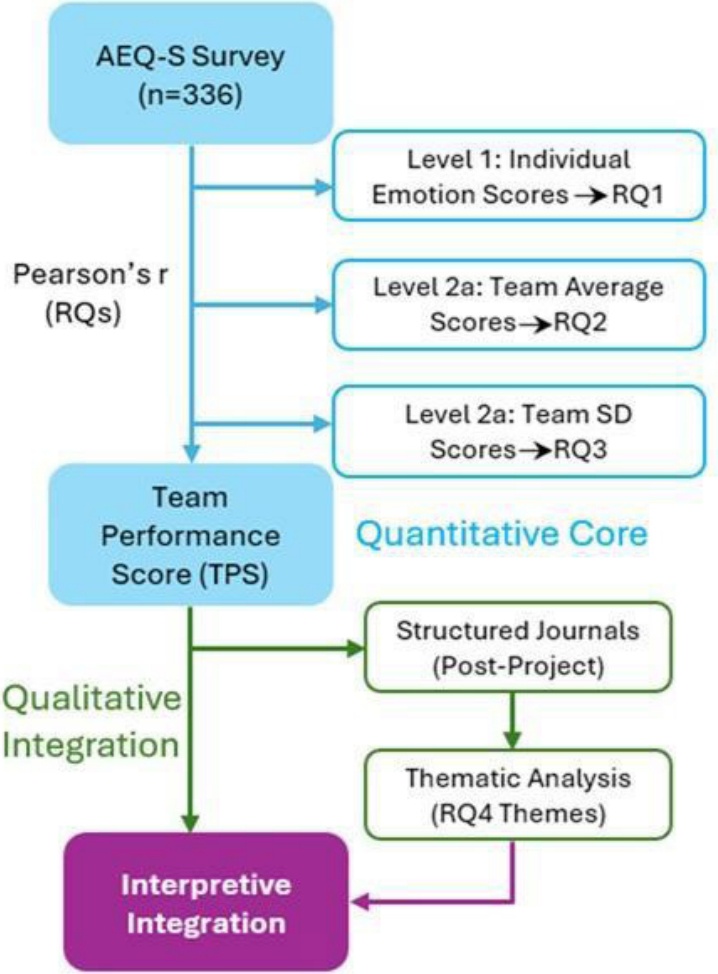
Embedded Mixed-Methods Design Framework
3.2 Participants
A total of 336 undergraduates (83 male, 253 female) enrolled in the Effective Study Skills module at a large public university in Vietnam participated in this study. They came from eight intact course sections and self-organized into 46 teams, each comprising approximately seven members. Teams remained intact for the duration of two sequential writing projects. The sample size was determined by enrollment in the participating intact course sections, consistent with a naturalistic instructional setting.
Students represented 11 academic majors. The largest groups were Primary Education (29.2%), English (16.1%), Chemistry (10.7%), and Literature (7.4%), followed by Early Childhood Education and Mathematics (each 6.0%), Information Technology (5.7%), Geography (5.1%), and smaller numbers in Korean, Japanese, and Chinese (each under 5.0%). Before beginning their team assignments, all participants completed a background survey capturing gender, major, GPA, prior experience with AI tools (especially ChatGPT), comfort with team-based learning, weekly self-study habits, and preferred study methods. These measures were collected for descriptive reporting but did not influence team formation or instructional procedures.
3.3 Instruments
Four primary instruments were employed: a background survey, the AEQ-S, a structured reflective journal, and two sequential team-based writing tasks.
A structured background survey was administered at the outset of the study to collect contextual and demographic information. This self-report included ten close-ended items organized into four thematic areas: demographic profile, AI familiarity and usage, study habits with AI, and perceived usefulness of AI tools in academic contexts.
The AEQ-S [5], administered in Vietnamese using a translation prepared through a forward–back-translation procedure and reviewed for cultural appropriateness by bilingual researchers familiar with the Vietnamese higher education context, is a validated self-report instrument designed to assess students’ academic emotions across three domains: class-related, learning-related, and test-related experiences. Grounded in Control–Value Theory, the AEQ-S measures eight emotions within each domain. Class-related and learning-related emotions include enjoyment, hope, pride, anger, anxiety, shame, hopelessness, and boredom. The test-related domain replaces boredom with relief. Each emotional construct is measured with four items per domain, yielding a total of 96 items — a reduced set compared to the full AEQ, which contains up to 232 items with varying numbers of items per scale [5]. Students rate each item on a 5-point Likert scale (1 = strongly disagree to 5 = strongly agree). The AEQ-S has demonstrated strong internal consistency in the original validation study (Cronbach’s α typically > .75) and construct validity consistent with CVT predictions.
The AEQ-S was administered in Week 1, before team formation and the collaborative writing tasks. The resulting scores therefore represent students' emotional dispositions toward academic work rather than state emotions experienced during the team projects themselves. This pre-task measurement was a deliberate design choice to ensure temporal precedence of emotional variables relative to the performance outcome, thereby strengthening the interpretive basis for the correlational analyses. Composite scores for each emotion were calculated by summing the relevant items across the domains in which that emotion appears (12 items for the seven emotions — enjoyment, hope, pride, anger, anxiety, shame, and hopelessness — that appear in all three domains, yielding a possible range of 12–60; 8 items for boredom, which appears in two domains, yielding a range of 8–40; and 4 items for relief, which appears in one domain, yielding a range of 4–20).
The reflective journal was a structured qualitative instrument with standardized prompts aligned with the four research questions. Four thematic sections addressed: (1) personal emotional experiences, (2) perceived team emotional climate, (3) awareness of emotional variation among teammates, and (4) perceptions of which emotions contributed most to team success or struggle. Students were instructed to respond individually and concisely, focusing on actual emotional experiences.
Two sequential, team-based academic writing tasks served as the performance measure. Project 1 (Issue Exploration Essay, Week 4) required each team to collaboratively write a short argumentative essay on a current educational issue. Project 2 (Position Paper, Week 5) extended the same topic into a full-length argumentative essay of 1,000–1,200 words. Teams were encouraged to use ChatGPT throughout the writing process. The task design, evaluation rubric, scoring procedures, and weighting are detailed in Section 3.4.
3.4 Data Collection and Procedure
Data collection was conducted over a five-week instructional period and was structured to align with the embedded mixed-methods design. All instruments and procedures were administered digitally.
Week 1: Initial Measures. Students completed the background survey and the AEQ-S. All 336 participants provided complete responses with no missing data. Immediately following the AEQ-S administration, students were introduced to ChatGPT (GPT-4) and its integration into upcoming team projects. They were informed that they could use the tool freely across all phases of the writing process, including brainstorming, outlining, drafting, revising, and information retrieval. To document actual usage patterns, students reported the phases in which they used ChatGPT and how they incorporated its outputs in the background survey and reflective journals. As summarized in Section 4.1 (Table 1), the most common uses were information search (88.7%) and self-study (75.0%), and 78.3% of students reported reading, modifying, and integrating AI-generated text into their own writing rather than copying it directly. These figures indicate that AI outputs were typically mediated by student revision rather than adopted verbatim. Students then self-organized into 46 teams of approximately seven members each.

Purposes for Using AI Tools and Approaches to Handling AI-Generated Responses(n = 336)
Week 4: Project 1: Issue Exploration Essay. Each team selected a current and debate-worthy issue in the field of education relevant to their major or collective interests and collaboratively wrote a short argumentative essay. The goal was to identify key perspectives surrounding the issue and articulate the team’s preliminary stance, supported by evidence and organized structure.
Week 5: Project 2: Position Paper on an Educational Controversy. Teams expanded upon or refined the same topic from Project 1 by developing a more comprehensive argumentative essay (1,000–1,200 words). This essay required teams to take a firm position, provide stronger evidence, incorporate counterarguments, and demonstrate deeper engagement with academic writing conventions.
Evaluation and Scoring. A single, unified rubric was applied to evaluate both writing tasks. The rubric comprised five criteria: (1) clarity and relevance of the topic, (2) quality of argument structure and logical progression, (3) integration of evidence and use of sources, (4) collaboration and equal contribution among team members, and (5) clarity of language, formatting, and academic tone. Because the rubric weighted argumentation, evidence integration, and equitable collaboration alongside language quality, scores were not driven by surface fluency alone. Moreover, as all teams had equal access to ChatGPT, any AI-derived linguistic polish constituted a common condition rather than a between-team confound; differences in TPS therefore reflect variation in collaborative and argumentative quality rather than differential access to AI phrasing. Each criterion was assessed on a 20-point scale, and the five scores were summed to produce a single project score (range: 0–100). Project 1 contributed 40% and Project 2 contributed 60% toward the final Team Performance Score (TPS), calculated as: TPS = (Project 1 score × 0.40) + (Project 2 score × 0.60). All essays were scored independently by two trained raters (intra-class correlation coefficient = .93), who subsequently met to resolve any remaining discrepancies and finalize consensus scores. These composite scores served as the team-level dependent variable in the quantitative analyses.
3.5 Data Analysis
The analysis was structured in two complementary components aligned with the mixed-methods design: a quantitative component addressing RQ1–RQ3 and a qualitative component addressing RQ4.
Preliminary checks. Descriptive counts and percentages were first used to summarize the background survey. Means, standard deviations, and Cronbach’s alpha coefficients were calculated for each of the nine aggregated AEQ-S emotion scales to verify internal consistency. Intra-class correlation coefficients (ICCs) were computed for each emotion scale; ICCs ranged from near zero (Anxiety, Shame) to .67 (Hopelessness) (see Table 3), with seven of nine emotions exceeding the .05 threshold commonly used to justify aggregation [37]. The low ICCs for Anxiety and Shame indicate minimal between-team variance for these emotions, and their team-level results should be interpreted with caution.
Descriptive Statistics, Internal Consistency, and Intra-Class Correlations for AEQ-S Emotion Scales and TPS
RQ1: Individual emotions and team performance. Pearson correlation coefficients were calculated between each student’s AEQ-S score and that student’s team’s composite Team Performance Score (0–100). Because students were nested within 46 self-selected teams, cluster-bootstrapped confidence intervals (2,000 resamples at the team level) accompanied each r-value, ensuring that p-values and intervals accounted for intra-team dependence.
RQ2: Team-level emotions and performance. Individual AEQ-S scores were averaged within each team to produce nine team-mean emotion variables (e.g., Team_Enjoyment, Team_Hope). Pearson correlations between these team-level averages and TPS were computed at the team level of analysis (N = 46 teams), with each team contributing a single observation. Two composite indices, a positive activating index (mean of Team_Enjoyment, Team_Hope, Team_Pride) and a negative index (mean of Team_Hopelessness, Team_Boredom), were also calculated for descriptive robustness checks, though primary inferences rely on the individual team-emotion correlations.
RQ3: Emotional diversity and performance. Within-team standard deviations of each AEQ-S emotion were computed to index dispersion. Pearson correlations between these diversity measures and TPS were calculated at the team level of analysis (N = 46 teams), consistent with the team-level operationalization of both variables. Scatterplots were inspected and quadratic terms tested exploratorily, but final reporting remains on the bivariate Pearson r for consistency with the study’s correlational scope.
The qualitative strand employed Braun and Clarke’s [35] six-phase Thematic Analysis to investigate students’ self-reported emotional experiences: (1) familiarization with the data through repeated reading of all journal entries; (2) systematic initial coding of meaningful text segments, capturing both explicit emotion terms and implicit references to emotional states or regulation strategies; (3) searching for themes by grouping related codes into broader conceptual categories; (4) reviewing themes to ensure internal coherence and alignment with the dataset; (5) defining and naming themes; and (6) producing the thematic narrative integrating themes into a coherent account.
A hybrid coding strategy was adopted. Deductive codes were derived from the four research questions to ensure the analysis addressed the study’s conceptual focus. In parallel, inductive codes emerged from the data, allowing unanticipated but salient emotional patterns to be incorporated. The coding framework reflected four primary analytic domains: personal emotional trajectories across the project timeline, perceived emotional tone or climate within teams, awareness and interpretation of emotional differences among teammates, and beliefs about which emotions enhanced or hindered team performance. All qualitative data were managed and analyzed using NVivo software, which facilitated systematic coding, transparent documentation of analytic decisions, and efficient cross-case comparisons. Coding was conducted by a single researcher, with regular peer debriefing sessions to challenge interpretations, refine theme definitions, and ensure analytic rigor. These themes were then grouped into three higher-order categories (emotions as engagement drivers, emotions as regulatory forces, and the emotional role of AI) based on their functional relationship to team performance. Peer debriefing was conducted with two colleagues experienced in qualitative research at three points during the analysis — after initial coding, after theme identification, and after final theme refinement — to verify interpretive consistency and challenge alternative readings of the data.
3.6 Ethical Considerations
This study was approved by the Research Ethics Committee of Ho Chi Minh City University of Education. All students provided informed consent by voluntarily completing the background survey and AEQ-S after receiving an information sheet detailing the study's aims, procedures, and the voluntary nature of participation. Participants could decline any question or withdraw at any time without penalty.
To safeguard confidentiality, each participant was assigned a unique numeric code. Identifying details were stored separately from research data, and all digital files were restricted to the core research team. Journal excerpts used in reporting have been anonymized.
In accordance with ethical guidelines [38, 39], all raw data will be retained securely for five years following publication and then permanently deleted. All reported quotations are fully de-identified.
4. Findings
This section presents the quantitative results (RQ1–RQ3, Sections 4.2–4.4) with brief qualitative illustrations, followed by the systematic thematic analysis of reflective journals (RQ4, Section 4.5).
4.1 Participants’ Background and AI Experience
A total of 336 students participated in the study. Most were already familiar with AI-based applications: 99.4% reported using them at least occasionally, and 61.6% did so weekly or more.
When asked how they handle AI-generated content, students showed a strong tendency toward critical engagement. As shown in Table 1, 78.3% reported that they read, modified, and integrated AI-generated text into their own writing before use.
Table 1 also shows the main purposes for which students use AI tools. The most common use was searching for information (88.7%), followed by self-study (75.0%), data analysis (73.5%), and completing assignments (62.5%). Preparing presentations (49.1%) was the least common, suggesting that students primarily rely on AI for individual learning and analytical support rather than for communication or presentation tasks.
Table 2 presents a cross-tabulation of AI usage frequency and perceived effectiveness. Among frequent users (n = 207), 95.7% rated AI as moderately effective or better, with 62.8% rating it “extremely effective.” Among rare users (n = 8), only 62.5% reached this threshold. Regarding the stage of AI use, reflective journals indicated that ChatGPT was most frequently employed during early brainstorming and outlining, and during language-level revision, whereas decisions about argument structure and final wording were typically negotiated among team members. This pattern suggests that ChatGPT functioned as an idea-generation and language-support aid embedded within, rather than replacing, human collaborative decision-making.
Crosstabulation of AI Usage Frequency and Perceived Effectiveness(n, %)
4.2 Individual Emotions and Team Performance (RQ1)
How are individual achievement emotions correlated with team performance in ChatGPT-supported assignments?
At the individual level, enjoyment showed a robust positive association with TPS, whereas hopelessness and boredom showed robust negative associations. Hope and pride were also positively correlated with TPS, but these relationships were less robust because their cluster-bootstrapped confidence intervals marginally included zero. Thus, the clearest individual-level patterns were observed for enjoyment, hopelessness, and boredom.
Descriptive statistics, internal consistency, and ICC values for all variables are presented in Table 3. As shown in Table 4, positive activating emotions were positively associated with higher team performance scores in the Pearson analyses: enjoyment showed the strongest association (r = .215, p < .001), followed by hope (r = .205, p < .001) and pride (r = .177, p < .01). Conversely, hopelessness showed a strong negative correlation (r = -.389, p < .001) and boredom a moderate negative correlation (r = -.157, p < .01).
Pearson Correlation Coefficients Between Individual AEQ-S Emotions and TPS(N = 336, Individual Level)
Anxiety, anger, shame, and relief did not show statistically significant Pearson associations with TPS.
Enjoyment showed a robust positive association with team performance (cluster-bootstrapped CI excluding zero), while hope and pride were in the expected positive direction but less robust under the clustering criterion (CIs marginally including zero) and are best regarded as suggestive trends. Students reporting stronger hopelessness tended to belong to lower-performing teams; the effect size for hopelessness (r = -.389) is notably larger than for the positive emotions, suggesting that this deactivating emotion may be a particularly strong marker of disengagement in collaborative settings. The positive emotion effects are small to moderate, consistent with prior CVT-aligned research [15].
Reflective journal data offered complementary illustrations. Students frequently reported that enjoyment and pride coincided with greater initiative and ownership, as one participant noted, “Enjoyment helped me generate many ideas and contribute actively to the group.” Conversely, hopelessness was described alongside withdrawal: “I felt overwhelmed and couldn’t keep up. I kind of shut down and let others do most of it.” These qualitative patterns are explored systematically in Section 4.5.
To assess the robustness of these patterns, we computed Spearman rank-order correlations as a non-parametric robustness check. As shown in Table 5, the direction and significance of all Pearson co-efficients were fully reproduced by the Spearman analysis (concordance = 100%), confirming that the observed individual-level associations are not driven by distributional anomalies.
Spearman Rank-Order Correlations Between Individual AEQ-S Emotions and TPS: Robustness Check
4.3 Team-Level Emotional Profiles and Performance (RQ2)
How do team-level positive and negative emotions correlate with team performance outcomes?
Team-level AEQ-S scores were computed by averaging each emotion scale across team members (N = 46 teams). With df = 44, an absolute r of approx-imately .291 is required for p < .05, so only large effects reach significance. As displayed in Table 6, enjoyment (r = .354, p < .05), hopelessness (r = -.489, p < .001), and boredom (r = -.315, p < .05) were significant. Pride (r = .252) and hope (r = .285) trended positively but did not reach significance. Shame, anxiety, anger, and relief were non-significant.
Pearson Correlation Coefficients Between Team-Level Emotion (TLE) Scores and TPS(N = 46, Team Level)
With only 46 teams, only the largest effects reached significance. Hopelessness emerged as the most robust negative correlate at both levels (individual r = -.389; team r = -.489). Among positive emotions, only enjoyment reached significance at the team level, with pride and hope trending in the expected direction. Boredom was significantly negative at both levels (individual r = -.157; team r = -.315).
The magnitude of the hopelessness correlation (r = -.489) warrants interpretive caution. This effect is substantially larger than the other team-level correlations (|r| = .13 - .35; see Table 7), which may indicate either that higher team-average hopelessness is a particularly potent correlate of lower team performance, or that a small number of teams with very high hopelessness and very low performance may have exerted disproportionate leverage on this estimate. Given the small number of Level-2 units (N = 46), this correlation should be interpreted as suggestive and in need of replication with larger samples.
Pearson Correlation Coefficients Between Team-Level Emotional Diversity Scores and TPS(N = 46, Team Level)
Reflective journal data aligned with these patterns.
Students in higher-performing teams described contagious enthusiasm: “Our excitement was contagious — when someone hit a milestone, we all felt proud and kept pushing.” Conversely, teams with higher average hopelessness scores were associated with passivity: “Once we convinced ourselves we were behind, no one tried to take charge.” These qualitative mechanisms are examined in detail in Section 4.5.
4.4 Emotional Diversity and Team Performance (RQ3)
How is emotional diversity within a team correlated with team performance?
Within-team standard deviations of individual AEQ-S scores were calculated to index emotional diversity across each of the nine emotions. Because both the diversity scores (team-level SD) and TPS are team-level variables, correlations were computed at the team level of analysis (N = 46 teams). As shown in Table 7, greater diversity in several negative emotions was significantly and positively associated with TPS: boredom diversity showed the strongest correlation (r = .467, p < .01), followed by shame (r = .366, p < .05), anxiety (r = .320, p < .05), and hopelessness (r = .310, p < .05). Anger diversity was in the expected positive direction but did not reach significance (r = .126).
Diversity in positive emotions — enjoyment (r = −.141), hope (r = −.104), pride (r = −.021) — and relief (r = −.050) showed no significant correlations with TPS. This asymmetric pattern is consistent with the complementary regulation perspective [10]: students' reflections suggest that members differing in negative affect may gravitate toward different functional roles, with less anxious members taking visible tasks and more anxious members contributing through careful, detail-oriented work. These findings challenge the assumption that emotional similarity is always beneficial for teamwork. Instead, certain forms of emotional diversity, particularly in negative or activating states, coincided with stronger team performance, potentially reflecting complementary role allocation and broader perspective-taking. Diversity in positive emotions and relief showed no significant relationship to outcomes. These emotion-specific patterns correspond to the nuanced expectations outlined in Section 2.4 and support the view that emotional diversity can function as either a resource or a risk depending on the specific emotion and the team’s capacity to integrate diverse affective states [10, 11].
Reflective journals provided insight into these mechanisms. Students described how emotional differences could translate into complementary roles, “The confident people inspired us, and the careful ones prevented mistakes”, but also noted risks of unmanaged diversity, “Some members were overly positive, giving ideas without listening, and others were too negative, afraid of being judged.” These dynamics are explored in Section 4.5.
4.5 Students’ Reflections on Emotion–Performance Mechanisms (RQ4)
How do students perceive the emotional factors that contributed to their team’s success or struggles?
The systematic thematic analysis of 336 reflective journals, following Braun and Clarke’s [35] six-phase framework with hybrid deductive-inductive coding, yielded seven interrelated themes organized into three overarching categories: emotions as engagement drivers, emotions as regulatory forces, and the emotional role of AI. Together, these themes provide the qualitative mechanisms underlying the quantitative associations reported in Sections 4.2–4.4. These relationships are visually summarized in Figure 2.
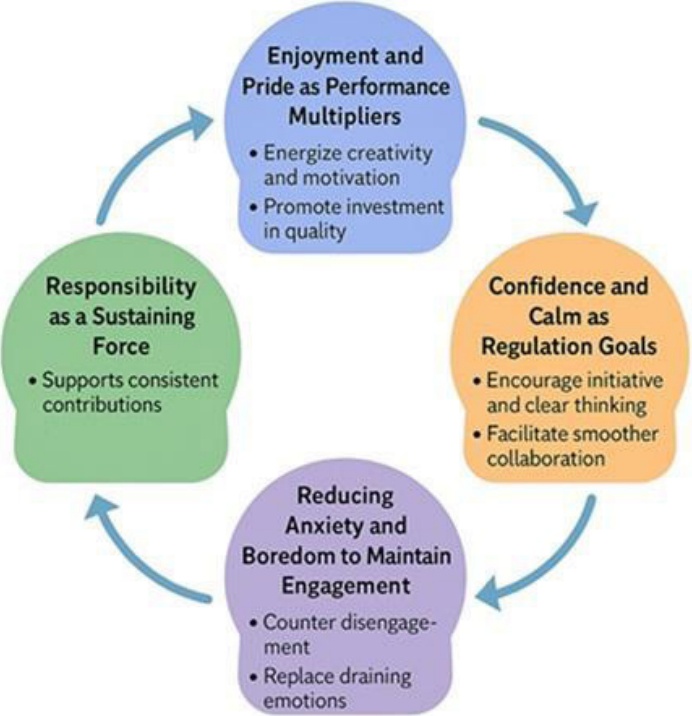
Key Emotional Themes Influencing Collaborative Performance
Theme 1: Enjoyment and pride alongside active participation. Enjoyment and pride were the most frequently cited emotions associated with active engagement. Enjoyment was described as coinciding with creativity, idea-sharing, and sustained motivation, while pride in one’s contributions was linked to attention to quality and willingness to take on challenging tasks. As one student put it, “Enjoyment made me more proactive and engaged in group work,” while another reflected, “Pride in my part made me want to produce the best work possible.” These accounts suggest that when students experience both pleasure in the process and satisfaction in their output, they tend to invest greater effort. This theme mirrors the positive individual-level associations between enjoyment, hope, pride, and TPS (Table 4) — with enjoyment the most robust — and the corresponding team-level patterns (Table 6).
Theme 2: Collective hopelessness and diminished performance. Collective hopelessness emerged as the most debilitating emotional pattern in students’ narratives, in line with its notably strong negative correlation with TPS at the team level (r = −.489). Students described a cascade effect: once a sense of futility set in, initiative declined across the team. One participant explained, “Once we convinced ourselves we were behind, no one tried to take charge, we all just waited for someone else to fix it.” Another described the spreading nature of the emotion: “When some members became hopeless, it spread to everyone.”
Theme 3: Disruptive tension through anger and boredom. In teams where anger or boredom ran high, students reported friction, off-task behavior, or passive withdrawal. As one participant recalled, “We argued over every detail, and some of us just tuned out until it blew over.” These accounts are consistent with the significant negative team-level correlation for boredom (r = −.315, p < .05; Table 6). Although anger did not reach significance at the team level (r = −.098), qualitative reports suggest that interpersonal friction, even when not statistically detectable in the aggregate, can undermine cohesion within specific teams.
Theme 4: Negative emotions and compensatory effort. Negative emotions, when experienced at moderate and manageable levels, sometimes coincided with increased effort. Feelings such as guilt over low early contributions or mild anxiety before deadlines were described as prompting harder work: “At first, I didn’t contribute much and felt bad about it. But I knew I had to make up for it, so I stayed late to finish my part.” This theme provides context for the non-significant individual-level correlation between anxiety and TPS (Table 4): anxiety may have functionally ambivalent associations with performance, energizing some students while paralyzing others.
Theme 5: Responsibility as a sustaining force. Responsibility emerged as a stabilizing factor that maintained performance even when positive emotions were low. Students framed it as a duty to the team that ensured timely and complete contributions regardless of mood. One participant explained, “Even when I wasn’t excited, I still finished my tasks because I didn’t want to let the team down.” This sense of obligation appeared to act as a safety net, sustaining productivity through emotional fluctuations. Responsibility is not measured by the AEQ-S, yet it surfaced prominently in the journals, suggesting it may function as an important moderating mechanism between emotional states and behavioral output.
Theme 6: Complementary regulation through emotional diversity . Students described how emotional differences served a regulatory function when managed inclusively. "The confident people inspired us, and the careful ones prevented mistakes," one student explained. However, unmanaged differences could lead to disengagement: "Some members were overly positive, giving ideas without listening, and others were too negative, afraid of being judged." This theme aligns with the positive correlations between diversity in negative emotions and TPS (Table 7), suggesting that emotional diversity functions as a resource when teams actively manage their members' differences.
Theme 7: ChatGPT as perceived emotional scaffold. Several students highlighted the role of ChatGPT in their emotional experience during collaboration. Positive reports described the tool as providing structure, language support, and validation that was associated with greater confidence and reduced stress: “I was nervous at first, but ChatGPT helped me organize my ideas. It made writing less scary.” For some, the tool appeared to lower the threshold for participation by helping students articulate ideas they might otherwise have hesitated to share. These accounts reflect students' subjective perceptions rather than measured effects of the tool; because the present design is correlational, they should not be read as evidence that ChatGPT causally produced these emotional changes. However, a minority of students noted frustration when AI-generated content did not align with the team’s direction or voice, or when team members relied on it unevenly.
5. Discussion and Conclusions
This section synthesizes the study’s quantitative and qualitative findings by interpreting them in light of Control–Value Theory and group-affect frameworks, translating the integrated results into theoretical contributions and practical recommendations, acknowledging the study’s methodological and contextual limitations, and suggesting avenues for future research.
5.1 Discussion of Findings
The positive associations between individual-level enjoyment, hope, and pride and team performance are broadly consistent with CVT's predictions that positive activating emotions are associated with deeper engagement and more strategic effort [4]. Among these, enjoyment showed the most robust individual-level association (cluster-bootstrapped CI excluding zero), while hope and pride were in the expected positive direction but less robust under the clustering criterion — a pattern consistent with their suggestive status at the team level as well. These findings provide preliminary evidence relevant to extending the well-established individual-level pattern [12, 15] to collaborative outcomes in AI-supported settings: students whose emotional dispositions were more positive tended to be members of teams that achieved higher performance scores. The negative correlations for hopelessness and boredom are congruent with prior work linking negative deactivating emotions to avoidance behaviors and reduced persistence [4, 13].
The qualitative data added an important nuance. Students reported that mild anxiety sometimes coincided with compensatory effort, double-checking work, staying late to complete tasks, echoing Pekrun et al.’s [13](2002) observation that anxiety can be associated with self-regulatory mobilization at moderate levels. This may explain why anxiety showed a non-significant correlation with TPS at the individual level: its relationship with performance appears to be functionally ambivalent, energizing some students while inhibiting others.
Responsibility, a construct not measured by the AEQ-S, surfaced prominently as a stabilizing mechanism that sustained contributions even when positive emotions were low. This finding suggests that future research on emotions in collaborative learning should consider duty-based motivational states alongside hedonic and evaluative emotions.
At the team level, the pattern of positive correlations for enjoyment, hope, and pride and negative correlations for hopelessness, boredom, and anger echoes Barsade and Knight’s [7] notion of “group affective tone.” Teams whose members had higher positive emotional tendencies tended to achieve stronger performance, as reflected in participants’ descriptions of contagious enthusiasm and mutual encouragement. Conversely, even moderate collective levels of anger or boredom corresponded with interpersonal friction and disengagement, consistent with Jordan and Troth’s [20] findings on tension in emotionally charged teams.
The emotional diversity results contribute to the ongoing debate in organizational psychology about whether within-team heterogeneity in affect helps or hinders performance. The finding that diversity in several negative emotions (boredom, shame, anxiety, hopelessness) was significantly and positively correlated with TPS — meaning greater dispersion was associated with higher performance — is consistent with the complementary regulation perspective. When team members differ in their negative emotional experiences, students' reflections suggest a possible complementary-regulation mechanism: members lower in negative affect may gravitate toward initiative and risk-taking, while those higher in negative affect may contribute through careful verification and quality control [10]. Students’ descriptions of confident members taking on visible roles while cautious members excelled in detail-oriented tasks illustrate this complementary mechanism. The inclusive bridging strategies described in Theme 6 (Section 4.5) further suggest that the benefits of emotional diversity may depend not just on the degree of dispersion but on the team’s capacity to integrate varied affective states through deliberate practices.
The absence of significant correlations for diversity in positive emotions and relief suggests that heterogeneity may be consequential primarily for negative and activating states, where differences in emotional intensity signal variation in perceived threat, difficulty, or engagement — cues that can either broaden a team's adaptive repertoire or fracture its cohesion.
The thematic analysis enriched the quantitative findings by revealing the perceived mechanisms through which emotions related to collaborative outcomes. Three observations are particularly noteworthy from a theoretical standpoint.
First, the prominent role of responsibility as a sustaining force, independent of positive emotional valence, suggests that CVT’s focus on achievement emotions should be supplemented by consideration of duty-based motivational states in collaborative contexts. Responsibility appeared to function as a behavioral floor, ensuring minimum contributions even during emotional lows. This finding resonates with research on conscientiousness and group commitment [23] and suggests that team norms emphasizing mutual accountability may buffer against the performance costs of negative emotions.
Second, students’ descriptions of emotional contagion and collective regulation processes, Theme 2 (hopelessness spreading) and Theme 6 (inclusive bridging strategies), provide narrative grounding for the statistical patterns observed at the team level. These accounts align with research on socially shared regulation of emotion [32, 33] and suggest that the emotion–performance link in collaborative settings is mediated not just by individual affect but by interpersonal affective processes.
Third, the characterization of ChatGPT as a perceived emotional scaffold (Theme 7) represents a novel contribution. Students reported that the tool was associated with greater confidence and reduced drafting anxiety, but also noted frustration when AI output misaligned with team goals. This dual role is consistent with emerging findings on affect-related uses of AI in education [27, 30, 31] and suggests that generative AI may function not only as a cognitive aid but also as an affective mediator in collaborative academic work. Importantly, the emotional effects of AI appeared to depend on how the tool’s role was framed and negotiated within each team, underscoring the need for instructional designs that explicitly address AI integration norms and expectations.
A reviewer rightly asked whether these emotional dynamics are specific to AI-supported collaboration or could emerge in any group writing task. The present design includes no non-AI comparison group and therefore cannot adjudicate this question definitively. However, two findings appear distinctive to the AI context: students attributed reduced drafting anxiety specifically to ChatGPT's immediate structuring and language support, and reported a novel source of friction when AI-generated content misaligned with team voice. Neither emotional pathway has a direct analogue in traditional group writing, suggesting that generative AI introduces affective dynamics beyond those documented in non-AI collaborative learning, although this proposition requires confirmation hrough controlled comparison.
The relatively large team size (approximately seven members) may have amplified within-team emotional dispersion and the potential for faultlines and process loss. Notably, however, diversity in several negative emotions was positively rather than negatively associated with performance, suggesting that in these larger teams emotional heterogeneity more often supported complementary role allocation than fractured cohesion. Team size nonetheless remains an uncontrolled factor and should be examined as a moderator in future work.
5.2 Implications, Limitations, and Future Directions
The findings suggest several actionable principles for designing collaborative assignments in AI-supported higher education settings.
First, instructors should aim to cultivate positive activating emotions at the outset of collaborative tasks. Strategies might include framing assignments to emphasize student autonomy and task value, the appraisal antecedents of enjoyment and hope in CVT [4], and building in early “quick wins” that generate pride and momentum. Structured team-building activities and clear goal-setting routines may help establish a positive emotional foundation before substantive work begins.
Second, monitoring and addressing deactivating emotions, particularly team-level hopelessness, should be a deliberate component of instructional design. Given the strong negative association between team hopelessness and performance, instructors might implement periodic “climate check-ins” or brief mid-project reflections that surface affective barriers before they become entrenched. Early identification of teams exhibiting signs of collective disengagement could prompt targeted interventions such as scaffolded milestones, instructor feedback, or peer consultation.
Third, emotional diversity should be recognized as a potential resource rather than an obstacle. Rather than seeking emotionally homogeneous teams, instructors might encourage teams to adopt inclusive practices, such as explicit role allocation that matches task demands to members’ strengths and deliberate invitation of quieter voices into discussions, that harness emotional heterogeneity for complementary problem-solving.
Fourth, when integrating generative AI tools such as ChatGPT into collaborative tasks, instructors should provide explicit guidance on how to negotiate the tool’s role within the team. The qualitative data suggests that AI’s emotional effects depend on team-level norms: teams that used ChatGPT reflectively, for structure, language support, and idea validation, reported more positive emotional experiences, while those that used it unevenly or uncritically experienced friction. Guidelines for AI use that emphasize reflective integration, shared decision-making about AI-generated content, and periodic meta-discussion about the team’s relationship with the tool may support both cognitive and emotional dimensions of collaboration.
Several methodological and contextual limitations should be considered when interpreting these findings.
Correlational design. This study is strictly correlational and cannot establish causal relationships between emotions and team performance.
Self-report measurement. All emotional data were collected via self-report (AEQ-S and reflective journals), which is susceptible to social desirability bias, retrospective distortion, and limited introspective access. The AEQ-S captures self-perceived emotional dispositions, which may differ from physiological or behavioral indicators of emotion.
AEQ-S measurement timing. The AEQ-S was administered in Week 1 as a measure of students' general emotional dispositions toward academic work. It does not capture the state emotions experienced during the collaborative tasks themselves. The observed correlations therefore reflect associations between emotional tendencies and subsequent team outcomes, not concurrent emotional states during collaboration. The qualitative data from reflective journals partially address this gap by capturing task-specific emotions retrospectively, but the journals were also administered post-project and may be subject to retrospective bias. Future designs should incorporate repeated state-emotion measures during collaborative tasks to capture the dynamic unfolding of affect within teams.
Single-site sample. All participants were undergraduates at a single public university in Vietnam, enrolled in the same module. This limits generalizability to other cultural, institutional, and disciplinary contexts. Emotional expression norms, attitudes toward AI, and collaborative learning practices vary across cultures and educational systems, and the patterns observed here may not be replicated in other settings.
Nested data and analytic scope. As discussed in Section 3.5.1, the nested data structure (336 students within 46 teams) would ideally be addressed through hierarchical linear modeling. However, with only 46 Level-2 units, HLM estimation is unreliable [40]. Cluster-bootstrapped confidence intervals were employed for RQ1 to mitigate intra-team dependence, but the study cannot fully partition within-team and between-team variance.
Multiple comparisons. Nine emotion variables were correlated with TPS for each research question, and no formal correction for multiple comparisons was applied. Given the exploratory nature of this study, unadjusted p-values were reported to balance Type I and Type II error risks [41]. Readers should interpret marginally significant results with caution. Confirmatory studies should apply formal corrections such as Bonferroni or Benjamini-Hochberg procedures.
AI usage not experimentally controlled. All teams were permitted to use ChatGPT freely, but the frequency, depth, and manner of AI use were not systematically measured or controlled. There was no AI-free comparison group. Consequently, the study cannot isolate the specific contribution of AI to the observed emotion–performance associations. In particular, the absence of a non-AI comparison group means we cannot determine whether the observed emotional patterns are unique to ChatGPT-supported collaboration or would also arise in conventional group writing. Likewise, because all teams had equal access to ChatGPT, the tool's linguistic contribution to essay quality was a shared condition across teams rather than a controlled variable; we therefore cannot fully partition the portion of the Team Performance Score attributable to students' own writing versus AI-assisted phrasing. Future studies should include AI-free control groups and capture per-team logs of AI use to disentangle these effects. The AI context should be understood as the instructional environment in which the emotional dynamics were observed, rather than as an experimentally manipulated variable.
5.3 Conclusion
This study investigated how university students’ achievement emotions are associated with team performance in AI-supported collaborative writing tasks, employing a mixed-methods embedded design that combined AEQ-S data with structured reflective journals. Three principal findings emerged.
First, at the individual level, enjoyment showed a robust positive association with team performance, while hope and pride were in the expected positive direction. Hopelessness and boredom showed robust negative associations at the individual level. At the team level (N = 46), enjoyment and hopelessness emerged as the strongest correlates; hope and pride trended positively but did not reach team-level significance. These patterns provide preliminary evidence relevant to extending CVT from its traditional individual-level focus to collaborative, AI-supported learning contexts.
Second, emotional diversity within teams was not uniformly helpful or harmful. Greater within-team dispersion in negative emotions (boredom, shame, anxiety, hopelessness) was positively associated with team performance, consistent with the complementary regulation perspective, while diversity in positive emotions showed no significant associations. These findings contribute novel empirical evidence to the debate on emotional heterogeneity in teams, suggesting that the functional consequences of diversity are emotion-specific and depend on the team’s regulatory capacity.
Third, qualitative data indicated that students perceived ChatGPT as an emotional scaffold associated with greater confidence and reduced drafting anxiety, though these were students' perceptions rather than measured causal effects, and their reports varied by team. Responsibility emerged as a critical sustaining force that maintained performance through emotional fluctuations, a mechanism not captured by standard achievement emotion instruments.
Taken together, these findings connect research on achievement emotions, team learning, and educational AI — domains that have developed largely in parallel — and suggest that effective collaborative instruction in AI-supported environments should intentionally cultivate positive activating emotions, monitor team emotional tendencies, harness emotional diversity through inclusive practices, and provide explicit guidance for negotiating AI’s role within teams. As generative AI tools become increasingly embedded in higher education, attending to the emotional dimensions of human–AI collaboration will be important for understanding how these tools can be used more effectively and responsibly in higher education.
참고문헌
-
Kasneci, E., Peer, A., Schubert, S., Goldhardt, O., Eberle, J., & Kasneci, G. (2023). ChatGPT for good? On opportunities and challenges of large language models for education. Learning and Individual Differences, 103, 102274.
[https://doi.org/10.1016/j.lindif.2023.102274]

-
Kim, M., Kim, J., Knotts, L., & Albers, D. (2025). AI for academic success: Investigating the role of usability, enjoyment, and responsiveness in ChatGPT adoption. Education and Information Technologies, 30, 14393–14414.
[https://doi.org/10.1007/s10639-025-13398-8]
-
Perifanou, M., & Economides, A. (2025). Students collaboratively prompting ChatGPT. Computers, 14(5), 156.
[https://doi.org/10.3390/computers14050156]
-
Pekrun, R. (2006). The control–value theory of achievement emotions: Assumptions, corollaries, and implications for educational research and practice. Educational Psychology Review, 18(4), 315–341.
[https://doi.org/10.1007/s10648-006-9029-9]
-
Pekrun, R., Goetz, T., Frenzel, C., Barchfeld, P., & Perry, P. (2011). Measuring emotions in students’ learning and performance: The Achievement Emotions Questionnaire (AEQ). Contemporary Educational Psychology, 36(1), 36–48.
[https://doi.org/10.1016/j.cedpsych.2010.10.002]
-
Barsade, G. (2002). The ripple effect: Emotional contagion and its influence on group behavior. Administrative Science Quarterly, 47(4), 644–675.
[https://doi.org/10.2307/3094912]
-
Barsade, G., & Knight, P. (2015). Group affect. Annual Review of Organizational Psychology and Organizational Behavior, 2(1), 21–46.
[https://doi.org/10.1146/annurev-orgpsych-032414-111316]
-
Lim, M., Gunasekara, A., Pallant, L., Pallant, I., & Pechenkina, E. (2023). Generative AI and the future of education: Ragnarök or reformation? A paradoxical perspective from management educators. The International Journal of Management Education, 21(2), 100790.
[https://doi.org/10.1016/j.ijme.2023.100790]
- Creswell, W., & Plano Clark, L. (2018). Designing and conducting mixed methods research (3rd ed.). Sage Publications.
-
Mindeguia, R., Soroa, G., Balluerka, N., & Gorostiaga, A. (2021). Team emotional intelligence: Emotional processes as a key factor in management teams. Frontiers in Psychology, 12, 619999.
[https://doi.org/10.3389/fpsyg.2021.619999]
-
Ely, J., & Thomas, A. (2001). Cultural diversity at work: The effects of diversity perspectives on work group processes and outcomes. Administrative Science Quarterly, 46(2), 229–273.
[https://doi.org/10.2307/2667087]
-
Tze, C., Daniels, M., & Klassen, M. (2016). Evaluating the relationship between boredom and academic outcomes: A meta-analysis. Educational Psychology Review, 28(1), 119–144.
[https://doi.org/10.1007/s10648-015-9301-y]
-
Pekrun, R., Goetz, T., Titz, W., & Perry, P. (2002). Academic emotions in students’ self-regulated learning and achievement: A program of qualitative and quantitative research. Educational Psychologist, 37(2), 91–105.
[https://doi.org/10.1207/S15326985EP3702_4]
- Zeidner, M. (1998). Test anxiety: The state of the art. Springer.
-
Mega, C., Ronconi, L., & De Beni, R. (2014). What makes a good student? How emotions, self-regulated learning, and motivation contribute to academic achievement. Journal of Educational Psychology, 106(1), 121–131.
[https://doi.org/10.1037/a0033546]
-
Camacho-Morles, J., Slemp, R., Pekrun, R., Loderer, K., Hou, H., & Oades, G. (2021). Activity achievement emotions and academic performance: A meta-analysis. Educational Psychology Review, 33(3), 1051–1095.
[https://doi.org/10.1007/s10648-020-09585-3]
-
Hu, Y., Elliot, J., Wouters, P., van der Schaaf, M., Kester, L., & Pekrun, R. (2024). Effects of peers’ emotions on students’ emotions, achievement goals, mental effort, and performance. Journal of Educational Psychology, 116(7), 1283–1299.
[https://doi.org/10.1037/edu0000895]
-
Lei, H., Cui, Y., & Chiu, M. (2018). The relationship between teacher support and students’ academic emotions: A meta-analysis. Frontiers in Psychology, 8, 2288.
[https://doi.org/10.3389/fpsyg.2017.02288]
-
Barsade, G., & Gibson, E. (2012). Group affect: Its influence on individual and group outcomes. Current Directions in Psychological Science, 21(2), 119–123.
[https://doi.org/10.1177/0963721412438352]
-
Jordan, J., & Troth, C. (2004). Managing emotions during team problem solving: Emotional intelligence and conflict resolution. Human Performance, 17(2), 195–218.
[https://doi.org/10.1207/s15327043hup1702_4]
-
Knight, P., & Eisenkraft, N. (2015). Positive is usually good, negative is not always bad: The effects of group affect on social integration and task performance. Journal of Applied Psychology, 100(4), 1214–1227.
[https://doi.org/10.1037/apl0000006]
-
Van Kleef, A., De Dreu, W., & Manstead, R. (2010). An interpersonal approach to emotion in social decision making: The Emotions as Social Information model. In P. Zanna (Ed.), Advances in experimental social psychology (Vol. 42, pp. 45–96). Academic Press.
[https://doi.org/10.1016/S0065-2601(10)42002-X]
-
Kelly, R., & Barsade, G. (2001). Mood and emotions in small groups and work teams. Organizational Behavior and Human Decision Processes, 86(1), 99–130.
[https://doi.org/10.1006/obhd.2001.2974]
-
Lau, C., & Murnighan, K. (1998). Demographic diversity and faultlines: The compositional dynamics of organizational groups. Academy of Management Review, 23(2), 325–340.
[https://doi.org/10.5465/amr.1998.533229]
-
Meng, Q., Wu, J., Duan, W., & Li, S. (2025). Effects of employee-artificial intelligence (AI) collaboration on counterproductive work behaviors (CWBs): Leader emotional support as a moderator. Behavioral Sciences, 15(5), 696.
[https://doi.org/10.3390/bs15050696]
-
Kolomaznik, M., Petrik, V., Slama, M., & Jurik, V. (2024). The role of socio-emotional attributes in enhancing human-AI collaboration. Frontiers in Psychology, 15, Article 1369957.
[https://doi.org/10.3389/fpsyg.2024.1369957]
-
Marrone, R., Zamecnik, A., Joksimovic, S., Johnson, J., & De Laat, M. (2025). Understanding student perceptions of artificial intelligence as a teammate. Technology, Knowledge and Learning, 30(4), 1847–1869.
[https://doi.org/10.1007/s10758-024-09780-z]
-
Yin, J., Goh, T., & Hu, Y. (2024). Interactions with educational chatbots: The impact of induced emotions and students’ learning motivation. International Journal of Educational Technology in Higher Education, 21, Article 47.
[https://doi.org/10.1186/s41239-024-00480-3]
-
Mohammed, J., & Khalid, W. (2025). Under the world of AI-generated feedback on writing: Mirroring motivation, foreign language peace of mind, trait emotional intelligence, and writing development. Language Testing in Asia, 15(7).
[https://doi.org/10.1186/s40468-025-00343-2]
-
Fang, M., Liu, R., Danry, V., Lee, E., Chan, T., Pataranutaporn, P., Maes, P., Phang, J., Lampe, M., Ahmad, L., & Agarwal, S. (2025). How AI and human behaviors shape psychosocial effects of chatbot use: A longitudinal randomized controlled study [Preprint]. arXiv.
[https://doi.org/10.48550/arXiv.2503.17473]
-
seph, Z., Hadar-Shoval, D., Asraf, K., & Lvovsky, M. (2023). ChatGPT outperforms humans in emotional awareness evaluations. Frontiers in Psychology, 14, Article 1199058.
[https://doi.org/10.3389/fpsyg.2023.1199058]
-
Rogat, K., & Linnenbrink-Garcia, L. (2011). Socially shared regulation in collaborative groups: An analysis of the interplay between quality of social regulation and group processes. Cognition and Instruction, 29(4), 375–415.
[https://doi.org/10.1080/07370008.2011.607930]
-
Järvenoja, H., & Järvelä, S. (2013). Regulating emotions together for motivated collaboration. In M. Baker, J. Andriessen, & S. Järvelä (Eds.), Affective learning together: Social and emotional dimensions of collaborative learning (1st ed., pp. 162–181). Routledge.
[https://doi.org/10.4324/9780203069684]
-
Alt, D., Raichel, N., & Naamati-Schneider, L. (2022). Higher education students’ reflective journal writing and lifelong learning skills: Insights from an exploratory sequential study. Frontiers in Psychology, 12, Article 707168.
[https://doi.org/10.3389/fpsyg.2021.707168]
-
Braun, V., & Clarke, V. (2006). Using thematic analysis in psychology. Qualitative Research in Psychology, 3(2), 77–101.
[https://doi.org/10.1191/1478088706qp063oa]
-
Ivankova, V., Creswell, W., & Stick, L. (2006). Using mixed-methods sequential explanatory design: From theory to practice. Field Methods, 18(1), 3–20.
[https://doi.org/10.1177/1525822X05282260]
- audenbush, W., & Bryk, S. (2002). Hierarchical linear models: Applications and data analysis methods (2nd ed.). Sage Publications.
-
merican Educational Research Association. (2011). Code of ethics. Educational Researcher, 40(3), 145–156.
[https://doi.org/10.3102/0013189X11410403]
-
World Medical Association. (2013). Declaration of Helsinki: Ethical principles for medical research involving human subjects. JAMA, 310(20), 2191–2194.
[https://doi.org/10.1001/jama.2013.281053]
-
Maas, M., & Hox, J. (2005). Sufficient sample sizes for multilevel modeling. Methodology, 1(3), 86–92.
[https://doi.org/10.1027/1614-2241.1.3.86]
- Rothman, J. (1990). No adjustments are needed

· 1974년 공주사범대학(문학사)
· 1980년 고려대학교 대학원 교육학 전공(문학석사)
· 1988년 미국 조지아 주립대학교 대학원 교육기초학과(철학박사)
· 2010년~현재 미국 보이시주립대학교 교육공학과 교수
관심분야 : 인공지능과 교육, 교육용 게임
youngkyun.baek@gmail.com
안홍 당(Anh-Hong Dang)

· 2017년 호치민사범대학(문학사)
· 2022년 호치민사범대학(문학석사)
· 2026년 호주 RMIT 대학 베트남(박사과정)
· 2017년~현재 호치민 사범대학 교수
관심분야 : 교육공학, 교사교육
hongda@hcmue.edu.vn