Artificial Intelligence in Higher Education: A Comparative Bibliometric Study of Korean and Chinese Research (2016-2025)
 ; Xu Xiwen††
; 서희문††
Abstract
This study conducted a comparative bibliometric analysis of artificial intelligence (AI) research in higher education using 923 KCI-indexed and 1,037 CSSCI-indexed articles published from 2016 to 2025. Each corpus was analyzed separately using CiteSpace to examine keyword co-occurrence, betweenness centrality, LLR clusters, and timelines. Generative AI research increased sharply in both corpora after 2023, but thematic development differed. In the KCI corpus, teaching and learning, pre-service teacher education, and writing education became relatively prominent around generative AI within a short period. In the CSSCI corpus, talent cultivation, smart education, and digital transformation remained relatively prominent within a longer research trajectory. AI literacy was linked to learner development and teaching practice in the KCI corpus, and to information literacy, institutional services, and academic integrity in the CSSCI corpus. The findings reveal different thematic structures across the two corpora and suggest examining AI literacy in relation to both individual competence and educational and institutional support.
초록
본 연구는 2016년부터 2025년까지 한국 KCI 등재 학술지 923편과 중국 CSSCI 등재 학술지 1,037편의 고등교육 인공지능(AI) 연구를 대상으로 계량서지학적 비교 분석을 수행하였다. 두 학술 코퍼스의 언어와 색인 환경의 차이를 고려하여 CiteSpace로 키워드 동시출현 네트워크, 매개 중심성, LLR 군집 및 타임라인을 분석하였다. 두 코퍼스 모두 2023년을 기점으로 생성형 AI 연구가 급증하였으나 주제적 전개 양상은 다르게 나타났다. KCI 코퍼스에서는 생성형 AI를 중심으로 교수·학습, 예비교사 교육, 작문 교육 관련 연구가 단기간에 상대적으로 두드러졌다. CSSCI 코퍼스에서는 인재 양성, 스마트 교육, 디지털 전환 관련 주제가 장기간의 연구 흐름 속에서 지속적으로 나타났다. AI 리터러시는 KCI 코퍼스에서는 학습자 발달 및 교수·학습과, CSSCI 코퍼스에서는 정보 리터러시, 기관 서비스 및 학술 윤리와 연계되었다. 두 코퍼스는 상이한 주제 연결 구조를 보여주며, 이러한 결과는 AI 리터러시를 개인 역량과 교육적·제도적 지원의 관계 속에서 검토할 필요성을 시사한다.
Keywords:
Generative Artificial Intelligence, Higher Education, Bibliometric Analysis, Korea-China Comparison키워드:
생성형 인공지능, 고등교육, 계량서지학적 분석, 한·중 비교1. Introduction
Generative artificial intelligence (generative AI) has become increasingly embedded in academic work in higher education. Since the public release of ChatGPT, students and teachers have encountered AI not only through institutional learning systems or specialized educational technologies, but also through general academic tools used for writing, feedback, information search, teaching preparation, research support, and assessment design. Earlier applications of AI in higher education were largely associated with system-level support for teaching, learning, prediction, assessment, and learning management. By contrast, generative AI has brought more immediate attention to academic practice, including information verification, authorship, academic integrity, responsible use, and institutional guidance [1-4]. As a result, the central issue is no longer limited to whether AI can be adopted in higher education. A more pressing question concerns how students, teachers, and institutions understand, evaluate, govern, and use AI responsibly in academic contexts. Responsible AI use also requires AI literacy and related capacities, including the ability to evaluate outputs, verify information, recognize limitations and bias, and make ethical judgments in specific academic tasks [5, 6].
The development of higher education AI research has been shaped by successive technological and educational changes. During the late 2010s, AI and broader digital competence became more visible in higher education research, alongside growing interest in AI-based learning, assessment, prediction, and institutional innovation. The COVID-19 pandemic subsequently accelerated universities’ engagement with digital infrastructure, online teaching, remote learning, and technology-mediated assessment [7, 8]. Since late 2022, the diffusion of generative AI has further intensified debates on authorship, academic integrity, information verification, and responsible AI use. The period from 2016 to 2025 therefore provides a useful window for examining how higher education AI research responded to changes in technology, educational practice, and institutional priorities.
National policy priorities, higher education systems, institutional practices, and scholarly traditions shape the conditions under which AI is discussed in education. Korea and China provide an informative comparative context because both countries have promoted AI, digital education, and educational innovation, while doing so through different policy and academic environments. In Korea, national initiatives have incorporated universities and graduate education into strategies for digital and artificial intelligence talent development by supporting interdisciplinary digital convergence programs and shared curricula across university consortia [9, 10]. Alongside these policy initiatives, domestic studies have examined AI-based course recommendation and adaptive learning, AI education in liberal arts, AI literacy education for pre-service teachers, and undergraduate AI literacy [11-15]. In China, policy and scholarly discussions have positioned AI within broader agendas of national innovation, higher education development, education digitalization, and institutional reform [16-18]. These contexts should not be treated as direct explanations for the bibliometric results. Rather, they provide the rationale for examining whether Korean and Chinese higher education AI research has developed similar or different thematic structures.
A comparative account of these two research traditions requires attention to the scholarly corpora through which national academic communities develop and circulate their work. Existing review and bibliometric studies of AI in higher education and generative AI in education have relied largely on Web of Science Core Collection, Scopus, or similar international citation databases [19, 20]. International citation databases are important for identifying globally visible trends, but they capture only part of the scholarship through which national research communities respond to AI-related educational change. The present study therefore examines two nationally indexed scholarly corpora: journal articles indexed in the Korea Citation Index (KCI), and journal articles indexed in the Chinese Social Sciences Citation Index (CSSCI). The purpose is not to treat the two corpora as fully equivalent, given their differences in language, indexing practices, database coverage, and keyword conventions. Rather, the study places two bodies of domestic journal literature within a parallel comparative frame.
Building on this rationale, the study conducts a comparative bibliometric analysis of higher education AI research in Korea and China from 2016 to 2025, covering 923 KCI-indexed Korean journal articles and 1,037 CSSCI-indexed Chinese journal articles. Each corpus is analyzed separately using CiteSpace, and the results are compared in terms of publication trends, keyword networks, thematic clusters, timeline evolution, and emerging topics after 2023. The analysis examines not only whether AI-related higher education research increased in each context, but also how its thematic composition changed and whether the two literatures developed along similar or different trajectories. The study is guided by the following research questions:
RQ1. How did higher education AI research in Korea and China develop from 2016 to 2025?
RQ2. What thematic structures and keyword clusters characterize Korean and Chinese higher education AI research?
RQ3. What topics emerged in Korean and Chinese higher education AI research after 2023?
2. Literature Review
2.1 AI and Generative AI in Higher Education
Before generative AI became widely available as an academic tool, AI research in higher education was largely organized around application-oriented and system-level concerns. Earlier studies identified major areas such as profiling and prediction, assessment and evaluation, adaptive systems, personalization, intelligent tutoring, AI assistance, and student learning management [1, 2]. Those studies provide a baseline for the present research by clarifying the dominant concerns of higher education AI research before the widespread diffusion of generative AI.
The emergence of generative AI has expanded the scope of higher education AI research. Earlier AI applications were often embedded in institutional systems or specialized educational technologies. Generative AI, however, can be used directly by students and teachers for writing, feedback, information search, research support, teaching preparation, and assessment-related tasks. Recent literature emphasizes that generative AI in education raises questions not only about technological adoption, but also about curriculum design, teaching and learning practice, assessment, academic integrity, institutional guidelines, and policy responses [3, 4]. Higher education AI research has consequently moved beyond system-level support toward academic practice, knowledge production, responsible use, and educational governance.
Policy and educational contexts further shape the development of higher education AI research. Korea and China have both engaged with digital education and technology-related higher education reform, but their efforts have been organized through different policy priorities and institutional arrangements. Earlier comparative work on ICT policies in Chinese and Korean higher education suggests that the two systems provide a useful basis for examining how technology-related educational reforms are shaped by different policy environments [21]. In Korea, higher education has been incorporated into broader national strategies for digital and artificial intelligence talent development. The 2022 Comprehensive Plan for Digital Talent Development included university and graduate-level pathways as well as digital convergence education for students from diverse disciplinary backgrounds [9]. At the university level, the Digital New Technology Talent Development Innovation Sharing University initiative supported university consortia in eight advanced fields, including artificial intelligence, to jointly develop and share curricula [10]. In China, policy documents such as the New Generation Artificial Intelligence Development Plan and the Artificial Intelligence Innovation Action Plan for Institutions of Higher Education link AI more directly to national innovation strategy, higher education reform, talent cultivation, education digitalization, and institutional transformation [16, 17]. These contexts support the need to examine Korean and Chinese higher education AI research as contextually situated bodies of scholarship rather than as directly comparable publication counts.
Across higher education systems, similar technological developments may be organized through different scholarly problem structures. Current higher education AI research covers teaching and learning, academic practice, digital transformation, assessment, responsible use, institutional response, and emerging forms of AI-related literacy. The present study therefore examines how these concerns are organized within Korean and Chinese journal literatures, rather than assuming in advance which themes should be central in each country.
2.2 Bibliometric Mapping of National Journal Corpora
Bibliometric mapping is appropriate for examining fast-developing research fields because it can identify publication trends, keyword structures, co-occurrence networks, thematic clusters, and emerging topics across a large body of literature. Donthu et al. noted that bibliometric analysis helps researchers map the intellectual structure and evolutionary patterns of a field [22]. CiteSpace was designed to detect and visualize emerging trends and transient patterns in scientific literature [23]. In fields such as AI and generative AI in education, bibliometric methods can describe publication growth and show how research topics are connected, reorganized, and transformed over time.
Previous bibliometric and review studies have begun to map AI and generative AI in education. Liu et al. used CiteSpace and VOSviewer to analyze Web of Science records. They reported rapid growth in research on generative AI in education, identified major journals, collaboration patterns, and research topics, and noted concerns about academic integrity and educational inequality [19]. Dai et al. reviewed 2,762 Web of Science articles published between 2022 and 2025. They reported rapid growth in the field, led by the United States, China, and the United Kingdom, alongside increasing participation from scholars and institutions outside the West. Their analysis also identified the major topics and research power dynamics shaping the field [20]. In Korea, Han and Kim identified four major themes: AI literacy and curriculum development in schools, language education supported by chatbots, convergence talent programs using AI and big data, and human-AI collaboration [24]. Kim and Sohn found that studies of generative AI focused mainly on writing, language education, and programming. Learner experience and teaching methods were the most common themes, qualitative studies were more frequent than quantitative studies, and the studies reported more positive than negative attitudes toward generative AI [25].
These studies differ in emphasis. Research based on global databases mainly describes the growth of the field, its leading contributors, collaboration patterns, and overall research structure, whereas Korean studies examine domestic themes and specific educational applications in greater detail. Existing studies, however, have generally focused on Korean domestic literature, AI education as a broader field, or the post-ChatGPT phase alone. Parallel and longitudinal comparison of Korean and Chinese higher education AI research based on nationally indexed journal corpora remains limited. Recent bibliometric work on China’s higher education digital transformation further demonstrates the value of tracing long-term thematic change in domestic corpora, especially in non-English-speaking contexts [26]. Taken together, prior studies point to the need for a research design that is sensitive to database coverage, language, indexing practices, and national scholarly context.
Korean and Chinese higher education AI research circulates partly through different scholarly infrastructures. The Korean corpus examined in this study consists of KCI-indexed journal literature, while the Chinese corpus consists of CSSCI-indexed journal literature. Given these differences, the present study treats the two corpora as distinct bodies of domestic literature rather than as a single comparable dataset. This framing avoids treating publication counts as direct indicators of national research productivity and keeps the focus on how AI-related themes are organized within each corpus.
By connecting bibliometric mapping with a comparative understanding of Korean and Chinese research contexts, the study offers a context-sensitive account of how AI, generative AI, and related educational concerns have developed and been organized within the two scholarly corpora.
3. Research Method
3.1 Research Design
This study employed a comparative bibliometric design to examine higher education AI research in Korea and China from 2016 to 2025, an approach suited to mapping the structure and development of fast-growing research fields [22]. CiteSpace was selected as the main analytical tool because it supports science mapping, cluster detection, timeline visualization, centrality analysis, and burst detection in scientific literature [23, 28].
The study compared two nationally indexed journal corpora rather than merging them into a single multilingual network. The Korean corpus consisted of journal articles indexed in the Korea Citation Index (KCI), and the Chinese corpus consisted of journal articles indexed in the Chinese Social Sciences Citation Index (CSSCI). Separate analysis was necessary because the two corpora differ in language, indexing practices, database coverage, and keyword convention. The comparison therefore focused on thematic structure, temporal pattern, and research orientation, rather than on direct node equivalence between the English (KCI) and Chinese (CSSCI) keyword terms used in the analysis.
3.2 Data Collection and Screening
The search strategy was designed to identify journal articles in which AI or generative AI was a substantive object of study within higher education. The main search combined higher education terms with general AI terms, while the supplementary search combined higher education terms with generative AI terms for the 2023-2025 period. Search terms were adapted to the metadata structure and language conventions of each corpus. Korean-language queries were used for KCI and Chinese-language queries were used for CSSCI, with commonly used English abbreviations and names retained where applicable. English translations of the search terms are presented in Table 1.

Search Strategy and Data Source Criteria
The searches were executed in the original languages of each corpus. The KCI main query was “(고등교육 OR 대학 OR 대학교 OR 대학생) AND 인공지능,” and the supplementary query was “(생성형 OR ChatGPT OR 챗GPT OR LLM OR ‘대규모 언어모델’) AND (대학생 OR 고등교육 OR 예비교사).” The CSSCI main query was “(高等教育 OR 高校 OR 大学) AND 人工智能,” and the supplementary query was “(高等教育 OR 高校 OR 大学) AND (生成式人工智能 OR ChatGPT).”
Retrieval, duplicate removal, and screening were reported through a flow diagram informed by PRISMA 2020 reporting principles [27]. Records were included when AI or generative AI was examined within a higher education context, including university students, faculty, teacher education in higher education contexts, curriculum, assessment, university services, and governance. Records were excluded when they focused only on K-12 or early childhood education without university relevance, treated AI only as a peripheral background term, consisted of non-research material, or were records incorrectly matched to higher education. After duplicate removal and eligibility screening, the final analytic corpora were fixed at 923 KCI-indexed articles and 1,037 CSSCI-indexed articles (Figure 1).
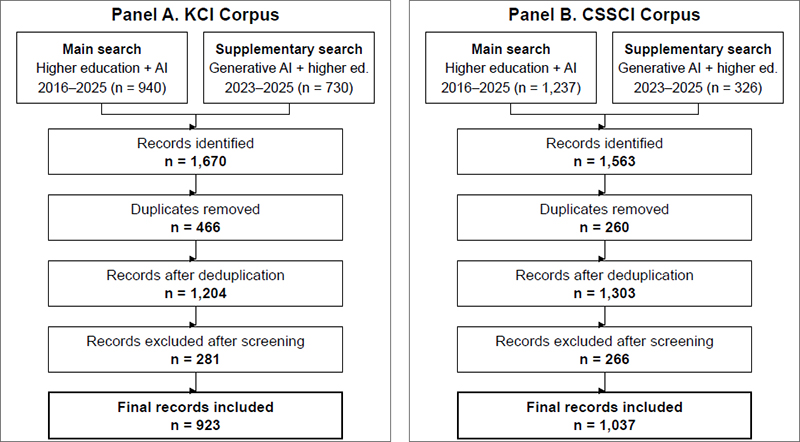
Flow Diagram of Data Collection and Screening for the KCI and CSSCI Corpora
Each included record was also classified according to whether it was retrieved by the main search, the supplementary search, or both. In the KCI corpus, 332 of the 806 records published during 2023–2025 were retrieved only through the supplementary search. These comprised 33 records in 2023, 146 in 2024, and 153 in 2025. In the CSSCI corpus, 69 of the 719 records published during the same period were retrieved only through the supplementary search. These comprised 20 records in 2023, 19 in 2024, and 30 in 2025.
3.3 Keyword Field Selection and Preprocessing
Metadata conventions differed between the two corpora, so keyword coverage was examined before analysis. The same selection principle was applied to both corpora: the keyword field with the highest coverage and the most consistent structure was selected for analysis. In the KCI corpus, English author keywords were available for 915 of 923 records (99.1%), whereas Korean keywords covered 788 records (85.4%). In the CSSCI corpus, Chinese author keywords were available for 1,007 of 1,037 records (97.1%), whereas usable English keywords were available for 406 records (39.2%). On this basis, the KCI corpus was analyzed using English author keywords, and the CSSCI corpus was analyzed using Chinese author keywords (Table 2).
Keyword Field Coverage and Preprocessing Summary
English author keywords were selected for the KCI corpus because of their higher coverage (99.1% vs. 85.4% for Korean keywords), whereas Chinese author keywords were the only viable field for the CSSCI corpus, given the limited coverage of usable English keywords (39.2%). This data-driven choice means the two networks were built in different languages; the analysis therefore compared their thematic structure, temporal patterns, and research orientation rather than seeking direct equivalence between individual English and Chinese terms. English translations of Chinese keywords were used only for reporting and interpretation, not as analytical inputs.
Keyword normalization was conducted separately within each corpus. Spelling and capitalization variants, abbreviations and full forms, singular and plural forms, and clearly synonymous expressions were standardized. For example, generative artificial intelligence and generative AI, pre-service teacher and pre-service teachers, and large language model and large language models were merged within the KCI keyword field. Broad boundary terms, including artificial intelligence, AI, higher education, university, and their Chinese equivalents, were excluded only when they functioned as general retrieval terms rather than specific research themes. This procedure affected only the keyword field; no bibliographic records were deleted. After preprocessing, the KCI corpus retained 2,434 unique analytical keywords, and the CSSCI corpus retained 2,184 unique analytical keywords (Table 2).
3.4 Bibliometric Analysis and Comparative Strategy
The study combined descriptive bibliometric analysis with knowledge mapping in CiteSpace 6.4.R1 [23, 28]. Descriptive statistics were used to calculate annual publication counts and the distribution of records across the three analytical phases. CiteSpace was used to generate keyword co-occurrence networks, betweenness centrality values, log-likelihood ratio (LLR) cluster labels, timeline views, and keyword burst results. In the visualized networks, nodes represent keywords and links represent co-occurrence relationships. Node size indicates keyword frequency, and link strength indicates the closeness of co-occurrence. Betweenness centrality was used to identify keywords that connect otherwise separate thematic areas [29, 30]. Modularity Q and silhouette S values were used to assess the overall structure and internal consistency of the clusters [31, 32]. The mean year of each cluster was used to locate its position in the research timeline. Burst detection was used to identify keywords that showed a marked increase during a specific period [33].
The same CiteSpace settings were applied to the KCI and CSSCI corpora. The analysis used one-year time slices from 2016 to 2025, keyword nodes, and the g-index selection criterion with k = 25. The displayed CiteSpace parameters were LRF = 3.0, L/N = 10, LBY = 5, and e = 1.0. Cluster labels were generated using the LLR algorithm, and keyword bursts were detected using the CiteSpace burst detection function. No pruning algorithm was applied to the displayed networks.
The burst results were treated as supplementary evidence. Because the 2023–2025 period is relatively short, burst detection may be sensitive to parameter settings and may not fully capture newly emerging generative AI terms. For this reason, the interpretation of the 2023–2025 phase was based primarily on publication growth, keyword frequency, betweenness centrality, cluster structure, and timeline evolution, with burst results used as supporting evidence. To reduce possible frequency bias introduced by the supplementary search, the term “generative AI” was not interpreted on the basis of frequency alone. Its role was examined together with its centrality, cluster membership, timeline position, and co-occurrence with related terms such as writing education, large language models, prompt engineering, AI literacy, and academic integrity.
To examine whether the unequal distribution of records between 2016-2022 and 2023-2025 affected the keyword results, each corpus was divided into two period-specific sub-corpora. Using the same keyword normalization and exclusion criteria as the main analysis, keyword frequency and betweenness-centrality rankings were calculated and compared within each period.
The comparative analysis proceeded in three stages. First, annual publication trends were examined to identify how research activity developed across the three analytical phases: the pre-pandemic AI phase, the pandemic-driven digital transformation phase, and the generative AI phase. Second, keyword co-occurrence networks, centrality values, and LLR clusters were used to examine the thematic structure of each corpus. Third, timeline views and keyword burst results were used to identify topics that became more visible after 2023. The final comparison focused on how the two corpora organized AI-related higher education research, rather than on direct comparison of national publication volume.
4. Results
4.1 Publication Trends Across 2016–2025
The first research question examined how AI research in higher education developed in Korea and China from 2016 to 2025. Publication trends show a common expansion after 2023, but the timing and concentration of growth differed between the two corpora (Fig. 2). In the KCI corpus, 19 records (2.1%) appeared in the pre-pandemic AI phase, followed by 98 records (10.6%) during the pandemic-driven digital transformation phase. The largest share of the corpus was concentrated in the generative AI phase, with 806 of 923 records (87.3%) published between 2023 and 2025. This concentration reflects both publication growth and the design of the supplementary search: 332 of these 806 records were retrieved only by the supplementary search. Among the 591 records in the full KCI corpus retrievable through the main search, the share published between 2023 and 2025 remained high at 80.2%. The CSSCI corpus followed a more gradual pattern of accumulation, with 97 records (9.4%) in the first phase, 221 records (21.3%) in the second phase, and 719 records (69.3%) in the third phase. Among these records, 69 were retrieved only by the supplementary search. Of the 968 records retrievable through the main search, 67.1% were published between 2023 and 2025, a proportion close to that of the full CSSCI corpus (Table 3).
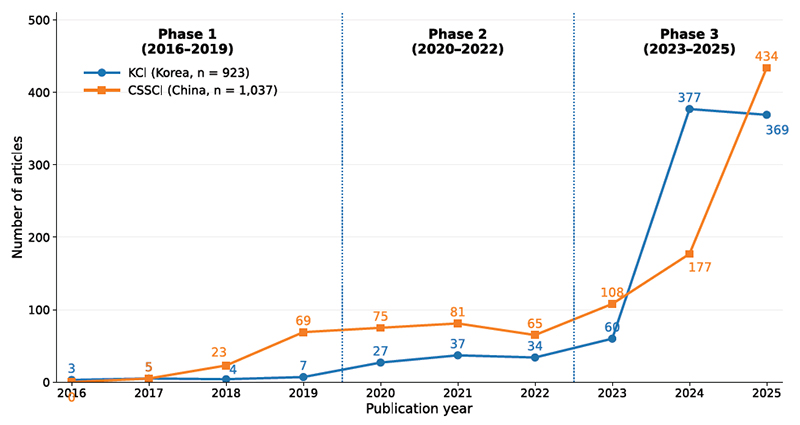
Annual Publication Trends in the KCI and CSSCI Corpora (2016–2025)
Publication Distribution by Analytical Phase
The phase distributions indicate both a shared post-2023 expansion and a difference in temporal formation. In both corpora, the increase after 2023 suggests that generative AI became a major focus of scholarly attention. The KCI corpus, however, was more concentrated in the final phase, with almost nine in ten records appearing after 2023. By contrast, the CSSCI corpus had already accumulated a larger body of AI research in higher education before the generative AI phase. The comparison therefore shows not only growth in publication volume, but also different temporal patterns: an expansion concentrated within a short period after the release of ChatGPT in the KCI corpus and a longer trajectory of accumulation followed by further growth in the CSSCI corpus. This contrast provides the basis for examining whether the two corpora also differ in keyword structures, thematic clusters, and emerging topics.
4.2 Keyword Structure and Thematic Clusters
The second research question examined the thematic structures and keyword clusters of the KCI and CSSCI corpora. Table 4 presents selected keywords with high frequency or high betweenness centrality in each corpus. These keywords are interpreted together with the co-occurrence networks and LLR clusters to identify the thematic organization of each literature.
Selected High-Frequency and High-Centrality Keywords by Corpus
In the KCI corpus, generative AI was the most frequent keyword and also showed the highest betweenness centrality, with 241 occurrences and a centrality value of 0.79 (Table 4). This indicates that generative AI functioned not only as a frequently occurring term but also as a connecting node across different parts of the keyword network. Other keywords with notable centrality included AI education (0.25), pre-service teachers (0.20), liberal arts education (0.12), and university education (0.10). The co-occurrence network (Fig. 3) places generative AI at the center of a closely connected set of terms, including AI education, pre-service teachers, AI literacy, writing education, computational thinking, digital literacy, and large language models. Overall, the KCI network is organized around generative AI, teaching practice, teacher preparation, learner capability, and literacy-related concerns.
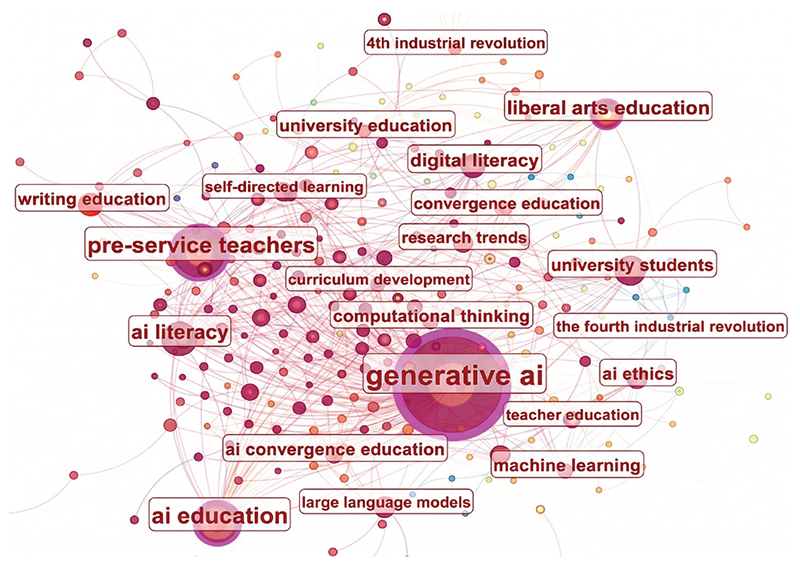
Keyword Co-occurrence Network of the KCI Corpus
The LLR cluster analysis further clarifies the thematic organization of the KCI corpus. Table 5 reports 13 interpretable LLR clusters from the KCI keyword network, with cluster labels following the original CiteSpace numbering. The cluster solution showed a modularity Q of 0.62 and a mean silhouette S of 0.89, indicating a clear cluster structure and a high level of internal consistency (Fig. 4; Table 5). The largest cluster, #0 generative AI, had a mean year of 2023 and included terms such as generative AI, AI education, design education, instructional design, and prompt engineering. This cluster confirms that generative AI occupied a central position in the recent KCI keyword structure.
LLR Keyword Clusters in the KCI Corpus
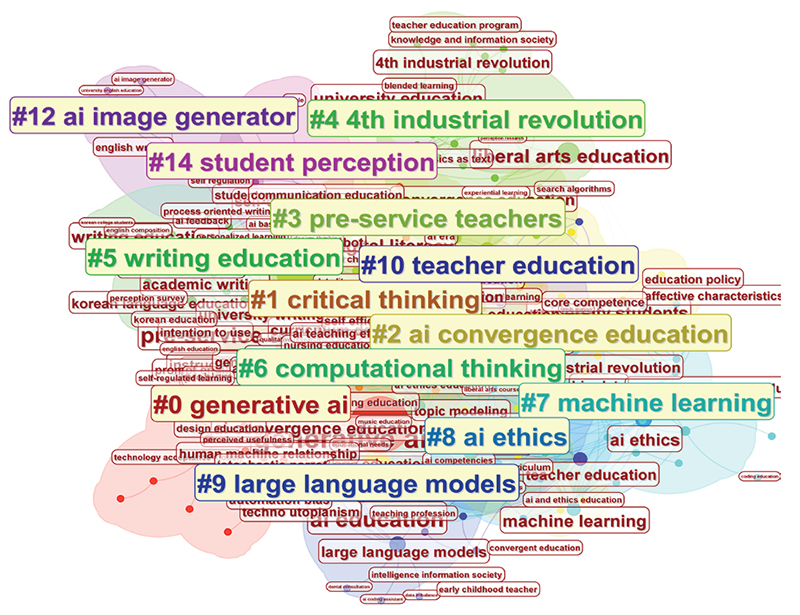
LLR Keyword Cluster Map of the KCI Corpus
The remaining clusters can be grouped into several educational domains. Teacher-related themes appeared in #3 pre-service teachers and #10 teacher education, while curriculum-oriented themes appeared in #2 AI convergence education and #4 fourth industrial revolution. Other clusters reflected writing and language education (#5 writing education), concerns related to thinking and literacy (#1 critical thinking and #6 computational thinking), technical methods (#7 machine learning), and ethical issues (#8 AI ethics). More recent clusters, including #9 large language models, #12 AI image generator, and #14 student perception, had mean years in 2023 or 2024. Overall, the cluster results suggest a temporal movement from earlier themes related to teacher education, machine learning, and curriculum development toward post-2023 concerns with generative AI, large language models, critical thinking, AI image generation, and student perception.
In the CSSCI corpus, the keyword structure was organized around a different set of anchors. Talent cultivation showed the highest frequency and betweenness centrality, with 69 occurrences and a centrality value of 0.40 (Table 4). Smart education also had a high centrality value (0.36), followed by AI literacy (0.14), digital literacy (0.12), big data (0.09), and university faculty (0.09). The co-occurrence network (Fig. 5) therefore shows a structure centered on talent cultivation and smart education, with links to digital literacy, big data, faculty development, information services, and digital transformation. Compared with the KCI corpus, the CSSCI keyword network appears less concentrated around a single dominant node and more oriented toward higher education reform, institutional development, and capability formation.
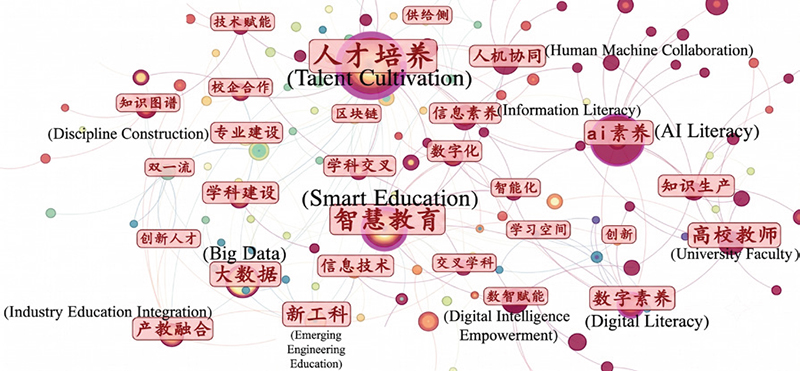
Keyword Co-occurrence Network of the CSSCI Corpus
The LLR cluster results further specify this structure. The CSSCI corpus formed 11 clusters, with a modularity Q of 0.75 and a mean silhouette S of 0.94, indicating a clear and internally consistent cluster structure (Fig. 6; Table 6). The largest cluster, #0 talent cultivation, had a mean year of 2020 and included terms related to talent cultivation, industry-education integration, emerging engineering education, discipline construction (学科建设, the strategic development of academic disciplines), and academic program development (专业建设, the development of undergraduate majors). This cluster suggests that AI research in higher education in the CSSCI corpus was closely connected to talent development and structural reform in higher education.
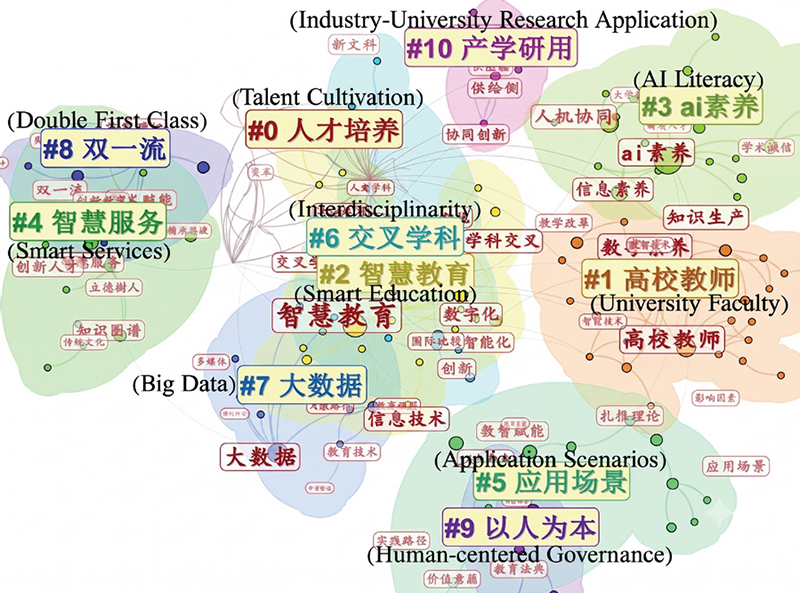
LLR Keyword Cluster Map of the CSSCI Corpus
LLR Keyword Clusters in the CSSCI Corpus
Other clusters reflected several related domains. Faculty and knowledge production appeared in #1 university faculty, while #2 smart education included terms related to smart education, adaptive learning, and digitalization. Cluster #3 AI literacy connected AI literacy, information literacy, university libraries, and academic integrity. Technology-enabled services and applicationoriented themes appeared in #4 smart services and #5 application scenarios. Additional clusters addressed interdisciplinarity (#6 interdisciplinarity), big data and educational technology (#7 big data), the Double First-Class initiative (双一流, the national initiative to build world-class universities and disciplines) (#8 Double First-Class), human-centered data governance (#9 human-centered governance), and industry-university-research collaboration (产学研用) (#10 industry university research application). The mean years show that earlier clusters were associated with big data, the Double First-Class initiative, and university-industry collaboration, whereas more recent clusters were related to AI literacy, application scenarios, and human-centered governance.
The KCI and CSSCI corpora differed most clearly in the types of keywords that organized their thematic networks. In the KCI corpus, the keyword structure was centered on generative AI as a highly frequent and highly central node. Its surrounding terms were closely related to teaching practice, teacher preparation, writing education, learner capability, and literacy development. This pattern suggests that research in the KCI corpus was organized mainly around the pedagogical use of generative AI and its implications for students, teachers, and classroom-based academic practices. By contrast, the CSSCI corpus was organized around broader institutional and developmental anchors, especially talent cultivation and smart education. These keywords connected AI research to higher education reform, discipline construction, faculty development, information services, digital transformation, and governance.
The different positions of AI literacy further illustrate this contrast. In the KCI corpus, AI literacy appeared near teaching, pre-service teachers, computational thinking, digital literacy, and learner capability, indicating a stronger connection with educational practice and learner development. In the CSSCI corpus, AI literacy was linked more closely to information literacy, university libraries, academic integrity, and smart curriculum, placing it within a broader institutional and information service context.
In sum, the two keyword structures suggest that the KCI corpus developed a configuration centered on generative AI and oriented toward pedagogy, whereas the CSSCI corpus showed a configuration oriented toward institutional reform and embedded in higher education structures. These configurations describe relative emphases within the two corpora rather than mutually exclusive orientations: both corpora contain micro-pedagogical and macro-institutional strands, and the contrast lies in their relative weight and structural position. The following section examines whether these differences also appear in the temporal evolution of themes after 2023.
4.3 Thematic Evolution After 2023
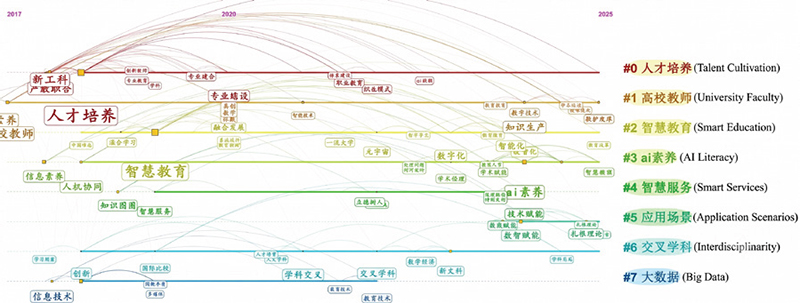
The third research question examined which topics became prominent after 2023 and how they were connected to earlier thematic trajectories. The timeline views indicate that the KCI and CSSCI corpora entered the generative AI period from different prior structures (Figs. 7 and 8). In the KCI corpus, earlier themes were associated with teacher education, machine learning, the fourth industrial revolution, liberal arts education, software education, and computational thinking. During the 2020–2022 period, AI convergence education, AI ethics, pre-service teachers, and AI literacy became more visible. The cluster and timeline results show increasing visibility after 2023 for generative AI, large language models, AI image generators, student perception, writing education, machine translation, and critical thinking. The KCI trajectory therefore suggests a movement from broader AI education and teacher education concerns toward generative AI-related teaching, writing, learner experience, and academic practice.
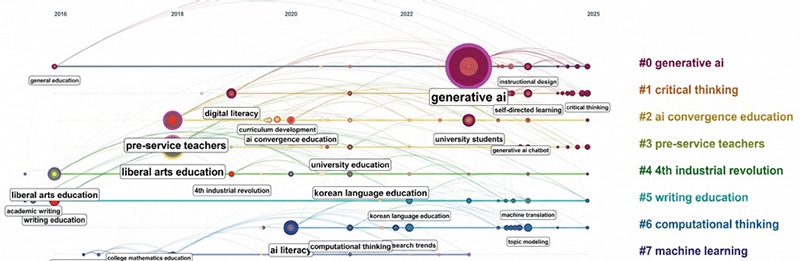
Timeline View of the KCI Corpus
Timeline View of the CSSCI Corpus
The CSSCI corpus showed a longer developmental path before the generative AI period. Earlier and middle-period themes included big data, Double First-Class, emerging engineering education, industry-education integration, smart education, talent cultivation, and university faculty. The cluster and timeline results show increasing visibility after 2023 for AI literacy, application scenarios, digital intelligence empowerment, interdisciplinarity, data governance, and human-centered governance. Rather than forming a timeline centered on one generative AI keyword, the CSSCI corpus incorporated recent AI-related concerns into an existing discussion of higher education reform, smart education, talent development, discipline construction, and institutional governance.
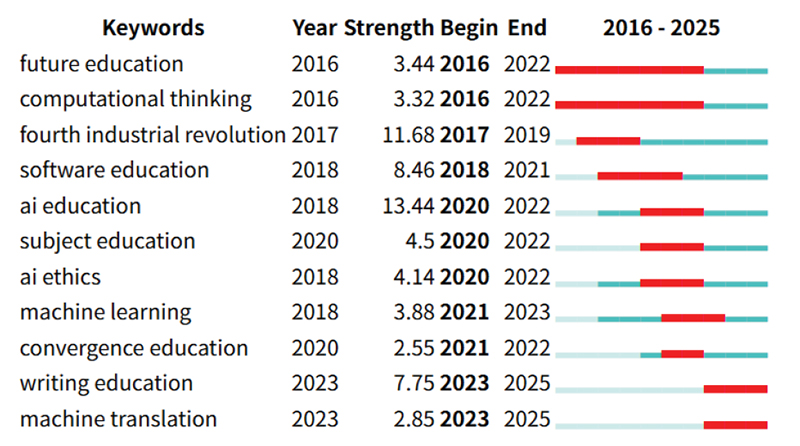
The keyword burst results were used as supplementary evidence because the 2023–2025 period is short and burst detection can be sensitive to parameter settings. In the KCI corpus, earlier burst terms included future education, computational thinking, the fourth industrial revolution, software education, AI education, subject education, AI ethics, machine learning, and convergence education (Fig. 9). These terms indicate that the pre-2023 burst structure was mainly related to future-oriented education, AI education, software education, computational thinking, and broader technology education. After 2023, the burst terms shifted to writing education and machine translation, suggesting that the most recent burst signals were linked more closely to language, writing, and academic practice.
Keyword Burst Results in the KCI Corpus
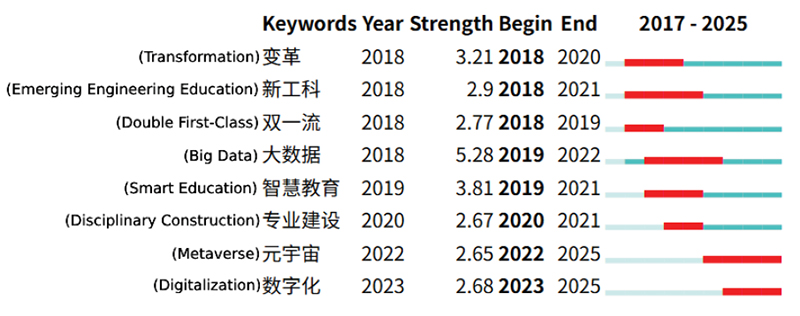
The CSSCI keyword burst results also support the temporal pattern observed in the timeline view (Fig. 10). Earlier burst terms included transformation, emerging engineering education, Double First-Class, big data, smart education, and academic program development. Later burst signals shifted toward metaverse-related discussion and digitalization. These results suggest that the CSSCI corpus did not simply shift from general AI to generative AI. Instead, recent AI-related topics were added to an already established reform and digital transformation trajectory.
Keyword Burst Results in the CSSCI Corpu
Across the timeline and burst evidence, the two corpora show two different temporal patterns. In the KCI corpus, the most recent period shows a rapid shift toward generative AI, writing, language use, learner perception, and academic practice. In the CSSCI corpus, the post-2023 period appears as an extension of a longer trajectory that had already connected AI with smart education, talent cultivation, disciplinary development, and institutional reform. For this reason, the interpretation of emerging topics after 2023 relies mainly on publication growth, keyword centrality, cluster structure, and timeline evolution, while burst results are used only as supporting evidence.
The supplementary period-split analysis provided a further check on these temporal patterns. In the KCI corpus, AI education occupied the leading frequency and centrality positions during 2016–2022, alongside pre-service teachers and liberal arts education. During 2023–2025, generative AI held the leading position in both frequency and betweenness centrality, well ahead of the remaining keywords, while AI literacy, university students, and writing education became more visible. In the CSSCI corpus, talent cultivation, smart education, and big data anchored the earlier period. During 2023–2025, terms related to generative AI, including large language models, rose in prominence, while talent cultivation remained among the leading terms in both frequency and centrality. Several keywords occupied leading centrality ranks in the CSSCI sub-corpus, whereas generative AI ranked first in the later KCI sub-corpus. Although differences in corpus size may affect the absolute frequency and centrality values of individual keywords, the period-specific rankings show that the broader thematic transition remained visible in both corpora.
5. Discussion and Conclusion
The purpose of this study was to compare how higher education AI research developed in Korea and China from 2016 to 2025 by analyzing nationally indexed journal corpora. The findings show that both the KCI and CSSCI corpora expanded after 2023, but the expansion did not produce the same thematic organization in the two corpora. Instead, generative AI-related research was organized through different thematic connections in the two corpora. The KCI corpus showed an expansion concentrated within a short period after 2023, organized around generative AI, teaching practice, teacher preparation, writing education, learner capability, and academic practice. The CSSCI corpus showed a longer trajectory of accumulation, in which AI research in higher education was organized around talent cultivation, smart education, discipline construction, institutional services, digital transformation, and governance. The study therefore contributes not only by documenting publication growth, but also by identifying how generative AI-related research was organized through different thematic connections in the two journal corpora. These differences concern relative thematic emphases within the two corpora rather than fixed characteristics of Korean and Chinese higher education.
The pattern observed in the KCI corpus suggests that the rapid diffusion of generative AI was closely associated with pedagogical and learner-facing concerns. In the KCI corpus, generative AI became the major organizing node, and its surrounding keyword structure connected it to pre-service teachers, AI education, AI literacy, writing education, critical thinking, large language models, and student perception. This pattern can be situated within a broader Korean policy context in which universities have been incorporated into national strategies for digital and artificial intelligence talent development through interdisciplinary programs, shared curricula, and inter-university collaboration [9, 10]. It also resonates with domestic research on AI-based course recommendation and adaptive learning, liberal arts AI education, AI literacy education for pre-service teachers, and undergraduate AI literacy [11-15]. These policy and research contexts provide background for the prominence of teaching, learning, teacher preparation, writing, and academic practice among the connections around generative AI in the KCI corpus.
The CSSCI corpus showed a different thematic pattern. In the CSSCI corpus, AI research in higher education had already accumulated before the generative AI phase, and post-2023 themes appeared as extensions of a broader reform and system transformation trajectory. Talent cultivation and smart education functioned as major organizing anchors, while clusters and timeline patterns connected AI to discipline construction, emerging engineering education, university faculty, application scenarios, digital-intelligence empowerment, data governance, and industry-university-research application. This pattern is consistent with the Chinese policy context in which AI has been linked to national innovation strategy, higher education reform, talent cultivation, and institutional transformation [16-18]. This policy context provides background for the prominence of higher education reform, institutional capacity, and system transformation in the CSSCI corpus, where recent generative AI-related themes were incorporated into an already established thematic structure.
Viewed together, the two corpora suggest several complementary directions for future research. The institutional themes prominent in the CSSCI corpus raise questions about how course-level uses of generative AI relate to university curricula, academic support services, and institutional policy. The pedagogical themes prominent in the KCI corpus raise corresponding questions about how broader reform agendas are enacted in classroom practice and experienced by students. Future comparative research could therefore examine the connections among institutional governance, curriculum and support structures, teacher implementation, and learner practice. For example, such work would need evidence that neither corpus makes visible on its own — whether reform-level agendas reach the assessment and writing tasks students actually encounter, and whether course-level generative AI use is matched by institutional curricular and academic-support provision.
A further point of comparison concerns AI literacy. AI literacy has been defined as a set of capacities that enable individuals to understand, use, evaluate, and critically engage with AI systems [5, 6]. In the KCI corpus, AI literacy appeared in connection with teaching, pre-service teachers, computational thinking, digital literacy, and learner capability. In the CSSCI corpus, it was associated with information literacy, university libraries, academic integrity, smart curriculum, and institutional services. These associations show that AI literacy was discussed in relation to different educational settings in the two corpora. Future studies could examine how individual AI-related competencies interact with curricula, information services, libraries, faculty development, and other forms of institutional support [4].
The study also has methodological implications. Many existing reviews and bibliometric studies of AI and generative AI in education rely on Web of Science, Scopus, or similar international databases, which are important for identifying globally visible research patterns but may not fully represent domestic scholarly discussions in non-English contexts [1-3, 19, 20]. By analyzing KCI and CSSCI corpora separately rather than merging them into a single multilingual network, the study illustrates how nationally indexed journal corpora can be used to examine different forms of thematic organization. The value of this approach lies not in ranking national research productivity, but in examining how global technological shifts are localized within domestic scholarly literatures. This approach is particularly useful for fast-moving topics such as generative AI, where publication volume alone cannot show how educational problems are defined and organized within a given body of literature.
Several limitations should be acknowledged. First, the KCI and CSSCI corpora are not equivalent in language, indexing practices, database coverage, or keyword conventions, and the two co-occurrence networks were necessarily built in different languages, English author keywords for the KCI corpus and Chinese author keywords for the CSSCI corpus. This asymmetry, driven by the differing coverage of each keyword field, means that the observed contrasts, including the differing positions of AI literacy, may partly reflect differences in keyword language and indexing convention rather than scholarly orientation alone. The two corpora were therefore analyzed separately, and the comparison focused on broader thematic and temporal structures rather than direct lexical equivalence; the findings should be read as structural comparisons across two differently indexed and linguistically distinct corpora. Future research using parallel translated keyword sets validated by bilingual experts could further assess the robustness of these patterns. Second, the analysis was based on bibliographic metadata and author keywords, and therefore could not capture the full argumentative content of individual articles; in particular, it could not identify whether individual studies took positive, critical, or ambivalent stances toward AI in higher education, or the specific controversies and normative judgments they advanced. Third, the post-2023 period remains short. For this reason, keyword burst results were treated as supplementary evidence rather than as the main basis for interpreting emerging topics. In addition, the number of records differed considerably between the two analytical periods, and the supplementary generative AI search covered only the 2023-2025 period. Although the period-split analysis was consistent with the overall direction of the thematic transition, these differences may still have affected the absolute frequency and centrality values of individual keywords, and centrality results were therefore interpreted through within-period rankings rather than through direct comparison of absolute values across networks of different sizes. Fourth, the study focused on keyword co-occurrence, centrality, clusters, timelines, and burst patterns. Future research could extend the analysis through full-text analysis, citation and co-citation networks, institutional collaboration patterns, or qualitative reading of representative articles.
In conclusion, higher education AI research expanded substantially in both corpora after 2023, but the most prominent thematic connections differed. In the KCI corpus, generative AI was closely connected with teaching practice, writing, teacher preparation, learner capability, and academic work. In the CSSCI corpus, prominent themes included talent cultivation, higher education reform, discipline construction, smart education, institutional services, and governance. These findings indicate different relative emphases within the two journal corpora rather than separate or mutually exclusive national models. Future research could examine how individual, pedagogical, and institutional dimensions of AI use interact, including how curricula, libraries, information services, and faculty development support the development of AI literacy.
References
-
Zawacki-Richter, O., Marín, V., Bond, M., & Gouverneur, F. (2019). Systematic review of research on artificial intelligence applications in higher education – where are the educators? International Journal of Educational Technology in Higher Education, 16, Article 39.
[https://doi.org/10.1186/s41239-019-0171-0]

-
Crompton, H., & Burke, D. (2023). Artificial intelligence in higher education: The state of the field. International Journal of Educational Technology in Higher Education, 20, Article 22.
[https://doi.org/10.1186/s41239-023-00392-8]
-
Ogunleye, B., Zakariyyah, K., Ajao, O., Olayinka, O., & Sharma, H. (2024). A systematic review of generative AI for teaching and learning practice. Education Sciences, 14(6), Article 636.
[https://doi.org/10.3390/educsci14060636]
- UNESCO. (2023). Guidance for generative AI in education and research. UNESCO. https://unesdoc.unesco.org/ark:/48223/pf0000386693
-
Long, D., & Magerko, B. (2020). What is AI literacy? Competencies and design considerations. Proceedings of the 2020 CHI Conference on Human Factors in Computing Systems, Honolulu, USA, 1–16.
[https://doi.org/10.1145/3313831.3376727]
-
Ng, D., Leung, J., Chu, S., & Qiao, M. (2021). Conceptualizing AI literacy: An exploratory review. Computers and Education: Artificial Intelligence, 2, Article 100041.
[https://doi.org/10.1016/j.caeai.2021.100041]
- Hodges, C., Moore, S., Lockee, B., Trust, T., & Bond, A. (2020, March 27). The difference between emergency remote teaching and online learning. EDUCAUSE Review. https://er.educause.edu/articles/2020/3/the-difference-between-emergency-remote-teaching-and-online-learning
- Marinoni, G., van’t Land, H., & Jensen, T. (2020). The impact of COVID-19 on higher education around the world: IAU global survey report. International Association of Universities. https://www.iau-aiu.net/IMG/pdf/iau_covid19_and_he_survey_report_final_may_2020.pdf
- Ministry of Education of the Republic of Korea. (2022, September 15). 2022 Comprehensive Plan for Digital Talent Development. Ministry of Education of the Republic of Korea. https://www.moe.go.kr/boardCnts/viewRenew.do?boardID=72769&boardSeq=92573&lev=0
- Ministry of Education of the Republic of Korea. (2021, May 3). Announcement of the Selection Results for the Digital New Technology Talent Development Innovation Sharing University Project. Ministry of Education of the Republic of Korea. https://www.moe.go.kr/boardCnts/viewRenew.do?boardID=294&boardSeq=84298&lev=0&m=020402&opType=N&s=moe&statusYN=W
-
Lee, J., Moon, K., Han, S., Lee, S., Kwon, H., Han, J., & Kim, G. (2021). Development and application of an AI-powered adaptive course recommender system in higher education: An example from K University. Journal of Educational Technology, 37(2), 267–307.
[https://doi.org/10.17232/KSET.37.2.267]
-
Cho, Y. (2022). Effects of AI-based personalized adaptive learning system in higher education. Journal of the Korean Association of Information Education, 26(4), 249–263.
[https://doi.org/10.14352/jkaie.2022.26.4.249]
-
Jun, S. (2021). Development of artificial intelligence education program based on experiential learning for liberal art education. The Journal of Korean Association of Computer Education, 24(2), 63–73.
[https://doi.org/10.32431/kace.2021.24.2.006]
-
Jun, S., Choi, J., Kim, S., & Park, J. (2022). Development of modular artificial intelligence literacy education program for pre-service teachers. The Journal of Korean Association of Computer Education, 25(2), 35–45.
[https://doi.org/10.32431/kace.2022.25.2.004]
-
Park, Y., & Yi, Y. (2021). The education model of liberal arts to improve the artificial intelligence literacy competency of undergraduate students. Journal of the Korean Association of Information Education, 25(2), 423–436.
[https://doi.org/10.14352/jkaie.2021.25.2.423]
- State Council of the People’s Republic of China. (2017, July 20). New Generation Artificial Intelligence Development Plan. State Council of the People’s Republic of China. https://www.gov.cn/zhengce/content/2017-07/20/content_5211996.htm
- Ministry of Education of the People’s Republic of China. (2018, April 10). Artificial Intelligence Innovation Action Plan for Institutions of Higher Education. Ministry of Education of the People’s Republic of China. http://www.moe.gov.cn/srcsite/A16/s7062/201804/t20180410_332722.html
-
Wang, T., & Ren, Y. (2018). Talent strategy in the era of artificial intelligence: An interpretation of the Artificial Intelligence Innovation Action Plan for Institutions of Higher Education III. Journal of Distance Education, 36(5), 52–59.
[https://doi.org/10.15881/j.cnki.cn33-1304/g4.2018.05.008]
-
Liu, J., Wang, C., Liu, Z., Gao, M., Xu, Y., Chen, J., & Cheng, Y. (2024). A bibliometric analysis of generative AI in education: Current status and development. Asia Pacific Journal of Education, 44(1), 156–175.
[https://doi.org/10.1080/02188791.2024.2305170]
-
Dai, K., Liu, Y., & Zhang, X. (2026). Generative AI in higher education: A bibliometric review of emerging trends, power dynamics, and global research landscapes. Computers and Education: Artificial Intelligence, 10, Article 100544.
[https://doi.org/10.1016/j.caeai.2026.100544]
-
Liu, T., & Ko, J. (2020). A comparative study on ICT policies in higher education between China and Korea. Asian Journal of Education, 21(1), 269–296.
[https://doi.org/10.15753/aje.2020.03.21.1.269]
-
Donthu, N., Kumar, S., Mukherjee, D., Pandey, N., & Lim, W. (2021). How to conduct a bibliometric analysis: An overview and guidelines. Journal of Business Research, 133, 285–296.
[https://doi.org/10.1016/j.jbusres.2021.04.070]
-
Chen, C. (2006). CiteSpace II: Detecting and visualizing emerging trends and transient patterns in scientific literature. Journal of the American Society for Information Science and Technology, 57(3), 359–377.
[https://doi.org/10.1002/asi.20317]
-
Han, S., & Kim, T. (2022). Research trends of artificial intelligence education in Korea: Keyword and topic analysis focused on LDA. The Journal of Learner-Centered Curriculum and Instruction, 22(13), 281–294.
[https://doi.org/10.22251/jlcci.2022.22.13.281]
-
Kim, J., & Sohn, E. (2025). A trend analysis of higher education research on generative artificial intelligence in Korea. Journal of Creative Information Culture, 11(4), 311–324.
[https://doi.org/10.32823/jcic.11.4.202511.311]
- Liu, T., Xu, X., & Ko, J. (2025). Tracing the digital transformation of higher education in China: A bibliometric analysis of research trends (1998–2025). International Research Journal of Education and Sciences, 9(2), 84–93.
-
Page, M., McKenzie, J., Bossuyt, P., Boutron, I., Hoffmann, T., Mulrow, C., Shamseer, L., Tetzlaff, J., Akl, E., Brennan, S., Chou, R., Glanville, J., Grimshaw, J., Hróbjartsson, A., Lalu, M., Li, T., Loder, E., Mayo-Wilson, E., McDonald, S., ... Moher, D. (2021). The PRISMA 2020 statement: An updated guideline for reporting systematic reviews. BMJ, 372, Article n71.
[https://doi.org/10.1136/bmj.n71]
-
Chen, C. (2017). Science mapping: A systematic review of the literature. Journal of Data and Information Science, 2(2), 1–40.
[https://doi.org/10.1515/jdis-2017-0006]
-
Brandes, U. (2001). A faster algorithm for betweenness centrality. The Journal of Mathematical Sociology, 25(2), 163–177.
[https://doi.org/10.1080/0022250X.2001.9990249]
-
Freeman, L. (1977). A set of measures of centrality based on betweenness. Sociometry, 40(1), 35–41.
[https://doi.org/10.2307/3033543]
-
Chen, C., Ibekwe-SanJuan, F., & Hou, J. (2010). The structure and dynamics of cocitation clusters: A multiple-perspective cocitation analysis. Journal of the American Society for Information Science and Technology, 61(7), 1386–1409.
[https://doi.org/10.1002/asi.21309]
-
Rousseeuw, P. (1987). Silhouettes: A graphical aid to the interpretation and validation of cluster analysis. Journal of Computational and Applied Mathematics, 20, 53–65.
[https://doi.org/10.1016/0377-0427(87)90125-7]
-
Kleinberg, J. (2002). Bursty and hierarchical structure in streams. Proceedings of the Eighth ACM SIGKDD International Conference on Knowledge Discovery and Data Mining, Edmonton, Canada, 91–101.
[https://doi.org/10.1145/775047.775061]

· 2017년 중국 베이징외국어대학교 컴퓨터학과(공학사)
· 2019년 성균관대학교 교육학전공(교육학석사)
· 2024년 성균관대학교 고등교육전공(교육학박사)
· 2025년~현재 한국공학대학교 전공교육혁신센터 연구교수
관심분야 : AIEd, 고등교육정책, 고등교육국제화, 비교교육, 이러닝
liuting0113@tukorea.ac.kr

· 2022년 연세대학교 경영학과(경영학사)
· 2024년 성균관대학교 교육학전공(교육학석사)
· 2026년 성균관대학교 고등교육전공 박사 과정 수료
관심분야 : AIEd, 고등교육정책, 고등교육국제화, 비교교육, 교육재정
xuxiwen@g.skku.edu